

Good morning! Today we start offshore, where the United States has apparently decided that the most efficient way to manage energy markets is by reenacting the Age of Sail, with a dash of piracy thrown in. Oil prices nudged upward after the U.S. intercepted an oil tanker off the coast of Venezuela in international waters, with another ship reportedly being pursued. Officials insist this is sanctions enforcement, but markets heard something else entirely: supply disruption, shipping risk, and geopolitical instability delivered by boarding party. West Texas Intermediate ticked up, because nothing calms energy traders like a superpower physically grabbing tankers on the open sea. Sadly, this passes for “strength” now, gunboat economics that does nothing for Americans at the gas pump and plenty to remind the rest of the world that U.S. policy is increasingly enforced with force rather than foresight.
If you were wondering whether that kind of chaos ever reaches land, bourbon country has your answer. Jim Beam announced it will halt production at its main Kentucky distillery for all of 2026. The official line is “site enhancements” and “volume assessments,” which is corporate for we have no idea what demand will look like under tariff whiplash. Trump’s trade wars have left American whiskey producers stuck with overflowing warehouses, retaliatory pullbacks abroad, and mounting costs at home, including tens of millions in state taxes on barrels aging with nowhere to go. From farmers to factory floors to distilleries, the tariffs keep delivering the same magic trick: stalled production, anxious workers, and higher prices for everyone else, all while politicians insist this is winning.
At CBS News, we got a case study in how censorship works in 2025, quietly, politely, and with legal department sign-off. New editor-in-chief Bari Weiss pulled a fully vetted 60 Minutes investigation into alleged abuses at El Salvador’s CECOT prison just 36 hours before airtime because the Trump administration declined to comment on the record. The segment had cleared standards, legal review, senior producers, the works. Correspondent Sharyn Alfonsi called the move what it was: political, not editorial. Her warning was blunt and accurate, if government silence becomes a veto, journalism no longer reports power, it waits for permission. All of this unfolds against the backdrop of CBS’s $16 million Trump settlement, ownership changes, regulatory courtship, and promises to be more “hospitable” to conservatives. The message to reporters everywhere was unmistakable: if you want to run the story, make sure the people implicated feel comfortable first.
That same loyalty-first logic is now reshaping U.S. diplomacy. The Trump administration is recalling nearly 30 career diplomats from ambassadorial and senior embassy posts around the world, hitting Africa hardest but touching nearly every region. These weren’t political appointees, they were professional foreign service officers mid-post, doing exactly what the job requires. The State Department says this is normal. It isn’t. It’s a purge dressed up as prerogative, replacing expertise with ideological alignment at a moment when global stability is already fraying. This doesn’t project confidence or coherence abroad; it signals a government more interested in obedience than competence.
Back in Washington, Congress is showing visible signs of burnout, and not just from the fringes. Elise Stefanik abruptly dropped her New York governor bid and announced she’ll leave Congress next year, closing the chapter on one of Trump’s most prominent House allies. The stated reasons were family and strategy. The unstated ones include a yanked UN nomination, blocked leadership ambitions, and a very public feud with Speaker Mike Johnson. She’s not alone. Senator Cynthia Lummis is also heading for the exit after one term, citing sheer exhaustion. Reporting suggests the number of Republican retirements has already surpassed pre-2024 levels, with dozens more members refusing to commit to running again. This is basically an attrition problem. Endless loyalty tests, perpetual crisis, and legislative paralysis have turned Congress into a treadmill where effort replaces progress and exhaustion replaces purpose.
And then there’s the story that exposes the moral rot most clearly. The Justice Department is sitting on nearly $90 million Congress explicitly appropriated to support human-trafficking survivors, money that simply hasn’t been released. More than 100 organizations have lost funding. Survivors are facing eviction, homelessness, deportation risk, jail time, and re-exploitation. Former DOJ officials say the bureaucratic steps were completed months ago. The money exists, it’s just being withheld. Senators are calling it illegal, while advocates are rightly calling it immoral. Survivors call it hauntingly familiar, the same message traffickers deliver: you don’t matter, and help isn’t coming.
This lands with particular force given the administration’s endless “save the children” rhetoric. The contrast is almost too on the nose. Anti-trafficking as branding, but abandonment as policy. And while DOJ starves survivor services, it finds plenty of energy for immigration enforcement stunts, including arresting immigrant survivors who try to report crimes.
Layer on top of all this the SNAP confusion, and the pattern sharpens into something impossible to ignore. Low-income families are being scolded, surveilled, and jerked around by contradictory messaging about “junk food,” while real nutritional support remains inadequate and unstable. Moral theater replaces material help. Rules multiply and assistance shrinks, and people are left navigating confusion instead of receiving care.
You can make a serious, good-faith argument that ultra-processed food is poisoning everyone across income brackets, and that the food system itself is the problem. But that’s not what RFK Jr. is doing. What he’s doing is carving out a poverty-specific morality code and enforcing it through the most bureaucratically brittle program in the federal government. This SNAP crackdown isn’t “Make America Healthy Again.” It’s Make Poor People Eat Correctly, Under Surveillance, With No Clear Rules.
What’s striking isn’t just the cruelty, it’s the sheer incompetence. There is no uniform definition of “junk food.” There is no federal list, no clear enforcement guidance. USDA hasn’t even pretended to be ready. Instead, you get a patchwork of 18 states inventing their own food theology while retailers, cashiers, and families are left playing nutritional roulette at the checkout line.
Is Gatorade a soda? Depends on the state. Is a granola bar food or candy? Depends on the aisle. Is chocolate acceptable if you plan to bake with it but not if you plan to feel joy? Ask your cashier, apparently.
And that’s where the discrimination becomes unmistakable. SNAP recipients are now the only people in America whose groceries are subject to moral inspection by overworked cashiers and glitchy point-of-sale systems. Wealthy shoppers can buy soda, candy, and processed sludge without explanation. Middle-class consumers can load up on energy drinks and snack cakes with zero stigma. But if you’re poor, your food choices become a public performance, one software error away from embarrassment, confrontation, or denial at the register.
Retailers know this is a mess. Some are openly questioning whether it’s worth staying in SNAP at all, especially small convenience stores in rural areas. If they drop out, food deserts deepen. People have to travel farther, so costs rise, and access shrinks. I doubt this is an unintended consequence, but it’s definitely a predictable outcome.
The timing makes it worse. These bans are rolling out alongside benefit cuts, eligibility purges, a government shutdown hangover, and staffing decimation at USDA. SNAP-Ed, the very program states planned to use to “evaluate” whether these bans work, has already been defunded. So the evaluation requirement is a farce. There will be no serious data. Just vibes and press releases.
Even nutrition experts are split, and for good reason. SNAP is supplemental. People will still buy soda, just with cash instead of benefits. Chronic disease doesn’t vanish because a cashier rejects a sports drink. What does increase is stigma, confusion, and administrative punishment aimed squarely at the poor.
If RFK Jr. actually wanted to confront junk food, he’d be talking about regulating manufacturers, subsidizing healthy food universally, breaking corporate capture of the food system, or taxing ultra-processed products across the board. Instead, he picked the easiest political target: people with the least power, the least flexibility, and the least room for error.
The SNAP fiasco illustrates in graphic detail how an autocratic kakistocracy actually functions, or rather, how it doesn’t. Decisions flow downward from ideology and grievance instead of evidence or capacity. Policy is announced before systems exist to implement it. Enforcement is delegated to the least powerful people in the room, while accountability floats upward and disappears. The result isn’t order, discipline, or efficiency; it’s chaos selectively imposed on people with the fewest options. That’s the signature of rule by the worst: not tyranny through competence, but domination through confusion, cruelty, and administrative collapse.Here’s the calming part, and it matters: once you see the pattern, the noise quiets. This isn’t a government spinning out of control. It’s one exercising control selectively, through delay, attrition, loyalty enforcement, and bureaucratic quiet. Funds don’t vanish; they simply never move. Stories aren’t banned; they’re postponed until irrelevant. Diplomats aren’t fired; they’re rotated out. Survivors aren’t denied help outright; they’re left waiting until the system collapses around them.
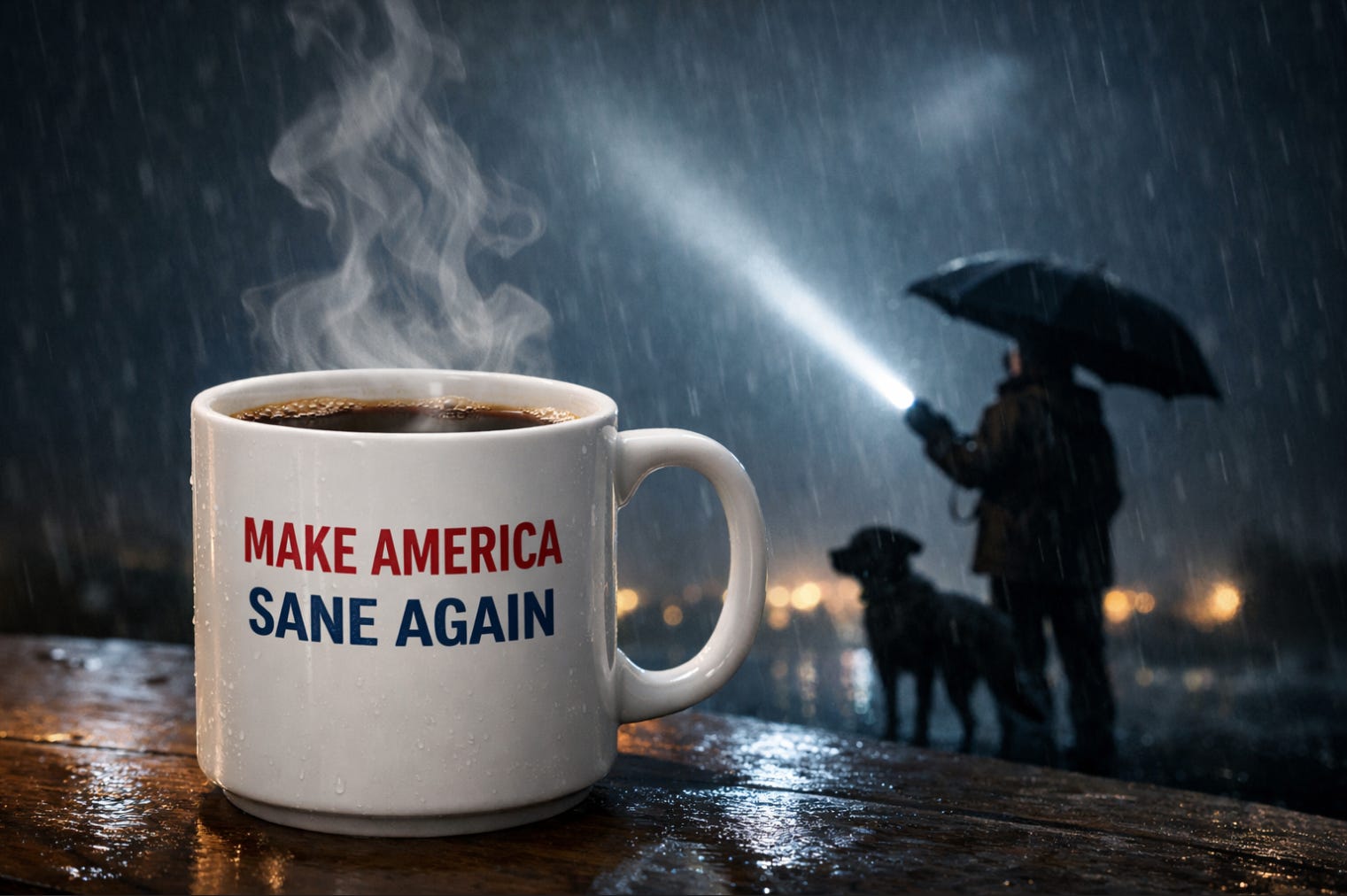
Which brings me back to last night. While all of this churned on, Marz and I held our little moonbeam vigil again. He objected strongly to the rain, splashing through creeks and mud puddles are fine, but falling water remains a personal insult, so I went back inside and grabbed an umbrella. We stood there anyway, focusing on peace, a healthy planet, and a sustainable future for the grandchildren. A small ritual, with quiet intention. Not hope as surrender, but intention as agency, choosing to aim our attention toward the future we want to build, even when current conditions aren’t accommodating.
That may sound sentimental in a roundup like this, but it’s just orientation. When institutions are being hollowed out and noise is used to exhaust us, clarity is an act of resistance. You’re not missing anything; you’re seeing it exactly as it is. Tomorrow morning, we’ll do this again, eyes open, umbrella ready.
What an effed up mess! Thank you for doing your excellent best to find sanity out of utter chaos.
Canadians were the biggest importer of bourbon, and we stopped buying because of tariffs and the 51st state nonsense. Canadian whisky sales are booming here. The whole country is trying to buy Canadian and avoid imports from the USA. At some point we will be saying thank you!