


Good morning! About an hour and 13 minutes into a rally in Dalton, Georgia, on Friday, Donald Trump explained a trick while performing it.
He had spent the afternoon warning the crowd about threats to their children. Democrats, he said, stood for “the transgender mutilization of your children,” for “men playing in women’s sports,” for open borders that let “the world’s worst criminals” walk in. Then, while mocking transgender athletes, he turned to the Supreme Court fight over participation in women’s sports and said this:
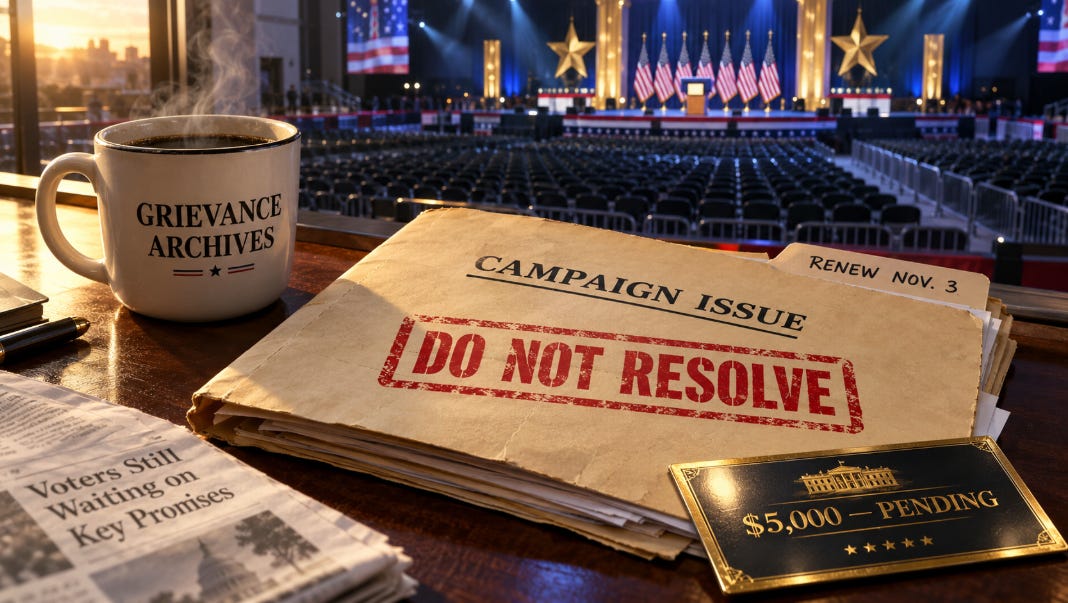
“We’ve won about 90% of the case already in the Supreme Court, but we’re going to have it finalized now. The only problem is I sort of don’t want to finalize it because I want to run on this for the Republican party for years. I don’t want to take this off. I want this and I only talk about it right before an election.”
He didn’t want Democrats changing their positions either, he explained, “because I want to continue to win.”
Sit with the arithmetic. Trump describes these issues as urgent threats to children, women, and the country. Yet he acknowledges that fully settling the sports controversy would deprive him of something valuable: an issue he can bring out every election. Political operatives say this kind of thing over drinks. Presidents don’t usually say it into a microphone.
It is a remarkable admission, less for the cynicism than the confidence with which he delivered it. He said it to the very people whose anger he was treating as a campaign asset. There was no knowing laughter. Behind him, several people sat with their chins resting on their hands, looking frankly bored. An extraordinary admission had become just another few minutes of an ordinary Trump speech.
That same afternoon he offered another glimpse of how he regards an audience. Riffing about Iran, he shared a tip: “If you’re in doubt about somebody’s name from the Middle East, just say Muhammad. You had about a 65% chance.” He added that he’d been doing it for years and had “never been wrong.”
Later he turned the joke on Abdul El-Sayed, the Democratic Senate nominee in Michigan, who is Muslim and whom Trump has taken to calling “Muhammad.” Mohamed is actually El-Sayed’s middle name. “I’m the president of the United States,” Trump declared. “I can call you whatever the hell I want.” He then called El-Sayed a “jihadist” and a member of the Muslim Brotherhood, accusations he offered no evidence to support and that El-Sayed has rejected. Trump also raised the prospect of El-Sayed serving on the Senate Intelligence Committee, although El-Sayed is not a senator and serves on no Senate committee.
On the same day he stood in Dalton, Trump talked about another war he says he wants to end.
“I don’t care anything except for one,” he told reporters at the White House on Friday. “I want that war ended.” In Georgia that afternoon he described the dead as “a Gettysburg field,” said he’d seen pictures he didn’t want to see again, and declared, “That’s a war that has to stop.”
Late that same night, he signed an executive order waiving the sanctions Congress had mandated in the Lindsey O. Graham Sanctioning Russia and Iran Act, a law he signed himself last month. The act targeted Russia’s defense and energy sectors and the shadow fleet of aging tankers Moscow uses to slip past existing restrictions. It was built to raise the cost of the war enough to bring Putin to the table. The order offered no explanation.
Days earlier, the administration lifted sanctions on Russian diesel, a deal Trump announced after a call with Putin, as Ukrainian and European diplomats were arriving in Miami for peace talks. In those same talks, according to the Financial Times, U.S. officials threatened to cut off intelligence sharing if Kyiv kept striking Russian oil refineries. And on the night of October 13, Ukrainian forces found their Starshield terminals, the military-grade version of Starlink their drone units depend on, suddenly throttled.
Asked about Starshield on Friday, Trump said, “No, we didn’t do that at all… I don’t even think it was slowed down.” He had checked that morning, he said. Elon Musk had already answered the question two days earlier: “Starshield systems are owned and controlled by the US government.” When the president and the man who owns the satellites disagree about who throttled the satellites, it’s worth noticing which one has the server logs. (There’s more to say about who controls that network and what it means. I’ll return to it soon.)
Russia, for its part, received the week’s gifts and answered overnight with one of the largest attacks of the war on Ukraine’s energy grid: more than 320 drones plus cruise and ballistic missiles, hitting over 15 power generation and transmission facilities as winter approaches.
Set the two halves side by side, as Dalton invites us to. In speech: a war that “has to stop,” and nothing else matters. In action: less economic pressure on Russia, more demands on Ukraine, and no public explanation of how those decisions will bring peace.
Diesel prices aren’t the only thing on the ballot. September inflation reached 3.7% over the previous year, a four-month high, with gasoline up 9.1% in a single month. So in Dalton the president returned to his most reliable answer: money, conditionally.
If Republicans hold both the House and Senate, he promised, every adult citizen gets a $5,000 “Trump dividend,” to be spent only in the United States. He priced it at “approximately $1 trillion.” With roughly 245 million adult citizens, the actual price tag would be about $1.2 trillion. That’s a $200 billion rounding error. Tariffs, he suggested, would cover it, although analysts estimate it would take more than six years of tariff revenue to pay for one round of checks. They were also supposed to fund the $2,000 checks he promised earlier, which never arrived.
The investment boom he says makes all this affordable has grown to “close to 22 trillion” dollars, while his own White House website lists $11.2 trillion in announced investments and commitments, not money actually spent.
Trump also offered the crowd a helpful suggestion for spending the money domestically: lunch at Mar-a-Lago, where, he joked, $5,000 “will get one hamburger and a small dessert.” On that figure, at least, no fact-check is necessary.
On Thursday afternoon, here in Oregon, a 16-year-old shot his way through the locked doors of Silver Rail Elementary School in Bend. Inside a special-education classroom, he killed three children, aged 5, 8 and 11, and a 25-year-old teacher, Megan Lambert, whose family said teaching at Silver Rail was her dream job. Two other people were wounded.
It could have been worse, and Bend police were clear about why it wasn’t. An unarmed teacher threw her cellphone at the gunman, tackled him and fought for control of his shotgun. A father who had seen the teenager approach the school followed him inside and shot him. Police credited both with likely preventing more deaths.
The next day, asked about the shooting, the president offered his version. “There was a great hero,” he said, who “went in and did the business.” Then: “Thank goodness for a man that had a gun and knew how to use it.”
There were two acts of courage inside that school, and the president mentioned one. A grieving town became, within a day, a slogan.
Hours later, in Dalton, Trump spoke for an hour and a half. He didn’t mention Bend. When guns came up, it was to warn that Jon Ossoff wanted to take them away and to promise protection of the Second Amendment. Nothing about the children of Silver Rail, about locked doors a shotgun could breach, and nothing about how a 16-year-old obtained the weapon.
A problem is something you try to fix. A talking point is something you use. Four people died in a school in Bend. Trump praised the man who stopped the gunman, but left unspoken the questions of how the killing began and what might prevent another.
Back in Dalton, Trump said the part politicians generally keep to themselves: “I sort of don’t want to finalize it.” He had described an urgent problem, then explained why keeping the argument alive might be more valuable than settling it. Political anger has a shelf life, but apparently no expiration date.
A solved problem never filled an arena.
Good article about so much wrong with our country.
My conclusion is that Putin sees Trump's presidency slipping away and has decided to call in his chips with whatever leverage he has over him before Trump loses his power.