


Good morning! Brace yourself, Donald Trump began yesterday the way he now begins most days: in front of cameras, inside a room he has recently redecorated, congratulating himself for existing. The cabinet meeting was billed as a routine governance check-in, but functioned instead as a three-hour-long infomercial for Trump’s feelings. The Cabinet Room, we were told, has never looked better. The economy has never been stronger. Crime has never been lower. Borders have never been tighter. Wars have been extinguished like birthday candles. Drug prices have collapsed by “five, six, seven, eight hundred percent,” depending on which arithmetic universe you’re operating in. At one point, Trump wandered from tariffs to windmills to Ukraine weather conditions to prescription drugs to coal to battleships, pausing only to sell the idea that everything good is because of him and everything bad is because someone else didn’t listen.
Think of it as a mood board: grievance, bravado, fantasy statistics, and the steady insistence that if reality disagrees, reality is wrong.
That tone matters, because it’s the backdrop for everything else that’s unfolding. First, the government did not shut down. Or rather, it almost did, then didn’t, in the most Washington way possible. Senate Democrats say they reached a deal with Trump to avert a partial shutdown by surgically removing the Department of Homeland Security from the funding bill. DHS gets a two-week extension, everyone else gets funded, and Congress buys time to argue about immigration enforcement later. This wasn’t a victory so much as a ceasefire. Democrats were reacting to the shooting of a second U.S. citizen by immigration agents in Minneapolis, and demanded limits on tactics like roving patrols, face masks, and the absence of body cameras. The White House hasn’t fully confirmed the deal, and the House still has to agree.
Accountability has been postponed, not delivered, which matters, because DHS and ICE are not operating in a vacuum. They are operating in a surveillance state that is expanding in real time.
POLITICO reported this week that ICE has dramatically scaled up its domestic surveillance arsenal, fueled by the massive funding injection it received through Trump’s “One Big Beautiful Bill.” That money is now underwriting contracts with Palantir, Israeli spyware firm Paragon, forensic phone-cracking tools, data brokers who sell Americans’ location histories, and facial recognition systems deployed in U.S. cities. ICE has also been granted access to sensitive data held by other federal agencies, including the IRS, Medicaid, and Social Security. This isn’t just about immigration enforcement anymore. It’s about data fusion, dragnet policing, and the normalization of treating entire communities as trackable objects.
People have noticed. Activists across the country are using encrypted messaging apps and social media to warn neighbors about ICE activity, map license plate readers, and document raids. Hackers have targeted ICE systems. A DHS data breach last week exposed the personal information of thousands of ICE and Border Patrol employees. The administration’s response has not been to narrow surveillance, but to narrow speech: pressuring Apple and Google to remove ICE-tracking apps, leaning on Meta to suppress databases, launching FBI investigations into Signal users, and attempting, then retreating from, subpoenas aimed at anonymous social media accounts.
The New York Times added devastating texture to this picture. In Minneapolis, ICE agents are openly using facial recognition technology not only on undocumented immigrants, but on U.S. citizens who protest or even observe ICE operations. At least seven citizens were told directly by agents that their faces were being scanned and added to databases. One of them, Nicole Cleland, was addressed by name by an ICE agent she had never met. Three days later, her Global Entry and TSA travel privileges were revoked without explanation. She is now suing DHS. “I am a totally average American,” she told the Times, “and I cannot abide by what is happening right now.” That sentence should haunt every lawmaker who waved DHS through with a temporary extension and promised to deal with it later.
Then came the part where press freedom stopped being theoretical. Federal agents arrested Don Lemon late Thursday night, not at a protest, not in Minnesota, but in Los Angeles, where he was covering the Grammys. The charge stems from Lemon’s presence at a January protest inside a St. Paul church against ICE operations. Lemon says he was reporting, not demonstrating. A magistrate judge already reviewed the evidence and rejected the case against him. The Justice Department tried to override that decision and was denied by an appeals court. And yet agents arrested him anyway.
This is not subtle. When courts say no and enforcement barrels ahead regardless, the message is about intimidation. Watch ICE and you may be tracked. Protest ICE and you may be surveilled. Report on ICE and you may be arrested, even after a judge says the case doesn’t hold. The state is not policing itself, it is policing the people who are watching.
Against that backdrop, Trump reappeared before the cameras to announce what he repeatedly called a “historic” executive order creating the Great American Recovery Initiative, an event that functioned less as an emotional pageant stitched together with exaggeration, rambling asides, and the occasional WeatherTech floor mat endorsement.
He opened by inflating drug and alcohol deaths to “300,000 a year,” then helpfully clarified that the real number is “probably much higher,” before pivoting to border theatrics and the claim that each drug boat kills “25,000 people per boat,” a statistic that exists only in the same alternate universe where the Gulf of Mexico has been renamed the “Gulf of America.” He credited himself for a decline in overdose deaths without acknowledging that the trend began before his return to office and is largely attributable to expanded naloxone access and post-pandemic normalization, policies he did not originate but is now happy to absorb.
What followed were deeply personal recovery testimonies from RFK Jr., Katherine Bergum, and Steve Witkoff. They were sincere and moving. Addiction was described correctly as a chronic medical disease rather than a moral failure. Yet the administration delivering this message continues to criminalize addiction, gut public health infrastructure, threaten Medicaid and SNAP, and frame substance use primarily as a law-and-order and border problem. Calling addiction a disease while governing as if it’s a crime doesn’t resolve the crisis. It just disguises it in softer language.
The executive order itself was heavy on buzzwords, coordination, alignment, breaking silos, whole-of-government, and conspicuously light on funding, enforcement mechanisms, or timelines. Trump wandered off topic to boast about his signature, tease “major announcements coming next week,” and casually claim he convinced Vladimir Putin to pause the Ukraine war because it’s cold outside. The stories were real. The grief was genuine. The initiative remains a glossy framework without teeth, accountability, or resources.
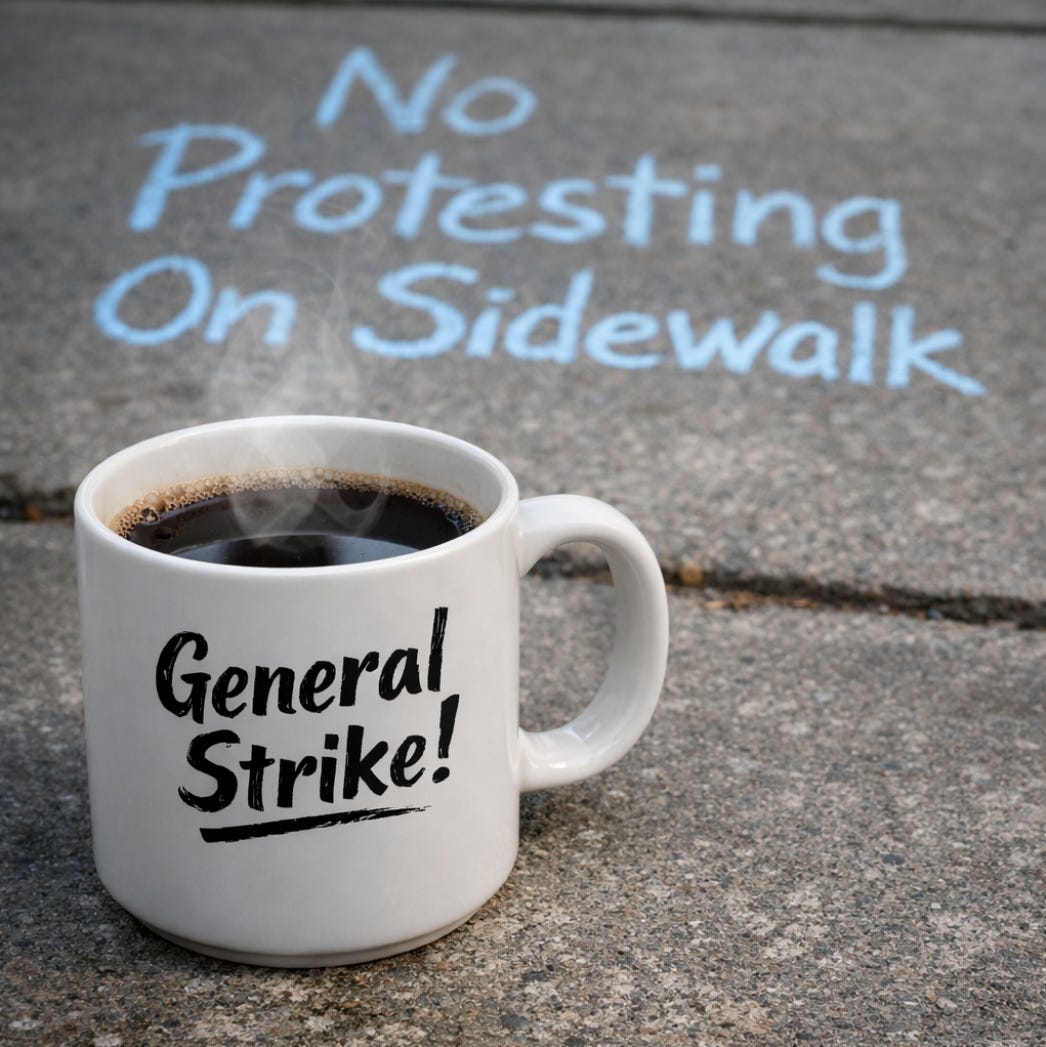
A similar pattern played out right here in Coos County. Turning Point USA brought its well-funded touring roadshow to Coos Bay. TPUSA arrived with professional logistics, national backing, and institutional protection. The counter-protest consisted of local residents showing up on a chilly winter evening to express disagreement peacefully. The organizers obtained a city permit to allow for tabling and amplification. The requirements effectively pushed those residents out of sight and off the sidewalk. When dissent is relocated, sanitized, and sidelined, even politely, it doesn’t disappear. It simply amplifies the visibility of the traveling roadshow while muting the community it has come to address. I’ll write more on this later and include photos.
Then there’s the Epstein file. Ghislaine Maxwell, currently serving a 20-year sentence for her role in Jeffrey Epstein’s trafficking operation, has filed a habeas petition accusing the Department of Justice of protecting nearly 30 of Epstein’s associates through secret plea deals and settlements. Her filing lands as the DOJ continues to defy the Epstein Files Transparency Act, passed in November, which required full release of the files within 30 days. That deadline has passed. Less than one percent of the material has been made public. DOJ now says it will process the rest “in the near term,” without a date.
Maxwell’s credibility is not the point, but her proximity is, and the timing is impossible to ignore. After a July interview with Deputy Attorney General Todd Blanche, Maxwell was transferred to a low-security prison camp and granted unusually generous privileges. Members of Congress are calling for a special master to force compliance with the law. The DOJ is slow-walking transparency while aggressively policing speech elsewhere. Draw your own conclusions.
Which brings us to the subject people keep whispering about, posting about, and carefully disclaiming before they mention it at all: the general strike. Hell yes!
A general strike enters the conversation when the normal pressure valves fail. When courts issue rulings that are ignored, and Congress passes laws that are slow-walked into irrelevance, and when journalism is criminalized, protest is surveilled, permits quietly sideline dissent, and transparency deadlines dissolve into “near term” assurances. Strikes are not born from impatience; they are born from exhausted legitimacy.
What’s striking about this moment is not that people are talking about withholding labor or participation, it’s that the state appears to be planning for that possibility in advance. The surveillance expansion, data fusion, and tracking of protesters and observers. Add in the scrutiny of encrypted communication, the removal of organizing tools from app stores. Arrests that proceed even after judges say no. All this signals coordination.
A general strike doesn’t require violence. It requires visibility, trust, communication, and numbers. Nearly every enforcement move we’re seeing right now is aimed squarely at disrupting those conditions. That tells you something important about what power fears most. Organized refusal, the quiet decision, en masse, to stop making things work. Withdrawing consent to be governed lawlessly.
Historically, strikes have emerged when people realize that participation itself is the leverage. When the economy, the bureaucracy, the spectacle, and the legitimacy all depend on ordinary people showing up, buying in, and keeping the lights on. A strike isn’t about burning the system down. It’s about revealing how much of it runs on consent that has been taken for granted.
That’s why the conversation keeps coming back, even as officials try to frame it as irresponsible or dangerous. When the law is enforced downward but not upward, when transparency is optional for the powerful but mandatory for everyone else, and when grievance replaces governance, people don’t radicalize, they calculate. The calculation is simple: if nothing changes while we keep participating, what happens when we don’t?
So that’s where we are this morning: a government that congratulates itself in mirrors, surveils its critics, slow-walks accountability, and treats participation as acceptable only if it’s quiet, distant, and easily ignored. When you see conversations about general strikes, mutual aid, encrypted coordination, and community presence resurfacing everywhere at once, it’s because they became realistic about where leverage actually lives.
Last night, after all of this, I stood out in the cold taking photos of a peaceful local protest that had been politely but firmly pushed out of view. Marz sat patiently in the car, earning an extra treat for the indignation and for keeping me company anyway on my little moonbeam vigil.
Thanks Mary, for the content, overwhelming as it is. It is hard for me to even formulate a starting point to discuss. But, if I had to, I would say this feels so much like the trajectory of the Ukranian war, (which if, readers haven't noticed is in its third year and 342nd day). If I could sum up the whole conflict in one sentence, it would be "The West watched Putin target and kill civilians, commit atrocities, kidnap thousands of children and take land that was never his to take; all the while the West wrung its hands about how not to upset Moscow".
Now... in the previous sentence, substitute the word Putin for Trump, and Moscow for Washington.
The only caveat I would inject would be in the absolute number of suffering humans in Ukraine.
But the methodologies are unmistakable in both cases.
I think this is where we are. And if Ukraine is an example, we should consider how difficult it is to reclaim territory once it is lost...
Keep writing, keep yelling, keep moonbeaming. Minneapolis had a general strike and it drew massive amounts of people (50 - 100K) into the street. At the same time, 800 businesses racked up a day's loss. That is sacrifice and that feels better than anger. This is exactly the thing people are hungry for - contributing to something meaningful.
Take Minneapolis's strike and multiply it by 100 American mid-sized cities. Then imagine the strike in 10 cities of one million or more. Then stop and think if just 10% of businesses closed in 20,000 American towns.
That is a big fn deal. And I'm being conservative with my calculations, not pretending to know the final number. But let me tell you, it would be ... massive.