

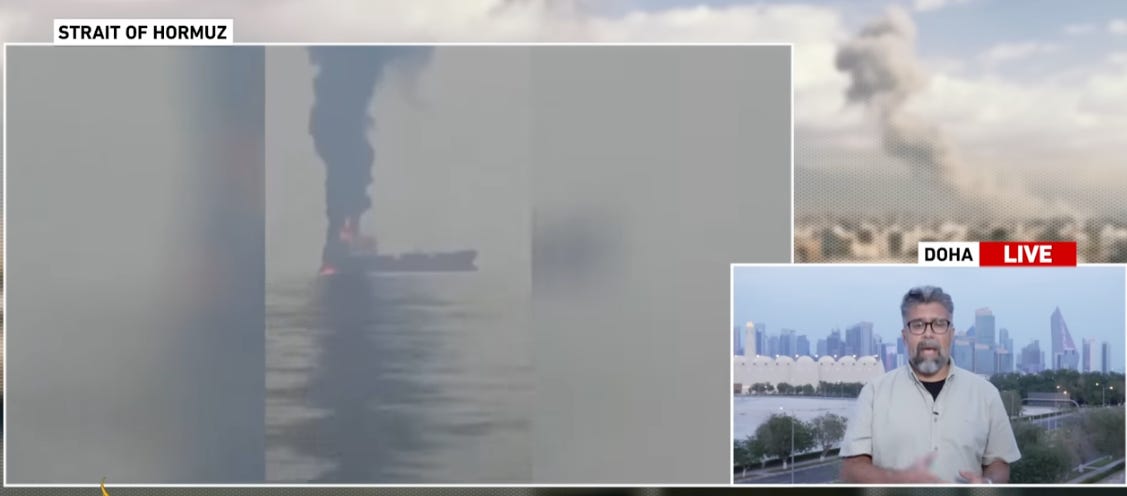
Three American service members are dead. Nine Israeli civilians were killed in Beit Shemesh. Iranian officials say more than 150 people, including children, have died in strikes inside Iran, with one report describing a school hit. A U.S. Navy base in Bahrain was struck by drone. The RAF shot down an Iranian drone headed toward Qatar. Oil tankers are reportedly burning in or near the Strait of Hormuz. Internet access inside Iran has been cut almost entirely, possibly a regime preparing for unrest and/or preparing for siege.
Somewhere in the middle of this, Donald Trump says operations are “ahead of schedule.”
Ahead of schedule for what? That’s the question hanging over every capital from London to Beijing, and over every energy desk from Houston to Rotterdam. Wars can begin with a target list, but they do not end with one. They end, if they end well, with an outcome that stabilizes the system. At the moment, what we have is velocity without visible destination.
The Strait of Hormuz is not a metaphor. It is not a cable-news graphic. It is not a talking point. It is a narrow maritime artery through which roughly one-fifth of the world’s oil supply moves every single day. When missiles land near tankers or insurance underwriters begin quietly recalculating risk tables, the consequences do not remain politely confined to the Persian Gulf.
They travel. They move through gasoline futures first. Then through shipping premiums, into fertilizer costs, and into food prices. Then into airline routes and cargo schedules, manufacturing inputs. And eventually, inevitably, into your grocery bill.
Maritime historian Sal Mercogliano has been blunt about what happens when shipping lanes become active war zones. “You don’t have to sink ships to shut down trade,” he’s warned in past crises. “You just have to make the risk too high.” Tankers don’t need to be destroyed en masse. They simply need to be close enough to danger that insurers pause, premiums spike, and charterers hesitate. Shipping companies operate on margins and risk modeling. Once war-risk insurance climbs, the cost always passes downstream.
Mercogliano has also emphasized something policymakers often gloss over: chokepoints are psychological as much as physical. “The maritime system runs on confidence,” he said. When confidence erodes, rerouting begins, and rerouting is expensive. Longer voyages mean more fuel, more crew time, more congestion at alternative ports. That cost does not evaporate; it compounds.
Energy analyst Matt Randolph has been equally clear that Hormuz is not interchangeable infrastructure. “There’s no easy workaround for the Strait of Hormuz,” he has explained in discussions about prior flare-ups. Pipelines can offset some volume, yes, but nowhere near the full daily flow. If that corridor is disrupted in a sustained way, “you’re talking about immediate price spikes.”
Randolph has also pointed out something critical for readers who think this is just about crude oil. “Oil touches everything,” he reminds us. Diesel moves food. Natural gas feeds fertilizer. Petrochemicals underpin plastics and manufacturing. When oil volatility rises sharply, it doesn’t stay isolated to the pump; it ripples through supply chains in layers.
Energy is the base layer of everything. If Hormuz is closed even briefly, markets spike. If it is unstable for weeks, insurance reprices. Should Hormuz become chronically dangerous, supply chains will reroute. LNG contracts have to be renegotiated. Strategic reserves are tapped, and refiners scramble for alternative blends. Shipping companies shift risk portfolios. Inflation, which central banks have been trying to wrestle back into its cage for years, roars back to life.
Here’s the part that makes foreign leaders uneasy: energy systems are sensitive to duration. A five-day shock can be absorbed. A five-week instability starts to bend pricing curves. While a five-month disruption reshapes contracts and politics.
When war planners focus on strike packages and target grids but do not articulate a stabilization path for the world’s most important maritime energy corridor, allies begin doing their own math.
Sal Mercogliano has warned repeatedly that maritime conflict is rarely about the first explosion. “The real question,” he has said, “is not what gets hit, it’s what stops moving.” In other words, you can win the tactical exchange and still lose the logistics war. If commercial shipping hesitates, if insurers tighten coverage, if crews refuse assignments, the disruption spreads far beyond the blast radius. “Trade doesn’t like uncertainty,” Mercogliano has noted. “It reroutes, it reprices, or it retreats.”
European governments remember this lesson vividly. When Russian gas flows collapsed in 2022, it wasn’t just about pipelines; it was about industrial slowdown, fertilizer shortages, power rationing, and political backlash. Energy insecurity is not theoretical in Berlin or Rome. It is lived memory. As one European energy official put it during that crisis, “Security of supply is economic security.” That lesson has not faded.
Matt Randolph has made a similar point about chokepoints like Hormuz. “Energy markets can handle disruption,” he’s said, “but they struggle with prolonged uncertainty.” Short shocks create spikes. Sustained ambiguity creates volatility that feeds into inflation expectations and investment decisions. And inflation expectations, once unanchored, are notoriously stubborn.
Gulf states, for their part, do not need reminding what investor confidence looks like when tankers burn on live television. Sovereign wealth funds, long-term development projects, and diversification plans all depend on the perception of stability. One regional analyst recently summarized the mood succinctly: “Capital flows to predictability.” Missile exchanges near export terminals do not project predictability.
Asian economies dependent on Gulf LNG are already calculating contingencies. Japan, South Korea, India, and China have built energy strategies around reliability of supply through Hormuz. They maintain reserves, yes. They diversify suppliers, yes. But they cannot magically reroute a fifth of the world’s oil overnight. As Randolph has put it bluntly, “There’s no easy workaround for Hormuz.” Pipelines can help at the margins, but they cannot replace the corridor.
So when the public narrative focuses on how many launchers were destroyed or how many ships were sunk, foreign capitals are asking a quieter question: What is the plan to keep the artery open?
The President took to Truth Social to announce, “I have just been informed that we have destroyed and sunk 9 Iranian Naval Ships, some of them relatively large and important… They will soon be floating at the bottom of the sea, also!” It is a line designed for impact, decisive, muscular, final. Ships at the bottom of the sea, naval headquarters largely destroyed. Mission momentum.
But markets do not trade on bravado; they trade on continuity. If the artery clots, tankers hesitate, insurers flinch, and shippers reroute, the consequences will not be confined to one coastline. They will show up in factory output in Germany, fertilizer prices in Brazil, and airline tickets in Chicago. In bond markets recalibrating inflation risk, and in political stability debates far from Tehran.
Winning the strike is one thing. Stabilizing the system is another. You do not need a tanker graveyard to create a crisis; only sustained uncertainty. And uncertainty in global energy markets is expensive.
All of this is before we even factor in the munitions burn rate. High-tempo air campaigns are expensive in ways that do not show up on cable news chyrons. Precision weapons are not infinite. B-2 sorties are not free. Naval deployments wear down platforms and crews. The United States has enormous military capacity, yes. It does not have infinite replenishment speed. While strike packages move, other adversaries are watching inventory levels and force posture like hawks at a numbers table.
Retired Lt. Gen. Mark Hertling put it plainly in a recent discussion: when you start expending large volumes of precision munitions in one theater, “the first red flag” for planners is what that does to risk elsewhere. If you pour resources into one campaign, he explained, you have to ask, “Where are the risks in other places?” Because adversaries are “ticking off how many precision weapons we have used, how many aircraft carriers have been deployed… how many air force airplanes have been flying sorties.” They are counting.
Hertling also reminded viewers of something policymakers already know but rarely emphasize publicly: precision weapons take time to build. “When you use them,” he said, “there’s a big hole in your warehouse for a long time.” The industrial base does not replenish bunker-busters and cruise missiles overnight.
This is not theoretical. During the Ukraine war, the Biden administration faced criticism for not sending certain long-range munitions immediately. The quiet explanation from defense officials was inventory management, ensuring the United States retained enough stock for its own contingencies. Even critics of that policy acknowledged the core truth: supply is finite.
Donald Trump himself leaned on similar reasoning last year when he argued against providing additional missile systems to Ukraine, citing U.S. stockpile concerns and readiness requirements. Supply mattered then; it was invoked as a reason for restraint.
Now, those same stockpiles are being consumed at an astonishing rate. More than a thousand strikes in two days. Tomahawks launched, B-2s flying, air defenses intercepting incoming waves, even naval engagements in the Gulf. Every missile fired is not just a tactical decision; it is an inventory decision.
China, Russia, North Korea are all watching burn rates. They are not rooting for one side or the other in this specific exchange. They are assessing capacity. How long can this tempo be sustained? How quickly can the U.S. replenish? What gaps might open elsewhere?
War planners understand this. They have to. The public rarely hears about it because it does not fit neatly into a soundbite.
But the uncomfortable reality is this: you can win strike packages and still degrade strategic flexibility. You can dominate the first week and constrain your options in the next crisis.
Our allies are watching too. The United Kingdom has drawn a careful line: we are not joining offensive strikes, but we will allow defensive use of British bases. That is coalition hedging. It says: we support defense; we do not own escalation. France and Germany are calling for diplomacy and civilian protection. Gulf states are weighing embassy closures. Evacuation plans are quietly being drafted for Western nationals across the region.
All of this signals anxiety about duration. Trump now speaks of “decapitation” and of “short versions or longer versions.” Foreign ministries are looking for clarity and instead hear optionality. They hear a campaign whose ceiling has not been defined or even considered in advance of striking another country.
Who governs and secures infrastructure? Who prevents factional fragmentation and controls the Revolutionary Guard remnants? Who prevents proxy escalation across Lebanon, Syria, Iraq, Yemen? Who keeps oil flowing while the political architecture shifts?
At the moment, those answers are not visible. Iran has not folded. Its foreign minister says military capability remains intact and its missiles are still flying.
The Pope has warned of an “irreparable abyss.” Strip away the theology and that is a systems warning. An abyss is what happens when feedback loops outpace control, when military escalation outruns diplomatic structure, when energy shock outruns stabilization policy, when retaliation outruns messaging discipline.
The domestic messaging so far has focused on resolve, vengeance, and speed. “We expect casualties with something like this,” Trump, a five-time draft dodger, said after three American service members were killed. Freedom isn’t free, we are reminded.
“Freedom isn’t free” is a phrase so familiar it barely registers anymore. It rolls off podiums, fills comment sections, and somehow stands in for an argument.
As justification for men and women dying in uniform, it is intellectually hollow.
Of course freedom has a cost. What is in dispute is purpose. When three service members are killed, when families are notified, when a nation is told to absorb the loss, the response cannot be a Hallmark platitude. Freedom for whom? Under what authorization? Toward what defined objective?
If a war is defensive, say so and demonstrate it. If it is preemptive, explain the threshold. Or, if it is about preventing nuclear proliferation, describe the measurable end state. If it is about regime change, articulate what replaces the regime and how stability is maintained.
Without those answers, “freedom isn’t free” becomes a substitute for thinking.
It is trite not because freedom lacks value, but because the phrase is used to evade specificity. It sanctifies sacrifice without explaining strategy.
The War Powers clock ticks whether acknowledged or not. Inflation does not care about political messaging. Tanker insurers do not care about campaign rhetoric. Central banks do not care about bravado.
If this is a short degradation campaign that quickly reduces Iran’s retaliatory capacity, stabilizes Hormuz, reopens negotiations, and restores energy flows, markets will calm. Gasoline will settle. Supply chains will adjust and move on.
If this stretches into weeks of sustained missile exchange, regional strikes, tanker vulnerability, and leadership uncertainty inside Iran, then the price of this war will not be measured only in lives lost on the battlefield.
Wars in the modern era are fought on two fronts: kinetic and systemic. The first is visible in satellite imagery. The second is visible in CPI reports and shipping manifests.
Right now, the kinetic campaign appears aggressive and tactically coordinated. The systemic stabilization plan is harder to see. That is what should concern readers. Not whether a radar dome was destroyed, or nine ships were sunk, but whether the architects of this campaign have mapped the economic and diplomatic aftershocks with the same precision as the targeting grid.
History does not only punish leaders for losing wars. It punishes them for winning the first week and losing the next six months.
Great column with a great ending.
It seems that another thought is likely also present within and outside the US: is trump cognizant of what he’s doing or simply reading scripts written by his handlers? I cannot believe Hegseth is competent to manage a war “wisely” if that term can even make sense. No one in the current administration creates any confidence of military or moral expertise in my opinion.