


The Trump administration has ended the lease on the Consumer Financial Protection Bureau’s headquarters and transferred the building to the General Services Administration, which sounds at first like the sort of bureaucratic housekeeping detail designed to make the public lose consciousness mid-sentence. But this one is unusually revealing, it contains the administration’s worldview in miniature. The story is technically about office space, in reality, it is about what this government thinks public institutions are for, and who it has decided they no longer need to defend.
Nothing says devotion to ordinary Americans quite like downsizing the agency created to stop banks, lenders, debt collectors, and the wider financial extraction apparatus from casually ruining people’s lives. The consumer watchdog loses its home, and the public is once again invited to accept the old theological claim that easing pressure on business is somehow a form of care for everyone else. This is always the trick, power is relieved of inconvenience, and the exercise is reintroduced as freedom.
You are meant to hear that regulation is burdensome, that business needs room to breathe, that the market performs best when government stops hovering over it with concerns and paperwork. You are not meant to notice that the first people to benefit from this liberation are always the ones who already have money, lawyers, lobbyists, access, insulation, and a professional relationship with impunity. Ordinary people do not typically experience deregulation as a thrilling expansion of economic liberty. They experience it as another unexplained fee, another impossible phone tree, another credit report error that somehow becomes their private administrative burden to resolve.
That is why the CFPB matters. It exists because consumers and corporations do not meet each other as equals, however many market sermons are delivered on cable news. A giant financial institution arrives with attorneys, compliance teams, PR staff, behavioral analytics, customer-service scripts, and a thousand small ways to turn your exhaustion into policy. A consumer arrives with half an hour, an elevated pulse, and the increasingly deranged need to prove that what is happening is in fact happening. To pretend those two parties can simply work it out without serious oversight is not wisdom, it is ideology performing moderation. More precisely, it is a tasteful way of siding with power.
The lease story matters because it is not really about a building, except in the sense that symbols are never only symbols. This move belongs to a larger effort to shrink the CFPB, narrow its role, and make the government less interested in intervening when companies become predatory in ways that are profitable, polished, and sufficiently technical to discourage resistance. They can call that efficiency if they like, upward transfer is forever trying to rebrand as maturity. But ordinary people know what efficiency usually means when it arrives from above, it means the path between a corporation and your wallet has been made smoother, and the obstacles being removed are rarely the ones that stood in your way.
None of this should surprise anyone who has paid attention to Donald Trump for more than ten minutes. He is not merely pro-business in the generic American sense, he is the concentrated product of a culture that worships the seller, glamorizes the dealmaker, and assumes the person with the largest branding budget must also be the genius in the room. His public life has been one long exercise in monetizing projection, the name, the image and the mythology were the product, and reality was welcome to participate when convenient. So of course he governs with instinctive sympathy for the people making the pitch, closing the deal, protecting the margin, and sending someone else the bill.
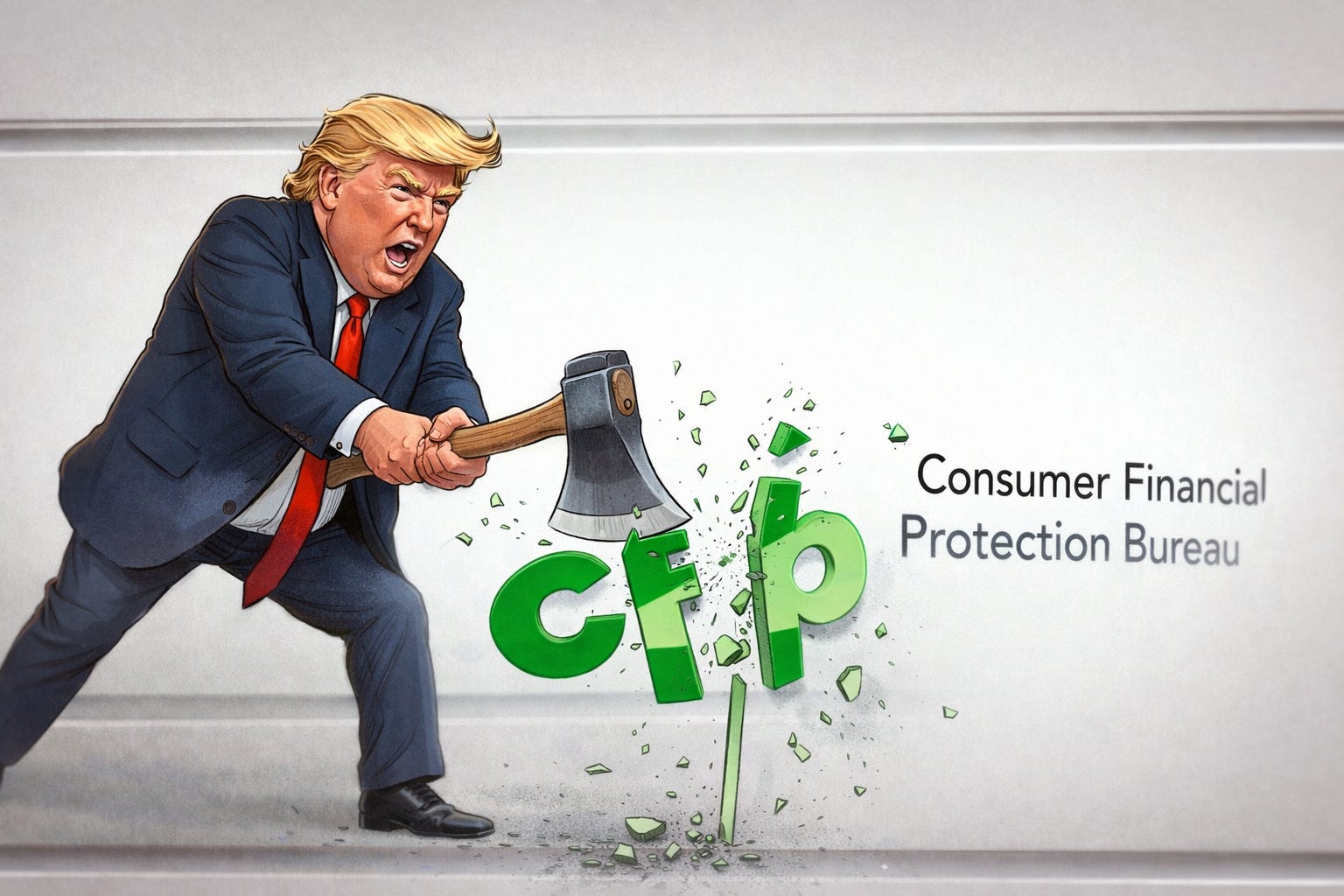
Why would a man whose central talent has always been selling a more lucrative version of himself become the patron saint of the overcharged, the underinformed, and the people getting flattened by fine print? Why would someone whose imagination is so obviously arranged around transactions develop a deep moral tenderness for those on the losing end of them? The answer is quite simple, he would not, and he has not. Yet the populist costume remains in constant circulation, because American politics still rewards anyone who can identify with landlords, lenders, luxury branding, and institutional muscle while performing grievance in the direction of the working class.
What we are watching is exactly what happens when a government is led by someone whose deepest instincts are commercial. Business confidence becomes morally urgent, consumer protection becomes negotiable, perhaps even vaguely embarrassing, and leaders speak like populists and govern like men trying not to upset the investment class before dessert. They tell working people they are finally being seen while quietly removing the few guardrails that might have made life less punishing, less humiliating, and less extractive. It is populism as advertising language, the policy lives elsewhere.
It is so disappointing and disheartening to see the consistency and ruthlessness with which the Project 2025 team manages to continue attacks on the modern regulatory state on all fronts. Trump is clearly not paying attention to most of this stuff - he would need to be able to read to do that, and to stay awake in meetings, not just at 2 a.m. in front of his phone. But it's his authority that lets the competent evil forces gut consumer and environmental protection and promote fossil fuel, while he pays more attention to killing the helpless in international waters and wondering how much more bombing he can get away with. (According to the Senate, there's no end to it.)
The people who bought his election are certainly getting an excellent return on their investment.
Trump is simply a man with no morals.