


There is an antelope in Kenya so shy and so rarely seen that people call it the ghost of the forest.
The mountain bongo moves through the misted highlands with a kind of impossible beauty, all chestnut fur and white stripes, an animal that looks like it was painted by someone who had just learned about both tigers and deer and decided, quite reasonably, to improve upon both. For decades, these animals have been vanishing from the wild, pushed toward the edge by habitat loss, hunting, disease, and all the other ways the human world sometimes forgets to leave room for anyone else.
But this week, I kept thinking about the mountain bongo because the story is not only that it disappeared, but that people noticed.
The story is that conservationists, communities, scientists, caretakers, and people who could have shrugged and said, “Well, that is sad,” instead began the long, unglamorous, deeply holy work of bringing the ghost home.
They bred them carefully, protected forest, taught animals born under human care how to become wild again, and made plans not for next week or next quarter, but for 2050, which is the kind of faith that makes me want to lie down on the floor for a moment and recover from the audacity of hope. There are still fewer than 100 mountain bongos left in the wild, but there are calves now, living proof that a species can be so close to becoming memory and still not be finished.
That’s the part I can’t stop carrying around with me. They aren’t gone, aren’t finished, and they aren’t beyond the reach of love organized into action.
And maybe that’s why this story found me so hard this week, because my own family has been living in one of those thin places between fear and possibility, where everything feels fragile, every phone call matters, and hope is not some gauzy abstract thing but a list of repairs, deadlines, signatures, documents, and people showing up with their sleeves already rolled. So, I’m pleased to tell you all, while admittedly out of breath, that our landlady accepted our offer.
I still almost don’t know how to type those words without wanting to laugh, cry, nap for three business days, and then wake up to ask whether anyone has seen my coffee, my sanity, or the tape measure. We aren’t at the finish line just yet, because the final step is making the house financeable, and there is real work ahead. We’ve already been hard at work, which is why I have been less active and less responsive than usual, and by “hard at work” I mean the kind of work where your body is tired, your brain is soup, and your browser history makes it look like you are either buying a home or preparing to become a very anxious general contractor.
But something else has been happening too, people have stepped in. Some amazing people, family and friends and readers and helpers in the truest sense of the word, have jumped in to help us carry what had started to feel too heavy to carry alone. Among them is a particularly special couple we had never met except through my writing, and yet somehow, in the kind of cosmic coincidence that makes a person look suspiciously at the ceiling, one of them grew up nearly sixty years ago with my husband’s grandparents. Nearly sixty years ago.
A childhood connection, a family thread, a stranger who was not really a stranger, a candle passed through time and somehow still lit when it reached our doorstep. The one in a million chances of all these things coming together to help my family are truly out of this world, and I don’t mean that in the casual way people say something is unbelievable when what they mean is “mildly surprising.” I mean I’ve had moments this week where I have looked around at the kindness gathering near us and thought, with my whole chest, that there are forces of goodness moving through this life that we just don’t usually have the pleasure of seeing so clearly.
Maybe that’s what hope looks like most of the time. Not a lightning bolt, or a miracle descending fully assembled from the clouds, more often, hope is a network. A habitat, a bridge, and a community of beings deciding that someone, or something, is worth saving.
Which brings me to the otters, because of course it does, and because it’s Mother’s Day and the universe apparently knew we needed a story with whiskers.
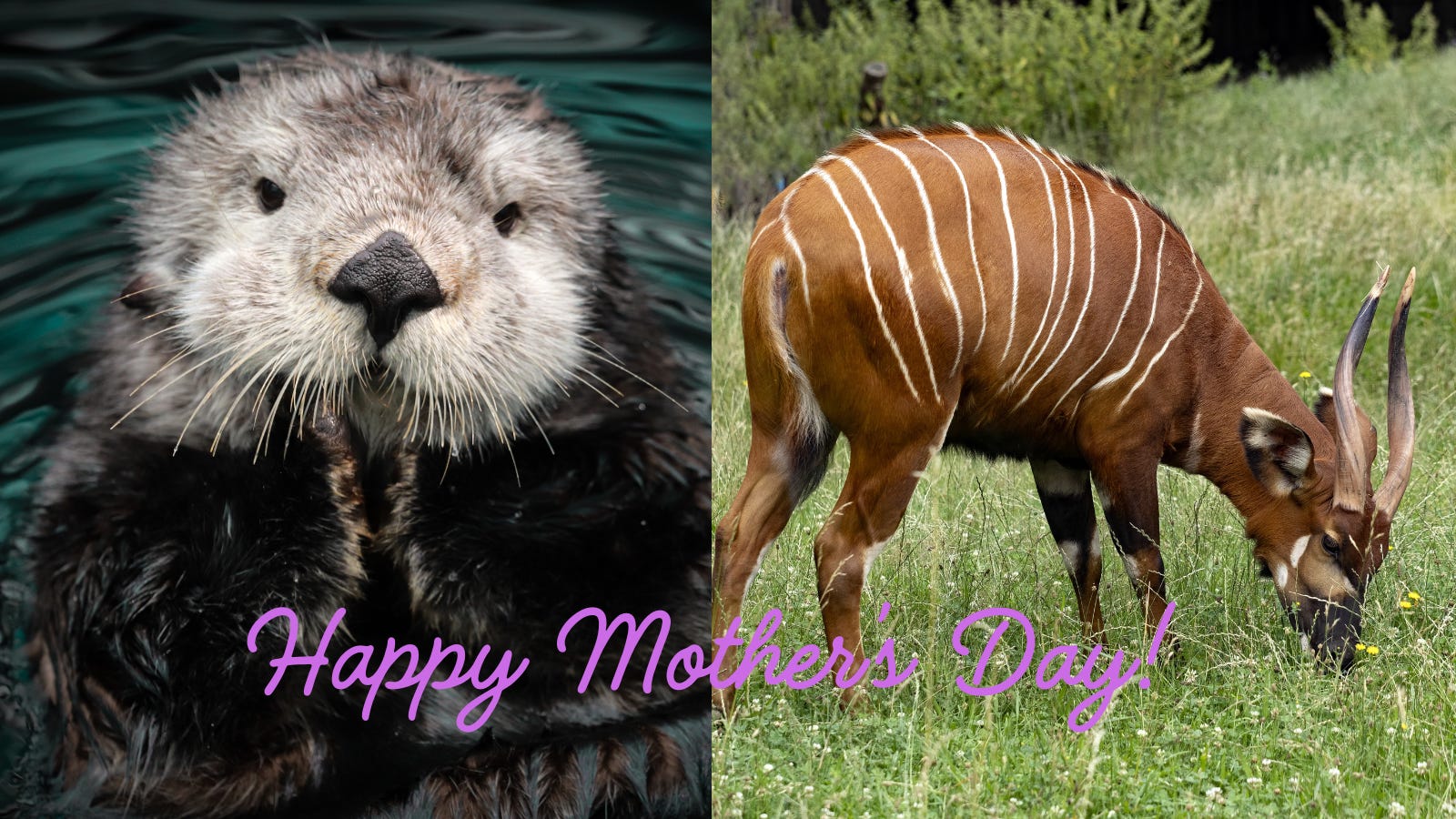
Sunny is an orphaned southern sea otter pup who was found alone on a California beach when she was only a couple of weeks old. She was too young to survive by herself, and too small to know how to be an otter without someone showing her the way. After she was rescued and stabilized, she was paired with Rey, another rescued sea otter, who is now helping care for her. There is something just so precious about that.
Rey was once an orphan too, and now she is helping Sunny learn how to be alive in the world. One rescued creature becoming refuge for another; one life, saved by care, becoming part of the care that saves the next life.
That is motherhood in one of its oldest forms, not only biology, but shelter; not only one person, but everyone who has ever bent down and said, “Come here, little one, I know you are scared, but I will help you learn the water.”
And what makes it even more beautiful is that sea otters are not just adorable little floating commas in the great sentence of the ocean, although they are absolutely that and I will be taking no further questions. They are also essential to the health of kelp forests, which means helping an orphaned otter is also helping an ecosystem breathe. Care moves outward, a rescued pup becomes a stronger otter community, a stronger otter community helps protect kelp, and healthy kelp shelters fish, stores carbon, steadies shorelines, and gives life room to keep making more life.
Which is the secret all these stories keep telling us. Nothing is saved alone, not the ghost of the forest, the orphaned otter, a family trying to hold onto a home, or a planet full of beings who keep needing each other in ways both practical and mysterious. When our family needs help, people rise, when our friends need help, people rise.
And when our planetary roommates need help, people rise too, sometimes with science, sometimes with money, sometimes with hammers, sometimes with expertise, sometimes with a spare bedroom, sometimes with a wildlife corridor, sometimes with a baby bottle, sometimes with a ridiculous amount of paperwork, and sometimes with the simple, sacred willingness to not look away. That may be the most hopeful thing I know about humanity.
We don’t always rise, and I would never pretend otherwise, because the world is too wounded for easy declarations and too many people are still waiting for someone to come back for them. But again and again, in the middle of all our mess and noise and exhaustion, someone sees a need and steps toward it. Someone builds the bridge, protects the forest, and takes in the pup. Someone says, “We can help.” And then, somehow, the ghost begins to come home.
So, this Mother’s Day, I am thinking about all the forms love takes when it refuses to remain only a feeling. I am thinking about mothers and grandmothers, aunties and neighbors, nurses and teachers, rescuers and conservationists, friends and strangers, readers and relatives, all the people who make shelter out of their lives. I am thinking about those who mother children, those who mother animals, those who mother communities, those who mother the future by doing work whose fruits they may never personally hold.
I’m thinking about Rey and Sunny, floating together in the water, one orphan teaching another that she has not been abandoned. I’m thinking about the mountain bongo, stepping back through the forest. And I am thinking about my own family, humbled beyond language by the people who have gathered around us at exactly the moment we needed reminding that the world is not only cruel, not only hard, not only expensive, although for the record it is being extremely committed to that last one.
The work ahead is real, the gratitude is real too. And if there is one thing I want to say this week, it is this: hope is not passive. Hope is what happens when love gets organized, when kindness meets need, when the community rises, when the living world says, in a thousand different voices, “Not yet, not alone, and not while we’re here.”
May we be that kind of hope for one another. May we be that kind of hope for every small, striped, whiskered, frightened, stubborn, beautiful life trying to make its way home.
Happy Mother’s Day!
Thank you for this beautiful essay. I am also glad that people have stepped up to help you.
So glad to hear of the progress on your home. Enjoyed this lovely and hopeful post. Thank you.