


Good morning! Mother Nature tried. There was a moment last night when it appeared the atmosphere itself had staged an intervention. Washington was overheated, storm-threatened, lightning-lit, and temporarily evacuated. People who had come to the National Mall for America’s 250th birthday were told to shelter in museums and government buildings while the sky did what no aide, adviser, teleprompter, or remaining adult in the room could do: interrupt Donald Trump before he could embarrass the republic in public.
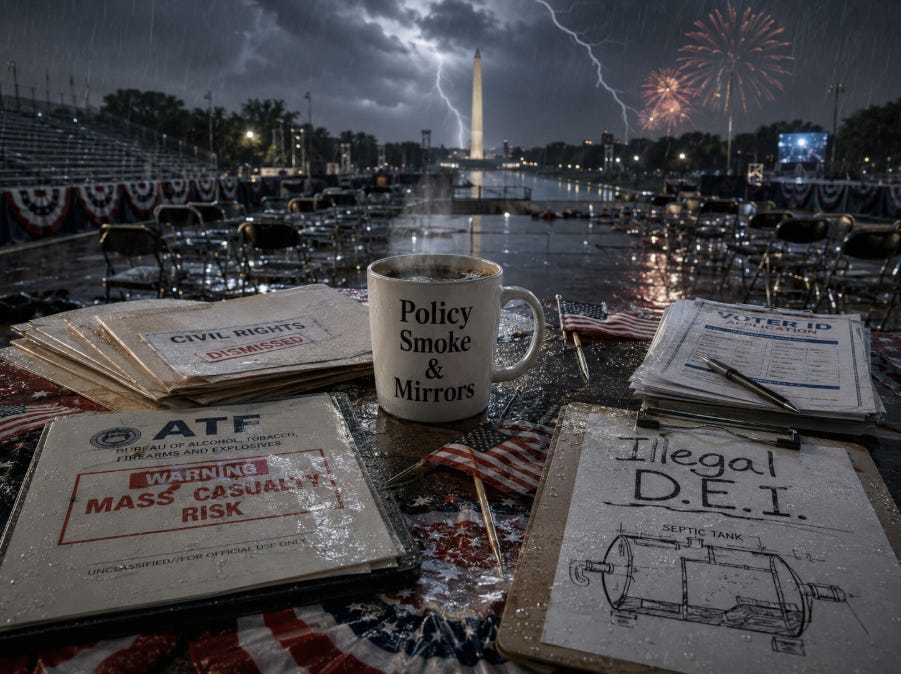
The rest of the country was not exactly having a tidy civic pageant either. Extreme heat disrupted celebrations up and down the East Coast. Some Western communities canceled fireworks over wildfire risk. In New York, the Brooklyn Bridge briefly caught fire during the Macy’s fireworks display, because apparently the national birthday required at least one major landmark to participate in the metaphor.
Alas, the weather did not hold. Trump eventually took the stage after 11 p.m., because the one thing more persistent than lightning is a man with a microphone and an unresolved grievance. He opened by thanking the people who had returned after the evacuation, then immediately began litigating the crowd size with the clouds. He claimed there had been 375,000 people before the storm and 150,000 afterward, which is a very Trump-shaped pair of numbers: large, round, emotionally convenient, and unsupported by the observable universe.
The New York Times described the post-evacuation audience as a “scattered crowd.” The bleachers had been “far from full” even before the storm, and after the forced evacuation, the crowd had thinned further. More than half the seats in the special guest section at the front of the stage were empty, though loyalists clumped near the aisles and close to the stage, standing on chairs and recording him with their phones. By fireworks time, the Mall was packed with “thousands,” which is a perfectly respectable crowd unless one has already claimed numbers requiring a small inland nation.
So began America’s 250th birthday: with the president congratulating himself for outlasting the weather and then nestling that ordeal into the general vicinity of Valley Forge, Yorktown, and Normandy. Lightning had made things “a little more inconvenient,” he said, but also “bigger” and somehow “more beautiful.” From there, it was a short march to “victory or death,” “live free or die,” and the sacrifices of the patriots who actually risked their lives for independence. The man had been delayed by a thunderstorm and was already auditioning for a monument.
The speech itself was supposed to be a grand patriotic pageant. It had all the required props: historic flags, veterans, Medal of Honor recipients, Gold Star families, the Declaration, the Constitution, the Wright brothers, the moon, God, the military, and enough red-white-and-blue bunting to upholster a midsize dictatorship. At its strongest, the event belonged to the veterans and families Trump brought onstage. They deserved the gratitude and the applause. They deserved a president capable of letting their sacrifice stand without turning every moment into another mirror.
But Trump is Trump, and the mirror always wins.
What began as a tribute to American history kept sliding into a campaign rally with museum pieces. He praised the founders, then detoured into his own legal grievances. He talked about equal justice under law and then immediately added that he had not been treated very well, adding, “we won’t get into that,” having already gotten into it. He praised the Second Amendment, boasted that he had guarded it “very, very powerfully,” and informed the country that it had the right to keep and bear arms at precisely the moment his administration is moving to scrap more than three dozen firearms regulations, after already ending the A.T.F.’s zero-tolerance policy for gun dealers who repeatedly broke the law. That policy had led to more than 600 license revocations from dealers who falsified records, skipped background checks, or otherwise sold guns to people prohibited from owning them. And in the administration’s own analyses, some of the proposed rollbacks carried public-safety risks ranging “up to and including potential mass casualty events.” In the patriotic pageant, the Second Amendment was sacred. In the machinery underneath, the regulators were describing the consequences and being told to stand down.
He warned repeatedly about communism, not as history but as accusation, a menace, he said, that had reared “its ugly head right back here in America,” and that “we’re not going to let it happen.” Then came the diagnosis: “It’s like a cancer. You got to cut it out. You got to cut it out fast.” This was not a solemn Cold War remembrance. This was a red-scare smoke machine rolled into the middle of a birthday party. The Declaration of Independence had barely finished blowing out its candles before it was drafted into a midterm campaign ad.
Then came the voting section. No national celebration is complete until the president uses it to demand fewer ways for people to vote. Trump called for the SAVE America Act, voter ID, proof of citizenship, and an end to mail ballots except in narrow circumstances. “You won’t have cheating on the elections anymore,” he promised. Nothing says “we hold these truths to be self-evident” quite like using the semiquincentennial to complain about absentee voting.
He also worked in the “third term” joke, saying he had rebuilt the military in his first term and used it in his “actually I should say third term, but I won’t do that because I don’t want any controversy.” Near the stage, the loyalists had been cheering and applauding almost every line. That is the permission structure for jokes like this. Authoritarian movements test the room with a wink before they write the memo. Trump winked. The room did not object.
The military-history portion became its own Trumpian smoothie of fact, myth, boasting, and campaign narration. He invoked Yorktown, Saratoga, the Civil War, Pearl Harbor, D-Day, Iwo Jima, Korea, Vietnam, the Cold War, the Panama Canal, the frontier, the Brooklyn Bridge, the moon, Mars, Space Force, Venezuela, and Iran. At one point he claimed the United States had recently sunk “the entire Iranian Navy, 159 ships to the bottom of the sea,” “all done in just a moment’s time.” The country turned 250, and somehow the birthday speech found room for a maritime action movie.
Across the pond, DW News looked at the whole soaked and overheated spectacle and understood the assignment better than the people who planned it. Their segment opened with the obvious metaphor: America marking 250 years of independence, divided, overheated, storm-delayed, heavily secured, and already deep into its next political fight.
Political analyst Scott Lucas, joining from University College Dublin, drew the useful contrast. Ordinary Americans interviewed by DW were still trying to talk about community, even when they admitted the country is badly divided. Trump, by contrast, used the celebration to make himself the center of the nation. In Lucas’s words, the festivities had been about Trump’s ego and his belief that he is not merely president of America, but somehow America itself.
That is the core of it. The people were trying to celebrate a country. Trump was trying to brand the country as an extension of himself.
Lucas also made the bicentennial comparison, and it cuts. In 1976, America was hardly floating through a golden age. The country was coming out of Vietnam and Watergate, dealing with stagflation and deep social conflict. It was not a cheerful moment. But Gerald Ford still tried to speak to a shared country. Fifty years later, Trump marked the national anniversary by dividing Americans into patriots and contaminants.
This is the difference between a damaged republic and a deliberately damaged republic.
The stagecraft was unity. The message was obedience.
And while the flags waved and the fireworks waited, the government underneath the spectacle was telling the truer story.
The New York Times reports that federal agencies across the government are abandoning discrimination cases at Trump’s direction, especially cases based on “disparate impact,” the legal theory that allows the government to challenge policies that may look neutral on paper but disproportionately harm protected groups in practice. This is not some obscure academic footnote. It is one of the tools civil-rights enforcement uses when discrimination has learned not to announce itself.
Disparate impact is why civil-rights law can reach beyond the smoking gun. Jim Crow literacy tests did not say “Black people cannot vote.” On paper, they looked like neutral rules: questions asked, forms completed, tests administered. In practice, they operated in a society where Black Americans had been systematically denied education, and the effect was discriminatory. Disparate impact is the legal recognition that discrimination does not need to wear a hood or leave a signed confession.
The Times story begins with Kenni Miller, a Black man in Pennsylvania who was fired from a Sheetz convenience store after a background check surfaced a nonviolent felony drug conviction from his teenage years. Miller had been doing the job. He was trusted with customers and the cash register. He felt valued. Then he was gone.
The E.E.O.C. sued Sheetz in 2024, alleging that the company’s background-check policy disproportionately screened out applicants of color. The agency found that the process denied employment to 14.5 percent of Black applicants, 13 percent of Native American applicants, and 13.5 percent of multiracial applicants, compared with less than 8 percent of white applicants.
Then Trump returned to office, issued an order telling agencies to deprioritize disparate-impact cases, and the E.E.O.C. dropped the lawsuit.
This is what the anti-D.E.I. crusade means in practice. On the Mall, Trump praised freedom, equality, the Constitution, the flag, and the immortal patriots of 1776. In the machinery of government, his administration is telling agencies to stop investigating discrimination unless someone is careless enough to leave behind a smoking gun. It is civil-rights enforcement rewritten for the benefit of people who know how to discriminate with a spreadsheet.
Then there is the Alabama septic-tank detail, which says everything. Trump’s Justice Department scrapped an environmental-justice settlement that would have provided septic tanks to Black residents in Alabama and called it “illegal D.E.I.”
Functioning sewage. That is what the administration decided had gone too far.
Not a controversial hiring seminar, or an elite university admissions policy, or a corporate diversity memo. Septic tanks. Basic sanitation. Human beings needing waste safely removed from their homes. A community’s public-health remedy became suspect because the people being helped were Black.
You do not need to embroider that sentence. You put it down and step back.
The same pattern appears in gun policy.
The Trump administration is rolling back more than three dozen firearms regulations, scrapping Biden-era efforts to crack down on illegal sales, loosening oversight of private weapons transactions, restoring gun rights to some people previously restricted because of mental illness or inability to manage their finances, and ending added scrutiny of stabilizing braces, the accessories that can make weapons more concealable and more lethal. It is “law and order” when the gun lobby writes the footnotes.
The administration has already ended the A.T.F.’s zero-tolerance policy for gun dealers who repeatedly broke the law. That policy allowed inspectors to revoke licenses from dealers who falsified records, skipped background checks, or sold guns to people legally barred from owning them. More than 600 licenses were revoked under the Biden-era policy before Trump’s team decided the real victim was the paperwork.
The most damning details come not from gun-safety advocates, not from Democrats, not from grieving parents, not from anyone the administration can dismiss as hysterical. They come from the A.T.F.’s own cost-benefit documents.
On loosening the mental-illness prohibition, the agency’s own cost analysis said the public-safety risk could range from minimal to considerably greater, “up to and including potential mass-casualty events.” On rolling back scrutiny of stabilizing braces, the agency acknowledged that the accessory’s use to create dangerous, easily concealed weapons would pose an increased public-safety problem. On raising the bar to revoke dealer licenses, the agency said it expected revocations to drop considerably.
The agency proposed the rules, and in the same documents explaining the rules, described the bodies.
The governing reality lies beneath the patriotic performance. The president stands in front of historic flags and praises liberty. His administration weakens civil-rights enforcement. He boasts about guarding the Second Amendment. His agencies loosen gun rules while acknowledging the risk of mass-casualty events. He praises equal justice under law. His Justice Department calls septic tanks for Black residents “illegal D.E.I.”
This is not to say America has no ideals worth celebrating. The Declaration, the Constitution, the promise of equal protection, and the sacrifices of veterans and Gold Star families matter. The hard, unfinished work of building a multiracial democracy matters. The fact that ordinary people still gathered in brutal heat and bad weather to celebrate community means the country is more than the man trying to stand in front of it.
Patriotism is not measured by how many flags you can fit on a stage, nor proven by fireworks volume, crowd-size inflation, red-scare warnings, or a president describing himself as the indispensable vessel of the nation. Patriotism is what the government does when the cameras turn away. Can Black workers challenge hiring rules that screen them out? Do Black residents in Alabama get functioning sewage? Do gun dealers who break the law lose their licenses? Does public safety matter more than industry applause? Are voting rights expanded or narrowed? Does “equal justice under law” survive contact with policy?
America turned 250 last night under lightning, heat, smoke, and spectacle.
The fireworks were red, white, and blue.
The policy was all smoke.
Since the felon does not joke (pretty sure he doesn’t understand how to), if he mentioned a third term, he is seriously considering it. That is assuming he actually lives that long, which is looking increasingly unlikely.
Demonizing all opposition as a “communist threat” is not only McCarthy-era but also straight out of Hitler’s playbook.
The word “coup” comes to mind; behind the curtain, MAGA wizards of evil continue their work to dismantle the constitutional republic.
These are not “Republicans” by any stretch. Opponents need to strip away the pretense MAGA is a “conservative” movement and hammer home MAGA seeks legitimacy by claiming the “Republican” brand while betraying every Reagan-Bush principle other than excusing the wealthy from paying taxes.