

Good morning! Welcome to another edition of the world is on fire and Donald Trump is still bragging like he just cut a ribbon at a mall food court.
In the past few hours, the Middle East lurched from horrific to economically catastrophic. Oil surged back above $100 a barrel as tanker attacks, terminal shutdowns, and the choking of the Strait of Hormuz turned what the administration keeps trying to sell as a clean show of force into exactly what critics warned it would become: a regional war with global consequences. Iraq shut oil terminals after tanker strikes near Basra. Oman closed a key export terminal for security reasons. Gulf infrastructure is under direct threat. European gas prices are jumping. Airlines are hiking fuel surcharges. Governments are already scrambling to shield consumers.
The latest escalation is especially grim. Mojtaba Khamenei, the newly installed son-successor to the regime his father built and bled for decades, has now reportedly called for the Strait of Hormuz to “remain closed.” Neither subtle, nor calibrated, that is the kind of statement that tells markets, militaries, and governments alike that this is no longer just a war of airstrikes and rhetoric. It is now a fight over the artery that carries a huge chunk of the world’s oil. The Trump administration, naturally, has answered this moment of tightening crisis with the strategic coherence of a drunk man trying to assemble IKEA furniture with a hammer. Trump talks as if victory is already here, while his own energy secretary admits the U.S. is “not ready” to escort ships through Hormuz.
Logistics matter, because the actual story of this war has become painfully clear: Trump and his people keep trying to narrate dominance while reality keeps narrating destabilization. The US president claims Iran has no navy, no air force, no defenses, no future, and maybe by lunchtime no furniture. He says they’ve been hit harder than almost any country in history. He boasts, he improvises, he free-associates through military destruction, Spanish trade retaliation, and a miraculous Texas refinery like a man speedrunning Fox News segments in his own skull. But every time he opens his mouth, the world gets another reminder that this operation still has no credible political endgame, no clear theory of victory, and no serious answer to the question David Petraeus famously said must come first: how does this end?
Right now, it does not look like it ends with regime collapse. The Iranian people are not rising up in the streets, because people under bombardment and repression don’t find that an ideal time to organize a neat liberal democratic transition. The IRGC still has its claws in the country. The old supreme leader is dead, and all that seems to have produced is a harder, angrier replacement who enters the stage drenched in vengeance and maximalism. So the fantasy that bombing would trigger some organic revolution now looks exactly like what it always was: a lazy fever dream from people who think real countries operate like the final act of an action movie.
The economic aftershocks are already arriving. Gas prices are rising, inflation risks are growing, financial markets are twitching, and bond yields are moving. The rulers of the Gulf, who spent years trying to sell the world on a gleaming post-oil future of tourism, finance, sportswashing, and expat luxury, are now watching that whole model get menaced by missiles, drones, and the sinking feeling that hosting American bases may no longer bring enough protection to justify the risk. That is one of the most underappreciated parts of this crisis. Iran is not just firing back militarily. It is trying to break the business model of the Gulf. It is trying to make safety look like a lie. Whether or not that works in the long run, in the short run it is already forcing exactly the conversation these states never wanted to have.
This is where Rory Stewart’s comments from across the pond land with such force. Stewart, a former British Conservative cabinet minister, diplomat, soldier, and one of the sharper foreign-policy voices in the UK, made the point with unusual clarity: Trump has shattered the old assumption that America, however hypocritical and self-interested, was at least broadly consultative, predictable, and capable of reciprocal alliance behavior. Stewart’s argument is that under Trump, the alliance system has been reduced to a protection racket. You can flatter him, indulge him, enrich him, buy from him, invest in him, even hand him symbolic gifts with all the dignity of a vassal approaching a medieval court, and he will still turn on you the second it suits him, because Trump does not understand alliances as mutual obligations. He understands them as opportunities for extraction. Stewart went even further, saying Britain and Europe cannot continue in a relationship like that because once you accept permanent dependency on a bully, you get abused forever. Hard to improve on that, honestly. It is one of the cleanest summaries yet of what Trumpism has done to the postwar order: take something already compromised and strip even the pretense of principle out of it.
Pete Hegseth, of course, has been doing his part to market this whole catastrophe/kakistrophe like a monster truck rally sponsored by testosterone supplements and Bible verse merch. Both the BBC and the New York Times had excellent pieces on his style and rhetoric, and together they paint a picture of a man who has mistaken vengeful performance for strategic clarity. Hegseth is not acting like a defense secretary in any traditional sense. He is acting like a war hype man, a cable-ready avatar of American bloodlust, all swagger and certainty and “warrior ethos,” with none of the humility or moral seriousness you’d hope to hear from someone charged with sending people to kill and die. The really chilling part of the Times analysis is the argument that Hegseth seems to have come away from Iraq not simply skeptical of nation-building, which would be understandable, but actively contemptuous of moral purpose itself. In his world, talk of justice, restraint, legality, democracy, civilian protection, or ethical duty is not just naïve, but weakness. The only thing that matters is punitive force. Kill faster. Hit harder. Stop apologizing. Maximum lethality, not “tepid legality,” as he has effectively put it. In other words, he has taken one of the oldest and dumbest lessons militarists learn from failed wars, that if only we had been crueler, we would have won, and turned it into doctrine.
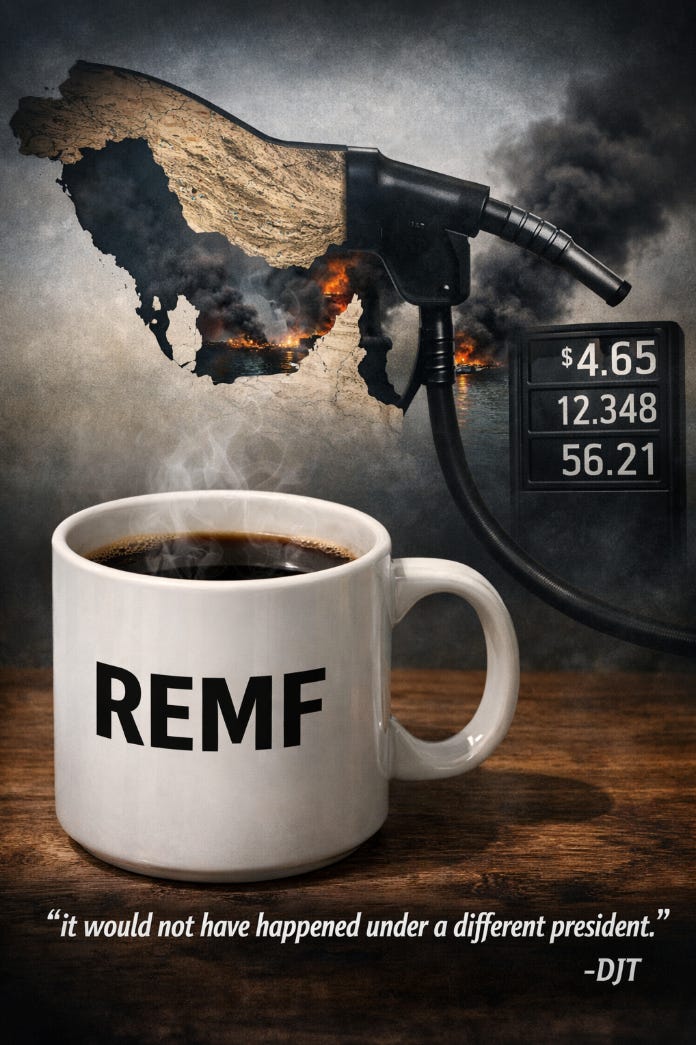
In military slang, that is REMF (rear echelon mother f——-) behavior to the bone. Rear-echelon swagger with front-line rhetoric. All chest-thumping from a safe distance while someone else does the bleeding. Hegseth sells battlefield glory from a podium, through a camera, wrapped in the kind of macho branding that always seems to thrive furthest from the actual dismemberment zone. He is exactly the kind of guy who sounds most certain about violence when other people’s children are the ones absorbing it.
Speaking of REMFs, Trump has now apparently decided that while oil spikes, shipping seizes up, and the global economy flirts with another inflationary shock, this would also be a perfect time to light a fresh fire under his trade wars. The administration announced a new round of tariff-related investigations into major trading partners including the European Union, Mexico, China, Japan, India, Taiwan, South Korea, Vietnam and more, because apparently the best way to respond to one self-created crisis is to shove a second one into the machinery while the gears are already smoking.
The Switzerland anecdote alone should be stapled to this presidency forever. Trump reportedly bragged that he had slapped a high tariff on Switzerland partly because its leader “rubbed me the wrong way.” Not because of coherent industrial policy, or some great strategic doctrine. Because he got annoyed on the phone. Instead of economic nationalism, we get grievance management by mob boss. The man is running trade policy like he’s punishing a waiter for bringing the wrong dressing.
That same pattern shows up in domestic politics too, where Trump is now demanding passage of the so-called Save America Act and throwing a tantrum at Senate Republicans who can’t or won’t twist the rules enough to ram it through. John Thune keeps pointing out that the votes simply are not there. Trump’s answer is essentially: be more magical. Get them anyway. This is not really about legislative craftsmanship or concern for electoral integrity. It is about fear. He looks like a man who knows the midterms could become a referendum on chaos, inflation, war, and incompetence, and who is desperately trying to change the subject before voters get their say. The act itself is a sprawling voter-suppression fantasy package built around proof-of-citizenship requirements, tighter voting restrictions, federal intrusion into voter rolls, and the usual lies about mass fraud. But the emotional core of it is panic. Trump is not trying to protect democracy, he is trying to protect himself.
The SAVE America Act is not a normal legislative priority. It is bunker construction, panic poured into bill form. A man who thinks the walls are closing in does not just try to pass policy. He tries to narrow the electorate.
Now, because this administration cannot encounter a real thing without inflating it into a carnival attraction, let’s talk about Brownsville. Trump has been bragging about the new refinery project in Texas like he personally willed it into existence, calling it “the greatest anywhere in the world” and declaring, “There’s never been anything like it.” In the same gush of self-congratulation, he treated it as proof that under him America has gone from “a dead country” to “the hottest country in the world.” The actual story is much less operatic. As energy analyst Matt Randolph pointed out, and as current reporting backs up, this is not a $300 billion refinery. It is a roughly $3 to $4 billion project, mid-sized by industry standards, and one that was already in motion before Trump started using it as a prop. Site prep and pre-construction work were already underway in 2024. The project has been discussed for years. It is designed to process light shale crude, not some magic all-conquering stream of anything America can pump. It may be a useful refinery, and in some ways a cleaner and more modern one than older facilities, but the way Trump talks about it is pure inflatable nonsense. He took a real project and stuffed it with so much helium it floated off into another dimension.
That matters because the Brownsville refinery story is a perfect miniature of the whole presidency. There is often a real thing somewhere in the background. Then Trump lumbers over, throws gold spray paint on it, inflates the numbers by two zeroes and one ego trip, claims sole authorship, and starts barking at reporters as though applause is an infrastructure plan. Asked about the refinery, he didn’t offer specifics so much as a campaign-rally incantation: “It’s great that it’s going up in Texas,” “this will be like nothing else ever built,” and, of course, “it would not have happened under a different president.” The refinery is not nothing, but it is not the world-historic monument he is pretending it is. It is just another example of Trump finding a genuine development and converting it into a personal theme park attraction.
So where does all of this leave us this morning? With a war widening faster than the White House can explain it, oil climbing, shipping imperiled, allies rattled, consumers set up for pain, and a president who still sounds like he’s pitching steaks in the middle of an evacuation. The surrounding people are no better. Hegseth is romanticizing vengeance. The tariff crew is threatening to torch supply chains while energy markets convulse. Congressional Republicans are being ordered to pass voting restrictions like hostages reading lines into a camera. Europe is finally starting to say out loud what many have suspected for years: that Trump is not an ally in any meaningful reciprocal sense, but a predator operating inside an alliance system he neither understands nor respects.
The story of this moment is not that Trump is in control. It is that he is once again confusing domination theater with actual statecraft, and the bill is arriving everywhere at once: at the pump, in shipping lanes, in allied capitals, in bond markets, in Gulf hotels, in Senate offices, and eventually, very likely, at the ballot box.
So pour the coffee, keep the receipts, and maybe check whether your nearest world leader has started using the phrase “short-term pain for long-term gain,” because that’s usually how you know the people in charge are about to make you pay for their stupidity.
The pain that this one man is inflicting upon the world makes Genghis Khan look like a mean town councilman. And yet, he continues as a he fails. I've often heard that the dragon does more damage with its tail when it's dying. It's what I fear most.
Oh, Mary, that last paragraph is coming way too late. We have already been bulldozed by this man and we have sat here for now 14-15 months waiting waiting waiting for the midterms as the horror has unfolded, his criminal minions kill indiscriminately and our beautiful country has become a dangerous place to live for anybody not white and male. We have become a mockery of the world. Boy what a huge case of schadenfreude our neighbors and allies, not to mention our enemies, are having.
I marvel at your scope of research and your wide open eyes at the world. You are a national treasure. I appreciate you. Good vibes.