

Good morning. Eight points. That is all that currently separates Donald Trump from Richard Nixon at the end of Watergate. Trump’s approval rating has fallen to 32 percent in the latest Quinnipiac poll. Nixon’s final Gallup rating before resigning the presidency was 24 percent. Different pollsters and different samples make this an imperfect scientific comparison, but as a measure of political altitude, the message is difficult to miss: Trump is eight points above the approval rating of a president preparing to climb into a helicopter and leave the White House for good.
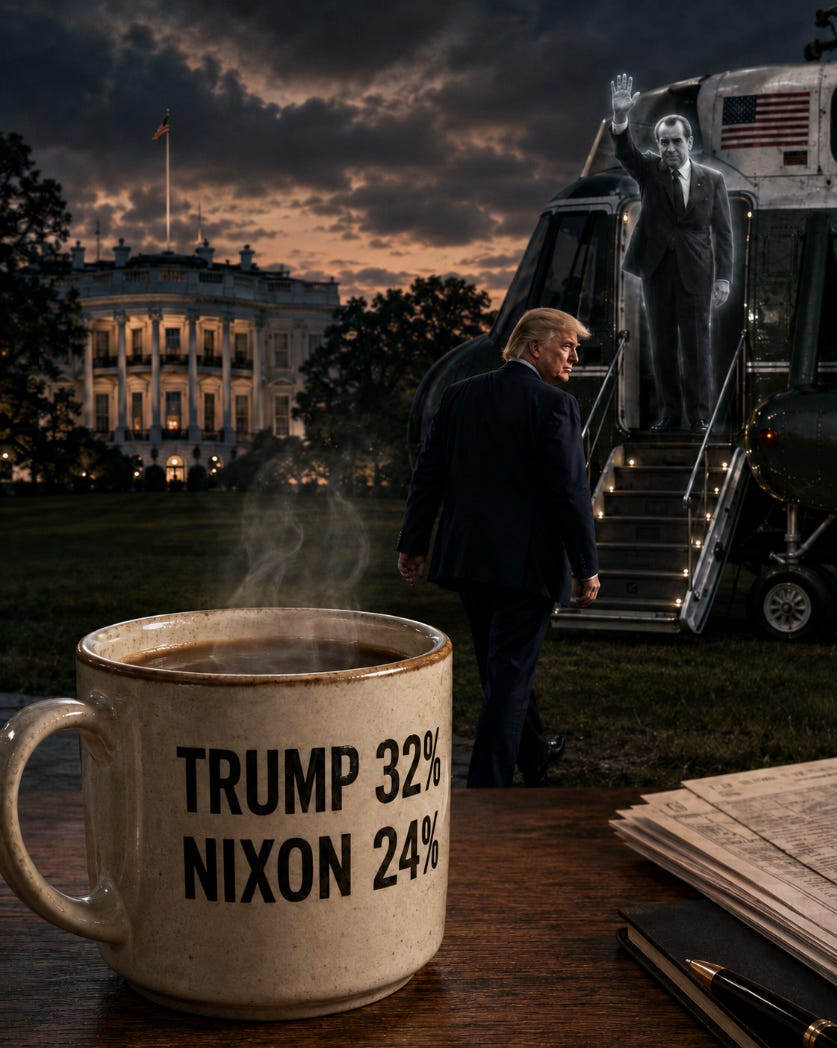
Nixon needed the Watergate burglary, the White House plumbers, the Saturday Night Massacre, the smoking-gun tape and the impending certainty of impeachment to reach 24 percent.
Trump has managed to come within eight points while insisting everything is going magnificently.
He is now less popular than he was after January 6. Quinnipiac has him at the lowest approval rating it has recorded in either of his terms. AP-NORC finds only about one-third of Americans approving. Nate Silver’s polling average places his net approval below the floor he reached after the attack on the Capitol.
Trump is about to embark on a West Coast tour to sell Americans on his economic agenda. This is an ambitious undertaking, rather like Richard Nixon launching a national lecture series on records management.
The White House would prefer the trip to be understood as an economic victory lap. Americans will have several opportunities to contemplate that victory while standing beneath six-foot signs advertising gasoline at more than four dollars a gallon. The trouble with running on the economy is that voters participate in one every day.
Every trip to the gas station supplies a price check. Utility bills arrive without White House talking points attached. Grocery aisles offer their own running referendum as packages shrink and shelf prices rise.
No presidential presentation is required to tell Americans whether they are better off than they were a year ago.
The receipts have already voted, and right now, they are voting no.
Five months after Trump promised a four-to-five-week war, at least 18 American service members are dead and more than 480 have been wounded, according to the Pentagon’s own casualty tracking system — a figure independent tallies put even higher, closer to 520. Gasoline is averaging about $4.10 a gallon.
The White House insists the pain is temporary, and victory remains just around the corner. American households are already paying the war tax in fuel, groceries, travel and nearly everything else that moves by truck.
Trump, having started the war producing the price increases, has now turned his attention to yelling at oil companies for enjoying the profits.
On Monday, he boasted that Chevron and Exxon had prospered under his policies, then demanded that they lower consumer prices immediately because they were making too much money. The president has apparently discovered that corporations seek profit, a development that must have come as a terrible shock after a lifetime spent running businesses, licensing his name and explaining capitalism to everyone else. Trump is screaming at the dashboard because the warning light refuses to flatter him.
The oil companies did not launch the Iran war, close the Strait of Hormuz or promise the conflict would end before spring properly settled in. They simply found themselves beneath the money spigot Trump opened and, being oil companies, brought buckets.
Iran has introduced a significant scheduling problem into Trump’s domestic agenda: it declines to behave according to his political calendar.
Iran knows Trump needs the war over before the midterms. Every additional week of uncertainty keeps gasoline expensive, Republicans trapped, and the president’s approval ratings falling through floors pollsters did not realize they would need to reinforce.
Iran does not have to defeat the United States militarily. It merely has to deny Trump the clean victory photograph he requires.
Perhaps that explains the latest round of miraculous deals. Trump said Monday that negotiations with Tehran had resumed and claimed the first phase of an agreement would reopen the Strait of Hormuz “literally by tomorrow.” Iran said it was not negotiating with the United States and was instead talking with Oman about arrangements for the waterway.
On Tuesday morning, Treasury Secretary Scott Bessent appeared on CNBC and announced that Washington and Tehran might reach a deal “today or tomorrow.” Brent crude promptly fell as much as four percent before recovering part of the decline. Broader markets rallied on the possibility that the world’s most important energy chokepoint might soon reopen.
Perhaps a deal really is imminent. Indirect negotiations may be occurring that Iran prefers not to acknowledge. Governments often use intermediaries and deny discussions until an agreement is sufficiently mature to survive daylight. But this administration has now established a recognizable cycle.
Trump threatens escalation. Oil rises. Trump announces peace. Oil falls. Iran denies the announcement or adds qualifications. The peace dissolves. Trump issues another threat. Somewhere between the missile launch and the next Sunday talk show, another magnificent deal appears just in time for the opening bell. Trump and Bessent can manufacture a tradeable headline. So far, they have not manufactured peace.
A market-moving statement is not evidence by itself of insider trading or commodities manipulation. But the sequence demands questions that Congress and regulators should already be asking: Who knew what Bessent planned to say before he went on CNBC? Who knew what Trump planned to announce before he spoke? What positions were opened in oil futures, energy companies, airlines, shipping firms, and related options before those statements became public?
One important question is who was positioned for the market reaction?
We are not the only people who have noticed the schedule. On the Andrew Neil Report in Britain, a listener observed that Trump repeatedly talks up a deal over the weekend, ensuring favorable headlines when markets open on Monday, and suggested that he then exploits the movement. Andrew Neil did not dismiss the proposition as fevered anti-Trump paranoia. He said the listener was “absolutely right,” described elements of the Trump administration as resembling kleptocracy and said he believed markets were being manipulated.
Neil noted that Trump always seems to have one eye on the headlines awaiting Wall Street at Monday’s opening. Again, that is not proof of a prosecutable scheme. It is recognition that Trump understands timing and that the timing has become too consistent to ignore.
He observed that analyzing Trump’s declarations has become almost pointless because they are either meaningless when issued or reversed within 24 hours. The presenters said they had considered leading their program with Trump’s latest announcement but decided against it because he had said the same thing so many times before. Neil recalled that, throughout his lifetime, statements from American presidents were taken seriously by allies and adversaries because they mattered. Now, he said, one might as well listen to the shipping forecast.
There is the strange new condition of American power under Trump: credibility without belief.
Diplomats do not trust what he says. Journalists increasingly hesitate to treat his declarations as news. Allies cannot build durable policy around promises that may expire before lunch.
Markets do, however, still have to react.
A trader cannot simply ignore the president of the United States announcing that the Strait of Hormuz will reopen tomorrow, even when the president has previously announced enough imaginary endings to qualify for a season-ticket package. Billions of dollars move because the statement might be true, not because anyone considers the speaker reliable.
That is an extraordinarily profitable environment for anyone who knows the next line before the rest of the audience hears it.
While the war raises the price of energy, Trump’s trade policy is working diligently to raise the price of nearly everything energy is used to manufacture, transport, or sell.
After the Supreme Court struck down Trump’s “Liberation Day” tariffs imposed under emergency powers, the administration reached for Section 122 of the Trade Act and installed a temporary worldwide tariff. The Court of International Trade struck that attempt down as well, though the ruling remains tied up on appeal.
A normal administration might interpret two adverse court rulings as evidence that Congress did not give the president unlimited authority to tax every imported object that displeases him. The Trump administration interpreted them as a scavenger hunt.
Having lost one statutory disguise and placed another under judicial review, Trump has now returned wearing a third. The administration imposed tariffs ranging from 10 to 12.5 percent on goods from 59 countries and the European Union under Section 301 of the Trade Act of 1974.
This time, Trump says he is fighting forced labor.
Fighting forced labor is a worthy objective, which makes it unfortunate that the policy looks exactly like his previous universal tariff with a humanitarian sticker placed over the price tag. The affected countries and the European Union account for 99.4 percent of all U.S. imports. A forced-labor investigation so exquisitely targeted that it covers nearly everything America buys from nearly everywhere resembles a net dropped over the planet.
The administration’s defense is that Section 301 is a well-established and legally durable tool. That is more persuasive than the claim that a 1977 emergency-powers law secretly gave presidents unlimited tariff authority that nobody noticed for nearly half a century.
The existence of a legitimate tool does not make every use of it legitimate. The states argue that the administration decided to continue Trump’s tariffs first and then rushed backward through the investigative process to produce a forced-labor rationale. They say the tariffs do not satisfy Section 301’s requirements and bear no meaningful relationship to the individual conduct supposedly being punished. Their evidence: USTR cited frozen beef from Brazil as one of three examples of goods tied to forced labor, then exempted that product from the tariffs anyway.
The debate now is whether Trump followed the statute or treated its procedural safeguards as decorative molding.
On Monday, 25 states, including Oregon, filed suit in the U.S. Court of International Trade, asking the court to halt the new tariffs, declare them unlawful and order refunds of duties already paid. A separate lawsuit has been filed on behalf of two small businesses that say Trump once again exceeded his executive authority.
Oregon Attorney General Dan Rayfield had already opposed the Section 301 plan in July, arguing that every time Trump loses in court he finds another way to place the cost on families and small businesses. Oregon has now joined the coalition asking the court to stop the latest version.
That gives Trump’s western economic tour a pleasing bit of local context. As he travels toward the Pacific to explain how his policies are helping, one of the states awaiting him is in federal court trying to protect its residents from those policies.
Trump’s war raises the cost of fuel. His tariffs raise the cost of imports. The higher fuel costs raise the cost of transporting the tariffed imports. Trump then blames oil companies, foreign countries, retailers, Federal Reserve officials, Democratic governors, and probably the concept of arithmetic itself. The only participant never assigned responsibility is the man signing the orders.
The numbers are not mysterious. Trump is failing on precisely the promises he expected to carry him through the midterms.
He was going to be the peace president. Instead, he launched a war without congressional authorization and cannot explain how it ends.
He was going to be the prosperity president. Instead, the war is raising fuel prices while his tariffs raise the cost of nearly everything else.
He was going to be the master negotiator. Instead, Iran disputes the negotiations he announces, allies plead with him not to escalate, and every claimed breakthrough arrives with the life expectancy of a fruit fly.
He was going to rebuild American manufacturing. Instead, 25 states and two small businesses are suing to stop what they describe as another unlawful tax on American consumers.
Trump calls the polls fake, but the polls are merely recording the distance between the presidency he advertised and the one Americans are paying for.
Trump built his political career around the belief that reality could be managed through repetition. Announce the deal. Rename the tax. Blame the company. Dismiss the poll. Declare victory. Reverse course. Begin again.
Eventually consequences acquire mass. Gas prices, casualty lists, tariff invoices, grocery receipts, legal complaints, and polling averages exist outside the television frame and continue accumulating after the chyron disappears.
Trump can push oil prices down for an afternoon with another promise of peace. He cannot make Iran sign the peace he needs.
He can move his tariffs beneath another statutory shell. He cannot guarantee the courts stop looking under the cups.
He can call every unfavorable poll fake. He cannot stop Americans from answering the questions.
The show is still running. The audience is leaving.
Another on-the-money analysis--and thank-you... At this point I'm reading your pieces that way I might fight a disease by using a weekly injection or a daily pill...
Two comments:
I'm guessing that you quote polls and supply real facts for us (and maybe yourself) to bolster our understanding of the fact--and to have some hope that things will, eventually, change for the better. ...But I'm know you don't imagine that Trump will resign because he realizes his situation is clearly hopeless or it dawns on him that he has done something wrong... He is way past "realizing" anything and obviously, has never been burdened by anything resembling shame...
Also, you make a solid case here--one we might hear from from the lead prosecutor at an impeachment proceeding or in a Federal court... All points adhering to the letter and spirit of the law; all points proving without a doubt Trump's blatant violation of the Constitution, The Ten Commandments and the Boy Scout's Oath...
Trump will never leave The White House the way Nixon did... No human law, constitutional principle or standard part of human nature will cause him to reflect, think, or consider leaving. We have to hope that some higher principle will eventually apply here or that the will of the people might be expressed in some way none of us can currently imagine...
Amazing that he would think he was welcome in the West. The West is on fire and he is holding back FEMA funds from blue states. Thank you for another excellent piece.