


The first time, you could squint and call it a hiccup, the kind of bureaucratic pratfall that happens when two federal agencies share a border, a budget, and the unshakable conviction that the other one is the problem. The second time, you have to start using words like “pattern,” “system,” and “how is this still happening,” because now we are not watching an isolated mishap so much as a slapstick routine where the banana peel is federal airspace and the performer keeps insisting the peel was planted by the Deep State.
Welcome to the Trump administration’s sequel, in which the government somehow manages to stumble into another airspace mess and, according to lawmakers, ends the episode by knocking one of its own Customs and Border Protection drones out of the sky, using a military counter drone system that sounds like it was pitched by a defense contractor at a Comic Con panel. I find myself picturing President Trump, in a meeting somewhere, with his pinky at the side of his mouth shouting “I want drones with laser beams attached to their heads!”
If you are thinking, “Surely they would not do it twice,” please understand that “twice” is the number you say right before it becomes a franchise, complete with merchandise, spin offs, and a grimly upbeat talking point about how this is actually evidence of strength. The first incident was already a little too on the nose for a country that has been forced to learn the phrase “interagency coordination” the way you learn a new curse word, which is to say, only after you hear it screamed in public.
You have a border region, you have aircraft and drones, you have the FAA, you have CBP, you have the Pentagon, and you have a White House that has treated competence like an optional accessory, so what could possibly go wrong besides the airspace itself temporarily turning into a bureaucratic escape room.
In the version that floated into public view, there was an earlier mix up involving counter drone measures and airspace restrictions, the sort of situation where the only reassuring thing you can say is that commercial flights were not affected, which is a bit like praising a kitchen fire for not spreading to the neighbor’s house. Then, because America is nothing if not committed to a theme, the second act arrives with the force of a punchline that refuses to stop. A CBP drone goes up to do whatever modern border surveillance drones do, which is to say, hover in the great liminal space between “security” and “we have decided that the future should feel like a dystopian screensaver.”
Somewhere in the same sky, the U.S. military is operating counter drone technology, which in a normal functioning government might come with a shared set of protocols, crisp communication channels, and a mutual agreement on what counts as a threat. In our current arrangement, it comes with the kind of chaos you get when everyone is talking on a different group chat, nobody is reading the pinned messages, and the admin is busy performing its favorite trick, which is loudly claiming it has total control while demonstrating the opposite in real time.
At this point, the story becomes less “border security” and more “federal improv troupe,” because according to lawmakers, the military uses a directed energy system to take down the CBP drone, meaning the government shot down the government’s drone, in the same way a person might accidentally lock themselves out of their own car while holding the keys and maintaining eye contact with the universe. The agencies, meanwhile, offered the kind of phrasing that makes a friendly-fire mishap sound like a routine act of competence: The Pentagon, Federal Aviation Administration (FAA) and Customs and Border Protection issued a statement saying the military used a “counter-unmanned aircraft system … to mitigate a seemingly threatening unmanned aerial system operating within military airspace.” You can almost hear the conversation afterward, because every administrative fiasco has its own little script.
One person says this is unprecedented, another person says it is complicated, a third person says it is classified, and then someone else says it is actually a win because it proves we can stop drones, which is a thrilling argument if you happen to be the drone’s enemy and an even more thrilling argument if you happen to be the drone’s invoice.
Because yes, the drone is almost certainly expensive, not because anyone has released a price tag in neon lights, but because the United States does not really do “cheap” when it comes to flying cameras with tactical vibes. The federal government has never met a piece of airborne technology it could not turn into a line item that requires three committees, two acronyms, and a procurement timeline long enough to grow a beard. So even if you do not know the exact dollar figure, you can safely assume this was not a hobbyist quadcopter you win at a raffle, and you can also safely assume that somewhere, quietly, a spreadsheet has begun to weep.
The Trump administration’s talent has always been turning basic governance into a reality show challenge, and here the challenge appears to be “keep track of your own aircraft,” which is not supposed to be the hard part. The hard part is supposed to be, you know, geopolitics, migration policy, humanitarian obligations, and the reality that border enforcement is a complicated and painful subject that demands seriousness and precision.
Instead, we get a different kind of precision, the kind that involves a military system successfully targeting something in U.S. airspace, except the something is literally a U.S. government drone, which is an almost poetic illustration of what happens when the state is simultaneously obsessed with force and allergic to management.
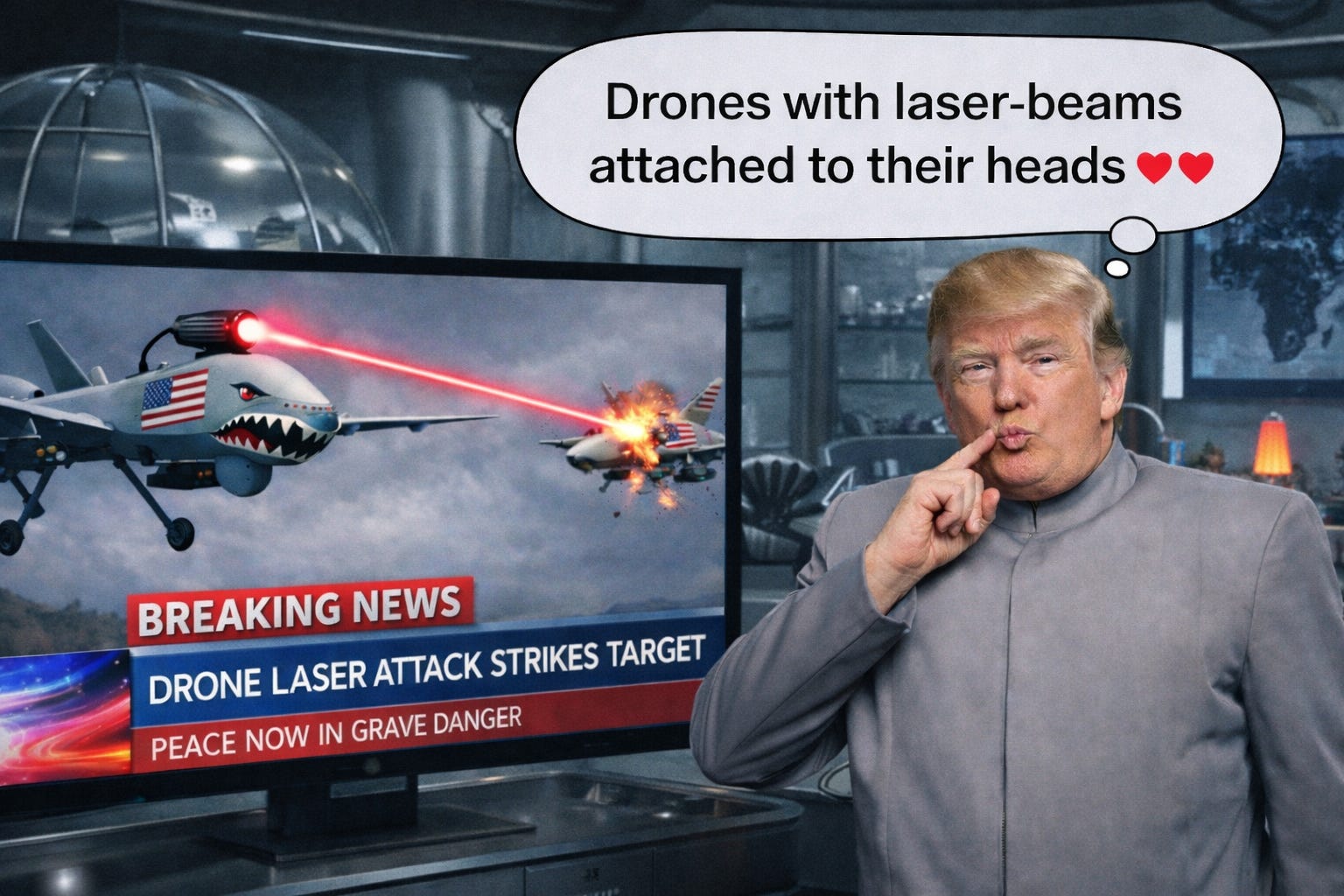
This is the part where the administration’s defenders will arrive with their favorite set of explanations, each one delivered with the confidence of a man explaining a broken toaster as evidence of patriotism. Maybe it was a necessary defensive action, maybe the drone was in the wrong place, maybe the agencies did not coordinate, maybe it was a freak sequence of events, maybe it was the fault of the Biden administration somehow, which is impressive given the time bending qualities required to blame your predecessor for your own live mistakes.
You can already imagine the talking points, because they come from the same factory. It will be framed as a “safety measure” with the vibe of a cop explaining that the best way to prevent accidents is to shoot the car, and then there will be some mention of how the administration is taking the border seriously, as if the definition of seriousness is closing airspace and vaporizing your own equipment like you are testing a new kind of bureaucratic self-harm.
What makes the second mess up funnier, in the bleak way that makes you laugh so you do not scream, is that it follows the first mess up like a reminder that nobody learned anything except maybe how quickly the public forgets. This is not an administration that treats mistakes as a cue for adjustment, because adjustment requires admitting that reality exists independent of your narrative. Instead, it treats mistakes as content, and if there is one thing content creators understand, it is that audiences love a callback, which is exactly what this is, a callback to the earlier airspace confusion, except now the stakes include a drone that is no longer flying and an entire federal ecosystem that continues to behave like it is being run by a collection of rival interns.
There is also something deeply Trumpian about a drone getting blasted out of the sky by friendly fire, because the Trump worldview is built around a very specific fantasy. In that fantasy, power is basically a spotlight and a loud voice, agencies are props, rules are obstacles, and competence is whatever happens after you announce that you are the best at something.
Reality, unfortunately, is a system of boring coordination, and reality does not care how many times you say “we have it under control,” because reality will happily demonstrate the opposite by letting you create your own no fly zone and then accidentally treat your own surveillance drone like a hostile intruder.
If you wanted to write this as a farce, you would place it in a low budget situation room with a giant map, and you would have one official pointing at a little icon and saying, “That drone is a threat,” and another official saying, “That drone is ours,” and a third official saying, “Define ours.” Then you would cut to the drone itself, minding its business in the bright indifferent sky, and you would watch it get swatted down by a system designed to protect the homeland, because the homeland’s greatest enemy, as always, is the homeland’s own inability to run its own operations without turning them into a headline.
Somewhere in the background of all this is the FAA, which exists to keep planes from colliding and to keep the sky from becoming a disaster film, and the FAA’s role in these incidents is essentially to react like a responsible adult walking into a house party where the teenagers have discovered fireworks.
You shut things down, you issue restrictions, you try to reestablish order, and you quietly wonder how many times you are going to have to do this before someone decides to stop treating airspace like a flex. The administration wants to sell the public on an image of muscular control, but what it keeps delivering is a portrait of government as a series of siloed fiefdoms, each one armed, each one sure it is the hero, and each one just coordinated enough to trip over the other at speed.
And because it is the Trump administration, there is always an added layer of performance, the constant insistence that chaos is strategy and that every mishap is either fake news or proof of boldness. In this case, the boldness seems to be the audacity to run two airspace mess ups so close together that they start to look like a policy choice, as if the plan is to make the border so secure that even U.S. government drones cannot survive it.
If the drone was expensive, then the administration did not merely waste money, it performed the waste as a kind of inadvertent art, a taxpayer funded sketch about miscommunication, ego, and the consequences of turning governance into a grievance fueled brand.
The punchline is that the drone did not need an adversary, because it had an ecosystem that could not tell the difference between an external threat and an internal asset, and if you are looking for a metaphor for this era, you could do worse than a government laser that obliterates its own flying camera while the people in charge argue over whose fault it is.
A country can survive a lot of things, including bad policy, loud leadership, and even the occasional bureaucratic pratfall. What is harder to survive, or at least harder to watch without developing a stress twitch, is a government that keeps repeating the same mistake and calling it strength, while the debris falls and the headlines write themselves.
Been laughing/not laughing all morning about this. On the one hand, yes, hilarious. On the other hand, this is the military that's supposed to be defending me? A little too Keystone Kops for my comfort.
Donald and Pete's Excellent Adventure!