


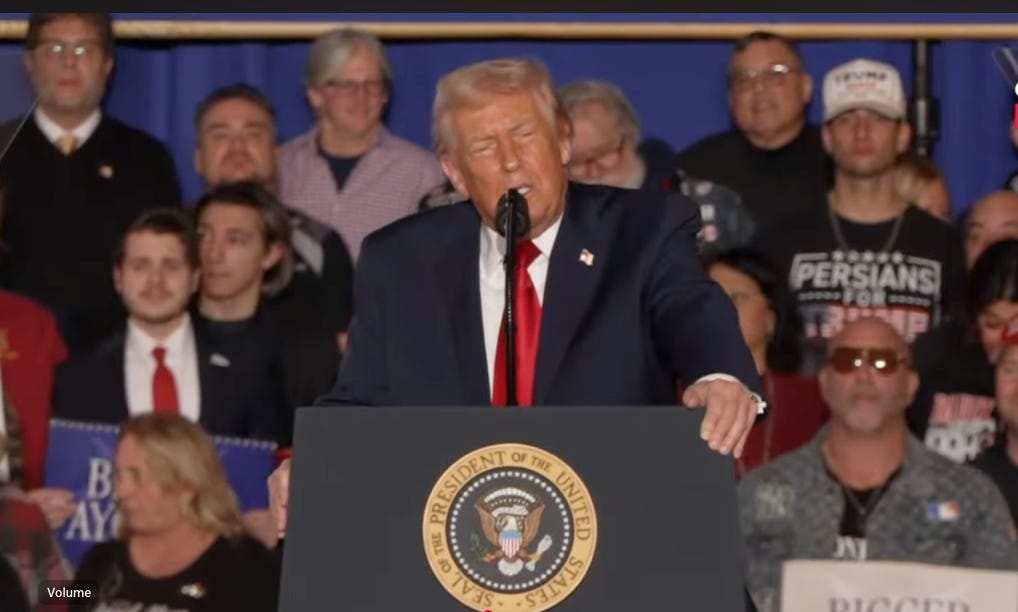
Trump was supposed to be at the Mount Airy Casino Resort to give a speech about the economy. That was the plan. It was billed as a serious policy address, an opportunity to reassure voters, calm donors, and project the image of a man capable of coherent thought in a venue best known for slot machines and midweek buffet specials. The idea was simple enough: talk about jobs and growth, maybe wave around some charts, and convince the country he still has a grasp on something larger than a microphone.
Instead, Donald Trump delivered remarks that felt less like an economic vision and more like a paranormal reenactment. If this was meant to mark the triumphant kickoff a “resurrection tour” to raise his sagging poll numbers, someone ought to tell him he accidentally conducted a séance instead. What unfolded wasn’t a revival; it was an attempt to summon his former political self. And even that failed, because whatever spirit he managed to call forth was sounding distinctly unwell.
The weirdness began before he even entered. The casino ballroom, already a fittingly liminal space where hope goes to be monetized, was overtaken by what can only be described as Karaoke Night at the End of the Republic. The crowd was treated to a disjointed, wandering medley of Bowie’s Space Oddity, Zeppelin’s Stairway to Heaven, a country lament about weary veterans, and what might have been the Rolling Stones filtered through a malfunctioning speaker. Periodically, as if summoned by some outlawed ritual, the audience erupted into an unexplained, metronomic chant:
“Heat. Heat. Heat.”
Heat indeed.
By the time Trump finally made his entrance, the atmosphere didn’t suggest that a president was about to unveil a serious economic agenda. It suggested that someone should, at minimum, perform a wellness check.
Trump opened with the confidence of a man who believes historical record-keeping is merely a suggestion. “We saved America. We won the most important election in the history of our country,” he declared, without specifying which election, which history, or even which country he was referencing. From there he drifted into one of his trademark mathematical hallucinations, insisting he had “won” Pennsylvania three times, carried “all seven swing states,” and secured the Electoral College by a tidy “312 to 226.” And for anyone tempted to raise an eyebrow, he offered the assurance that “the real vote was much more than this, but we wanted to make it too big to rig”, a fascinating strategic innovation in which one triumphs so overwhelmingly that one somehow loses.
Having rewritten the nation’s electoral laws and arithmetic in under a minute, he then paused to remind the crowd of his greatest cultural victory: “We brought back Christmas.” Jesus, presumably, remains unavailable for comment.
The economic portion of the speech felt like being trapped in a PowerPoint presentation conducted by a man who’s never seen a chart but is deeply emotionally attached to the idea of them.
He unveiled phantom graphs supposedly showing Biden-era prices skyrocketing and Trump-era prices plummeting, all while insisting:
“Inflation is stopped.”
This was bold, especially given that inflation numbers… exist.
He then declared tariffs his favorite word:
“My favorite word is tariff. I love it more than any other word in the dictionary.”
A moment later, aware of how that might sound, he amended:
“I moved it back to fifth. Now I’m in no trouble with the fake news.”
Somewhere, Merriam-Webster is quietly filing for a restraining order.
Trump then offered what amounted to an energy policy update from 1954, proudly announcing that “clean, beautiful coal” was back, that the United States was producing more energy than at any point in its history (it isn’t), and that gas had fallen to $1.99 in four states (it hasn’t). He also assured the audience that China avoids wind power because “they’re smart,” a claim that would surprise the country that currently leads the world in wind capacity.
But it was his long-standing vendetta against windmills that reached operatic heights. “Wind is the worst,” he warned. “It ruins your valleys, your peaks. Every time it goes around, you lose $15.” Fifteen dollars per rotation, an economic model so fragile that a moderately breezy afternoon could bankrupt the Commonwealth of Pennsylvania. He later grew somber, as if delivering sad news from a conservation summit, and declared: “Windmills kill all our birds.” All of them, every last one, apparently rendered extinct by a single turbine blade.
This was the point where the speech lurched from incoherent to openly dangerous. Trump declared he had accomplished what no president, no policy, no known dimension of reality has ever produced: “For seven months in a row, zero illegal aliens have been admitted.” Zero. He then offered a helpful clarification, this count excluded the ones admitted legally, which did little to shore up the claim’s structural integrity.
But reassurance was on the way, because Trump revealed he has found a new model for American border security: North Korea. “North Korea has the safest border,” he said admiringly. “Seven walls of wire. A million volts. You get over the first one, you’re dead for the next one.” Nothing captures the spirit of “America First” quite like aspiring to Kim Jong-un’s electrified obstacle course.
From there, the speech dove headfirst into an extended racist tirade, so naked, so bile-soaked, and so divorced from factual or moral grounding that it felt less like a political argument than an eruption of whatever filters he once possessed finally giving way. Trump described Somalia as “filthy,” “dirty,” “disgusting,” and “ridden with crime,” language designed not to convey information but to dehumanize an entire nation and, by extension, its diaspora. He then declared that Minnesota’s Somali community had somehow stolen “tens of billions of dollars”, a ludicrous fantasy that would require an entire state budget to evaporate and reappear in a single neighborhood, perhaps tucked neatly into a coffee tin beside the halal market.
He revived the long-disproven conspiracy theory that Rep. Ilhan Omar married her brother and punctuated the rant with the authoritarian flourish: “She should get the hell out.” There was no dog whistle here, no coded nod to the base, just a direct attempt to expel a Black Muslim immigrant woman from the body politic. It was repugnant, unmistakably racist, and delivered with the casual ease of a man who no longer remembers there are boundaries he’s supposed to pretend to respect.
What made the moment even more alarming was how it exposed the widening fault lines in Trump’s cognitive landscape. The racist venom didn’t appear as a calculated wedge issue; it spilled out as though he were no longer capable of distinguishing between inside voice and outside voice, campaign rhetoric and barroom rant, policy argument and personal fantasy. His disinhibition, already on full display throughout the speech, reached its apex here, amplifying not just his cruelty but his confusion. The collapse of restraint and the collapse of coherence marched in lockstep.
This wasn’t a gaffe or an offhand aside, or even a tangent. It was the argument, an argument shaped by grievance, propelled by bigotry, and unfiltered by the cognitive capacities that once kept at least a thin membrane between Trump’s impulses and a live microphone.
Trump then wandered into a sweeping fantasy of global statesmanship, insisting he had single-handedly ended conflicts everywhere from Kosovo and Serbia to Pakistan and India, Israel and Iran, Egypt and Ethiopia, Armenia and Azerbaijan, even Cambodia and Thailand. According to him, all these crises evaporated because he picked up the phone and told them to. “Who else could say, ‘I’m going to make a phone call and stop a war?’” he asked, basking in his imagined omnipotence.
The answer, of course, is no one, because that is not how war works. Or, for that matter, diplomacy, or hell, even phones.
In one of the most bewildering detours, Trump alleged that Biden did not personally sign Federal Reserve appointments:
“Did he sign it or did the autopen sign it? I’m hearing the autopen may have signed all four.”
He delivered this with the gravity of a man unveiling a major constitutional crisis, rather than describing… a common clerical tool used since the 1800s.
Trump brought a series of everyday Pennsylvanians onstage to praise his “no tax on tips” and “no tax on overtime” proposals. Their testimonials were earnest; his reactions were anything but. When one longtime waitress stepped forward, a woman he had just finished describing as emblematic of hardworking America, Trump immediately shifted the spotlight to himself by turning her into a prop.
“Look how beautiful she is,” he announced to the crowd, before adding with performative defiance, “You’re not allowed to say that anymore. I don’t care.”
It was a perfect distillation of his worldview: even complimenting a waitress becomes a culture-war performance. Everything is a grievance. Everything is a battlefield. Even this woman’s moment, intended to highlight economic policy, was commandeered and reframed as Trump bravely resisting the imaginary tyranny of political correctness.
Trump crescendoed into the fully delusional portion of the program:
“These first 10 months are the best 10 months ever in the history of the presidency.”
“They’re saying better than Lincoln, better than Washington.”
“They,” of course, remains unspecified. Scholars suspect it might be an internal monologue.
He brought the ordeal to a close with the familiar cadences of his ritualistic catechism, intoning that he would make America powerful again, wealthy again, healthy again, strong again, proud again, safe again, and, inevitably, great again. And then, with no transition whatsoever, the speakers erupted into “YMCA.” A disco anthem about communal showering became the grand finale of a speech ostensibly crafted to persuade the country that Donald Trump is once again a serious statesman, restored to form and ready to lead.
Thus the resurrection tour ended exactly as it began: unintentionally comic, deeply strange, and wildly off-key.
If this spectacle was meant to reintroduce Trump as disciplined, focused, and firmly in command, the man who could steady an administration wobbling in the polls, it achieved precisely the opposite. What emerged instead was a portrait of cognitive drift so pronounced it seemed to tug him off course mid-sentence; a torrent of casual falsehoods delivered with the ease of long habit; racism so lazy and repetitive it looped back on itself; authoritarian fantasies offered as practical governance; economic claims untethered from anything resembling reality; foreign policy as performance art; conspiratorial asides whispered into the mic as though they were state secrets; and, above all, a performer who no longer appears capable of controlling the act he once mastered.
Instead of resurrecting his political brand, he exhumed it. What crawled out of the Poconos, muttering about clean coal and windmill birds, autopens and North Korea, Christmas and the ever-present “Heat! Heat!”, was not the triumphant comeback he promised. It was an alarm bell, very loud, and set, improbably, to classic rock.
This review of Trump in the Poconos at his bombastic best could be funny if it were a Mel Brooks movie. But I doubt this script would meet his standards. When oh when is this going to be over??
Great observations on an infuriating spectacle. How will we ever dig ourselves out from this morass?