

The thing about bluster is that it always sounds different depending on where you live. On an American plane, under American flags, after a ceremony returning American dead, Trump can look into a gaggle camera and declare, without missing a beat, that “we’re winning the war by a lot,” that an “evil empire” has been “decimated,” that Iran’s navy is “at the bottom of the sea,” and that the whole thing is a “short excursion,” the kind of quick, righteous errand nobody had the guts to run for 47 years. And for a certain domestic audience, it lands exactly as intended: dominance, certainty, the vibe of a guy banging the table until reality gets embarrassed and leaves the room.
But if you’re watching from the Middle East, it lands less like strength and more like a familiar kind of imperial weather system moving in, loud, self-assured, allergic to details, and somehow always surprised that the people under the storm don’t call it “liberation” while it’s happening.
That’s why Al Jazeera’s reaction matters, not because they add exotic commentary, but because they don’t have to. They just run the tape, and when you run the tape for a regional audience, Trump’s “short excursion” doesn’t sound like decisive leadership. It sounds like the way outside powers have always described wars in the region: short for the people launching them, endless for the people living inside them. When he talks about unconditional surrender, “where they cry uncle… or there’s nobody around to cry uncle,” that doesn’t play as a clever metaphor. Instead it plays as a threat that the endpoint isn’t stability, it’s obliteration.
What’s really happening here is a collision between two media languages. In the U.S., cable news tends to treat Trump’s war talk the way it treats Trump’s everything: a personality event, a comms strategy, a fight over “optics,” a debate over whether he meant it, plus a quick detour into gas prices and polling. The tone is often clinical even when the content is obscene, because American political media has trained itself to translate extremity into “messaging.” Foreign outlets, especially in the region, don’t need that translation layer. They don’t have to launder the language into punditry because their audiences hear the stakes without assistance. So instead of sanding down the edges, they often do the opposite: they let long, unfiltered clips run, they foreground civilian-casualty questions, and they keep the frame wide enough to include what U.S. coverage frequently trims away, how it sounds outside the empire. That’s why Al Jazeera can feel “biased” to Americans even when it’s simply doing something U.S. media rarely does with Trump: allowing his words to arrive intact, without domestic normalization and without the comforting assumption that this is mostly theater.
Then there’s the ceremony itself, the dignified transfer, the moment where presidents usually lower their voices and choose words like grief, sacrifice, duty, and loss. Trump’s choice is different. Asked whether he’ll be coming back for more transfers, he says, “Sure… it’s part of war, isn’t it?” When pressed, he adds, “deaths are part of war.” It’s not merely blunt; it’s transactional. It’s the sound of a man trying to normalize the cost while selling the spectacle. For Middle Eastern audiences, that line doesn’t read as toughness. It reads as a warning: if American deaths are “part of war,” then so are yours, and don’t expect solemnity to slow the machinery.
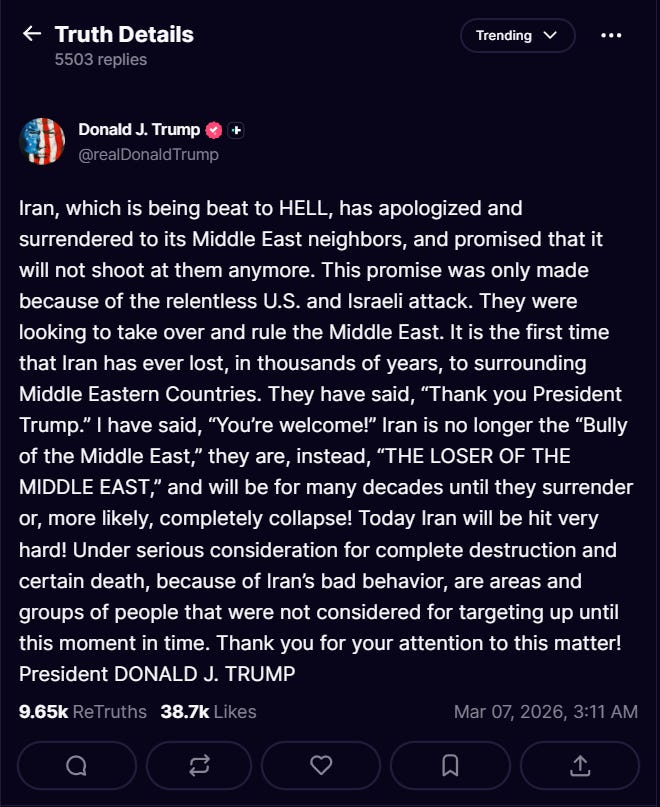
The Truth Social post is where the bluster stops flirting and takes its clothes off in public. “Iran… is being beat to HELL,” he writes, claiming Iran “apologized and surrendered” to its neighbors, promising it “will not shoot at them anymore,” and then, this is the part that should set off every alarm bell in every newsroom, he announces that “today Iran will be hit very hard,” and that “areas and groups of people” previously not considered for targeting are now “under serious consideration for complete destruction and certain death.” The phrasing is the point: it’s not a strategy memo, it’s a permission slip. It reads like the kind of language that tells regional audiences exactly what they’ve long suspected about “precision,” “restraint,” and “rules-based order”: when the leader is in a mood, the circle of who counts as “targetable” expands.
A recent MS Now broadcast strengthens this argument, because it drags the story out of Trump’s self-narration and drops it into the institutions he’s using as props. MS Now lays out the immediate escalation arc: Trump publicly demands “unconditional surrender,” privately expresses interest in ground troops inside Iran (according to NBC’s sourcing), and then uses Truth Social to float widened targeting as if he’s teasing a season finale. Meanwhile, the White House waves it away as anonymous-source “assumptions,” which is a neat trick when the president is literally shouting the same thing into his own megaphone.
Then you get the gut-punch detail that makes all of this feel less like war and more like a hostage situation: Rep. Seth Moulton (D–Massachusetts) and a member of the House Armed Services Committee and a Marine veteran drops a bombshell that the war is costing the U.S. $1 billion a day, while gas prices jump 14%, with average unleaded hitting $3.41. That’s the domestic echo of what regional viewers already know: even when a war is described as a “short excursion,” it immediately becomes a siphon, of money, attention, legitimacy, and life. The “excursion” is short only in the way a match is short.
And the enabling matters. Moulton’s interview is basically a prosecution: Congress didn’t restrain Trump not because it couldn’t, but because it wouldn’t. War Powers resolutions fail. Courage fails. The Constitution fails in the most banal way possible, by being ignored in broad daylight. That, too, is legible in the Middle East. Regional audiences have watched American power operate for decades with the same pattern: lofty language, flexible law, and the immediate disappearance of restraint the moment a commander decides restraint is “not the right time.” Moulton says that behind the scenes Republicans “cannot wait to get rid of” Defense Secretary Pete Hegseth.
Moulton’s line that Rubio effectively described Israel as the “imminent threat” because their timeline was driving U.S. action lands like a confession of weakness disguised as alliance. He says Trump “starts wars due to peer pressure,” manipulated by allies, donors, and strongmen. That’s not just a domestic insult. It’s a regional hazard. In the Middle East, where wars are often triggered by miscalculation, rumor, provocation, and saving face, the idea of an American president operating on impulse and pride “gut instinct,” as Trump says about refilling the Strategic Petroleum Reserve, reads as unstable.
In the gaggle clip, when asked directly whether the U.S. bombed a girls’ elementary school in southern Iran and killed around 175 people, Trump immediately says he believes Iran did it to itself, arguing they’re “very inaccurate” and that “the only side that targets civilians is Iran.” Hegseth says it’s still being investigated, which creates an on-camera contradiction: Trump assigns blame while his Defense Secretary won’t confirm responsibility yet.
Al Jazeera’s choice to foreground that exchange makes sense for their audience because civilian harm and attribution aren’t sidebars in Middle East war coverage; they’re often the central moral and political question. And in this case, that emphasis also clashes with reporting elsewhere indicating U.S. investigators have been looking at possible U.S. responsibility for the strike (with the investigation ongoing).
They also have their own reporting context: Al Jazeera ran an investigation raising questions about the Minab girls’ school strike and disputing the idea that it was simply an Iranian “misfire,” which makes Trump’s blame-shift especially salient in their framing. Multiple outlets report the school was near (and possibly formerly part of) an IRGC facility, which complicates and arguably weakens Trump’s claim that Iran likely hit it with its own inaccurate munitions.
When Middle Eastern outlets air Trump’s words, they aren’t merely “anti-American” or “biased.” They’re translating. They’re taking an American domestic performance where words like “cancer,” “obliteration,” “unconditional surrender,” and “short excursion” are meant to signal strength, and running it through a regional memory bank filled with wars that began as “operations,” expanded into occupations, and ended with everyone pretending the plan was always to leave.
Trump’s bluster is designed for an American audience that has the luxury of treating war as a political mood. In the Middle East, it’s heard as a material threat, because people there have learned the hard way that when the most powerful country on earth starts talking like this, the rhetoric is never the worst thing that happens, it’s just the first thing.
And somewhere in the middle of all this, after a ceremony for dead soldiers, the president shrugs and says deaths are “part of war.” Not that he would know given he avoided service five separate times.
while lots of press states that trump does not have a plan, i think he has a page from Netanyahu's playbook or is following Netanyahu's directives. this was never about nuclear arms, this was never about regime change. just like Netanyahu's war in Gaza was never about getting hostages back. it is about wiping out a country, wiping out a people. Genocide. all the while the world listened to the protestations coming from the Israeli government about what they were "not doing" and right before our eyes, they did it. now the jr trumps are moving in and talking about condominiums. I think Netanyahu has the same plan for Iran and he now has trump's help. trump does not care about deaths, the price of oil, or how long this takes. deaths of American soldiers is just the cost of getting what he wants, which is pleasing Israel and getting at Iranian oil. if the war is protracted into the mid terms, he would probably like that, use it as an excuse for more election tampering or canceling them all together because of a "state of emergency". he is already teeing up another conflict with Cuba. we are now back in the days of the Shah and elsewhere where we want a puppet regime or no regime at all. what comes across as an ill-thought out plan is not the case. the end game is wiping out Iran and profiting from their natural resources. when the world feels too much pressure from the closure of the straits of Hormuz, that will drag the UK, France, and other countries into the fray to provide naval escorts for tankers through the straits. Iran will hit tankers and naval vessels, and things will get even muddier. he does not give a rats behind about the cost of oil, that helps his buddies at the oil companies and falls in line with his cancelation of renewable energy programs and eliminating any chance of EV growth in the US. that is all driven by his big donors in oil and gas. LNP exports get a boost from this conflict, another plus for oil and gas, and another factor that will drive up natural gas prices for Americans. Everyone seems to be writing his reactions to oil prices and casualties as just callous and lack of a plan. i think the plan has been there all along, just not shared
Powerful prose, Mary, for a dangerous time. Thank you for your vigilance and artistry.