


Good morning! Let’s begin with the sound of flash-bangs. While most of America was scrolling, Homeland Security officers were once again demonstrating what “less lethal” means in 2026. It means rubber bullets that shatter faces, and tear gas canisters bouncing off chests. It means flash-bangs exploding near 73-year-old men who thought they were exercising their First Amendment rights instead of auditioning for a war documentary.
NBC’s reporting this week documented a pattern that is no longer accidental. Federal officers in military-grade armor are conducting open-air immigration raids in cities across the country and meeting protest not with de-escalation, but with force. Pepper spray to the face. Chemical agents into crowds. “Everybody f—— gets it if they touch you,” one operation commander was caught saying on body cam. Whose city is it? “It’s our f—— city.” That’s the language of an occupying force, not law enforcement.
While courts in multiple states have found that force was used indiscriminately, the administration’s response has not been contrition but acceleration. Stephen Miller told officers, “You are unleashed.” Another federal judge described DHS’s culture as one that “celebrates violent responses over fair and diplomatic ones.” The administration, in turn, is fighting those rulings.
The flash-bangs on the street are loud. But the quieter shift might be even more consequential. The Guardian reported this weekend that the administration has dramatically expanded the 287(g) program, deputizing more than 1,400 local police agencies to function as federal immigration enforcement. Local officers can now interrogate anyone they suspect of being undocumented during routine policing and detain them purely on immigration suspicion. That’s a federal civil matter now embedded in everyday traffic stops.
Any consideration of oversight has been trimmed. The Department of Homeland Security’s civil rights watchdog office, which had been reviewing suspected racial profiling and civil liberties violations, was gutted. A congressionally mandated report raising red flags has gone “into limbo.” An advisory board reviewing new partnerships was dissolved. Former officials describe the current structure bluntly: “I don’t think anybody’s doing any of the oversight work.”
They have also added incentives. Equipment grants, vehicle reimbursements, and salary coverage. “Monetary performance awards” based on how many undocumented immigrants officers identify. One former official called it what it looks like: a bounty system.
On the surface, you have armored agents firing tear gas into crowds. Underneath, you have the quiet rewiring of American policing so that immigration enforcement is everywhere and oversight is nowhere.
Then there’s the other story that will not die, because the system cannot metabolize it: Epstein. The files are back. Six million documents, give or take the repetition. Britain is convulsing. Peter Mandelson’s career is radioactive. Prince Andrew is already politically extinct. In London, association with a convicted sex trafficker is not treated as a quirky networking misstep, it is career-ending. In Washington? It’s just another taxpayer-funded golfing holiday.
The latest document dump exposes what we already suspected: the web was larger than previously understood and more international. Julie K. Brown, who has been hammering at this story for years, says what surprises her most is the scale. Recruiters in multiple countries. Lawyers arranging visas for teenage girls under the guise of modeling contracts. Emails showing trajectories, flattery, promises, father-figure mentorship, followed by discarding and indifference.
This was not a one-off monster in a Palm Beach mansion. It was a global apparatus, yet here we are. Survivors report their names remain sprinkled throughout the released files while powerful men’s names are redacted. The Department of Justice says there is no credible evidence to pursue further charges, but provides little visible evidence of follow-up on credible tips. A congressionally mandated oversight report on the immigration crackdown disappears into bureaucratic limbo. Another system that exposes everyone and holds no one accountable.
In Britain, proximity destabilizes leadership. In America, it becomes atmospheric. Scandal becomes climate, not weather, because everyone’s dirtiness uniquely disqualifies no one.
Julie Brown made another observation worth sitting with: this is not a partisan story. Epstein donated across party lines. Sexual assault does not discriminate by political affiliation. The common denominator was not ideology; it was power, money, and access.
The problem may not have been a single monster in the center of the web. It may have been the web itself. Which brings us to monuments. The New York Times ran a news analysis this weekend describing what it called an American cult of personality. President Trump, one year into his second term, is engaged in a spree of self-aggrandizement unmatched in modern American history. His name etched on federal institutions. Pressure on cultural institutions to display flattering portraits. A proposed “Trump-class” of ships. Whispers of coins, airports, mountains. And somewhere in an Ohio sculptor’s studio, a 15-foot gold-covered bronze statue called “Don Colossus” waits for installation. Washington declined “Your Majesty.” Trump wonders why Washington didn’t brand Mount Vernon.
This isn’t just vanity, as one historian noted, it’s about omnipresence. A president is more powerful if he is ever-present than if he keeps his head down. The cult architecture binds loyalty not to policy, but to persona. Those who stand against the persona are not opponents; they are traitors.
An immigration enforcement system expanding downward into local policing, guardrails stripped away. Federal officers escalating force in American cities. An elite scandal that reveals proximity but produces little accountability. A presidency increasingly framed not as an office, but as a myth.
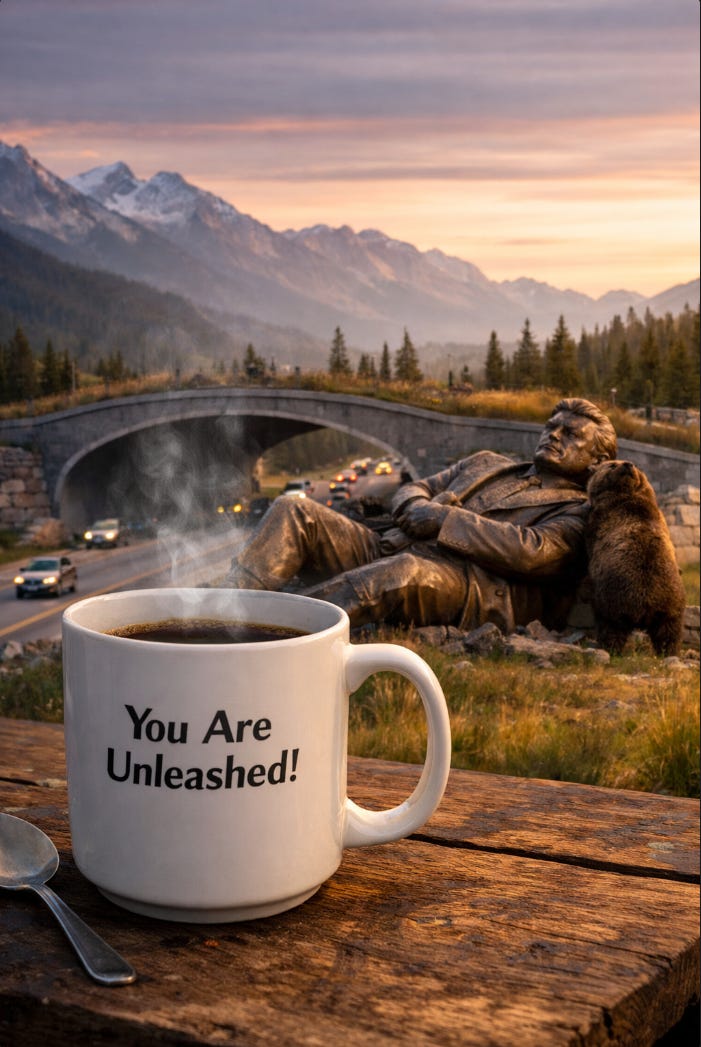
Far from Washington and Westminster, in the Rockies, something else is happening. Engineers are building bridges that are not bridges so much as forests suspended over highways. The Yellowstone to Yukon initiative has been quietly stitching together one of the largest wildlife corridors on Earth, 1.3 million square kilometers, spanning five states, two provinces and more than seventy-five Indigenous territories. Grizzly bears whose populations were split by highways and railways are being given safe passage to find one another again. Wildlife crossings reduce collisions by more than 90 percent. More than 150,000 animals have already used them.
In one part of North America, we are building a system that expands movement, reduces harm and reconnects what was fractured. In another, we are building statues. For now, the Don Colossus still sits in the sculptor’s studio, instead of casting a long bronze shadow across a golf course.
Systems can be redesigned, even the US Constitution has amendments. We know how, we have the engineering diagrams. We know how to build guardrails instead of removing them, and how to structure incentives so they reduce harm instead of rewarding it, and how to fund oversight instead of dismantling it. We know how to create corridors that reconnect fractured populations rather than walls that divide them, and how to build institutions that outlast egos.
What makes this moment uncomfortable is that it is so clarifying. The flash-bangs, the bounty-style enforcement incentives, all the redacted names. None of it is subtle. The wiring and the architecture are fully exposed. Exposure, as painful as it is, is an opportunity because once you can see how a system works you can dismantle it.
We are rarely handed moments this stark or so ripe for change. The engineers in the Rockies are not asking which bear deserves to cross the highway. They are building a bridge so that life can move freely and safely again. We know how to do that in our civic life, too.
This is all so depressing(except for the animal overpasses).
We live in the greatest country on earth and yet we cannot keep our elected officials from killing us.
A great analogy in real time. We HAVE the knowledge. We just need the overwhelming will.