


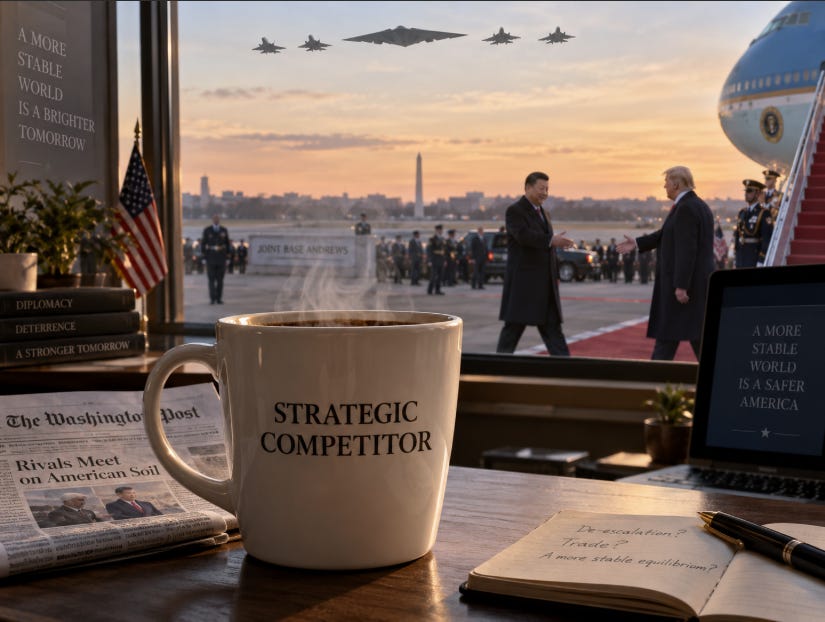
Good morning! Xi Jinping arrives in the United States today, and Donald Trump isn’t sending somebody else to meet the plane. At 6 p.m. Eastern, Trump is scheduled to be waiting at Joint Base Andrews for an arrival ceremony welcoming the Chinese president and his wife, Peng Liyuan, to American soil.
That’s only the warm-up. Tomorrow the pageantry moves to the White House, where 479 military personnel, trumpets, drums and a flyover by a B-2 Spirit and four F-22 Raptors will provide the state-visit version of the welcome.
Trump used this same diplomatic vocabulary in Alaska last year. Vladimir Putin stepped onto an actual red carpet while American military aircraft flew overhead. There were smiles, handshakes, and even a ride together in the presidential limousine before the two men disappeared into talks about Ukraine. The summit ended without the ceasefire Trump had been pursuing, but the pictures were magnificent.
Xi now gets the deluxe Washington edition.
Xi is the leader of the world’s second-largest economy, America’s largest strategic competitor, and one of its most consequential trading partners. A state visit is normal diplomacy between major powers. But Trump does have a fondness for communicating foreign policy through architecture, choreography, and things that make a pleasing whooshing noise overhead. Nothing says “we have a complicated bilateral relationship involving export controls, military deterrence and supply-chain vulnerability” quite like a stealth bomber.
Complicated barely begins to describe what Xi is walking into. China is simultaneously the country Washington is trying to deter, the supplier Washington is trying to become less dependent upon, the technological competitor Washington is trying to outrun, the trading partner American farmers and manufacturers still depend upon, and one of the very few governments the United States may actually need if anyone hopes to put meaningful international guardrails around increasingly powerful artificial intelligence.
Welcome to Washington. Would you care for the beef or the fish?
The contradictions were already gathering around Trump yesterday at the United Nations.
The day before Xi’s arrival, Japanese Prime Minister Sanae Takaichi sat down with Trump in New York for about 35 minutes. The public portion was almost comically brief, Trump praised Takaichi and Japan; Takaichi thanked him, flagged Asia’s difficult security environment, and essentially suggested the press could leave so the adults could discuss the complicated stuff.
Tokyo’s official readout tells us what that was: economic security, AI, semiconductors, critical minerals, and deterrence in the Indo-Pacific, with the timing made unusually explicit. Trump and Takaichi exchanged views on China “bearing in mind the upcoming U.S.-China Summit meeting” and agreed to coordinate closely. Diplomatic language for: before you sit down with Xi, Donald, there are a few things we’d like you to remember.
The concern underneath it, per Takaichi’s own framing before she left Tokyo, is resilience. Not simply tariffs or who wins the next headline, but supply chains, including energy, that can survive whatever comes next.
That word, resilience, keeps following us around.
It is one thing to possess leverage. It is another to build an economy that can withstand someone else using theirs.
China demonstrated the distinction efficiently when rare-earth export restrictions began disrupting global manufacturers; these aren’t decorative rocks for the presidential ballroom, but the material embedded in electronics, EVs, communications systems, missiles, aircraft, and much of the modern industrial economy. Even the White House’s own economic analysis has acknowledged how fast that exposed American and allied supply-chain vulnerabilities.
Trump and Xi tried to address some of this when Trump visited China in May. The resulting agreement included Chinese commitments to address American concerns about rare earths and other critical minerals, along with agricultural purchases, Boeing aircraft and new bilateral trade and investment mechanisms. But implementation has been decidedly less “historic deal accomplished” and more “please see attached spreadsheet.”
Which brings us to the stranger part of this week’s welcoming ceremony.
While Washington prepares to fly America’s premier stealth bomber over Xi’s head, American officials have been connecting Chinese commercial technology to something considerably less ceremonial.
The Wall Street Journal reported this month that U.S. officials have linked high-resolution satellite imagery obtained by Iran from Chinese entities to the July 17 ballistic-missile attack on Muwaffaq Salti Air Base in Jordan, the strike that hit a housing area, killed three American service members and wounded four others. Iran obtained imagery of the base both before and after the attack, according to the officials.
U.S. officials stopped short of accusing the Chinese government itself, and China has denied wrongdoing and demanded evidence. But we are well past the earlier stage when this could be waved away as generalized suspicion about Chinese commercial satellite companies. American officials say they have linked Chinese-supplied imagery to a specific Iranian strike that killed Americans.
Bluntly, the United States will demonstrate some of the most sophisticated military hardware on Earth to the leader of a country whose commercial entities, according to U.S. officials, supplied imagery connected to a missile strike that killed three American troops.
Diplomacy occasionally has a sense of humor so dark it requires no assistance from us.
That issue came up in an illuminating Bulwark discussion this week with Democratic Rep. Jim Himes of Connecticut, the ranking member of the House Intelligence Committee, former CIA officer Mark Polymeropoulos and journalist Michael Weiss.
Weiss juxtaposed Russia’s intelligence assistance to Tehran with the increasingly concrete evidence surrounding Chinese commercial satellite imagery and asked what it means to lavish ceremonial honors on Xi while American officials are connecting Chinese-supplied capabilities to Iranian attacks on U.S. forces.
Himes’s answer was more interesting than simply demanding Trump snarl harder at China: mixed messages, he argued, are unavoidable because the relationship itself is mixed. Washington should be extremely reluctant to strengthen certain Chinese capabilities, he singled out advanced AI processors, saying bluntly the US should not send China H200 chips or comparable technology.
That isn’t hypothetical. In January, Trump’s Commerce Department changed licensing policy so Nvidia H200s, AMD MI325Xs, and comparable chips could be approved for export to Chinese customers case by case, subject to security requirements, the administration’s bet that controlled sales can strengthen the American tech ecosystem without surrendering its most advanced capabilities.
So tomorrow, beneath the B-2 and F-22s, another weapons-system argument will happen quietly indoors. Not about airplanes. About compute.
An H200 does not make quite the same entrance as a B-2 Spirit, but China’s access to advanced computing power affects everything from commercial AI to scientific research to military applications. Washington therefore finds itself trying to preserve an American technological advantage while American chipmakers understandably remain interested in selling very expensive chips to one of the largest markets on Earth. Capitalism has always enjoyed a complicated relationship with the phrase “strategic competitor.”
But Himes made the turn that makes this entire story more interesting than another round of China hawks versus China doves.
Immediately after arguing that Washington should restrict China’s access to advanced American chips, he said the United States also needs to work with China on AI safety.
His reasoning is difficult to dismiss. America can construct all the domestic guardrails it wants, but artificial intelligence will not respect customs checkpoints. If an increasingly capable system creates a national-security crisis in one country, the consequences could cross borders before diplomats finish deciding whose embassy should issue the sternly worded statement.
Himes argued that Beijing may have its own powerful incentive to cooperate because the Chinese government has little affection for things it cannot control.
Already this is moving from theory toward actual diplomacy.
Treasury Secretary Scott Bessent and Chinese Vice Premier He Lifeng met in New York over the weekend preparing the ground for Trump and Xi. Among the subjects was a proposed mechanism through which the United States and China could notify one another about AI incidents that rise to the level of national-security threats. Bessent has described this as an area of “shared risks,” and Trump and Xi are expected to discuss it during the visit.
We may be reinventing the Cold War hotline for robots.
We spent decades worrying that somebody would misread a radar screen and launch nuclear weapons. Now the working question is what happens if an AI system launches a cyberattack, penetrates infrastructure or begins behaving in ways neither government intended, and Washington and Beijing have to determine whether the thing currently setting fire to the internet is hostile Chinese action, hostile American action, or merely Tuesday.
Trump, in almost classic Trumpian irony, has repeatedly framed AI as a race America must win against China. Yet one of the potentially most important deliverables from his summit with Xi may be an agreement to call each other if the race car catches fire.
Contain the capability. Cooperate on the catastrophe.
Iran complicates the relationship in another direction: energy.
Yesterday, Trump stood before the UN and offered Tehran a particularly Trumpian menu: agreement and “potential greatness,” or obliteration. Later, beside Zelenskyy, he revealed Witkoff and Kushner had just finished a three-hour meeting with Iranian representatives, with another planned. Beneath the threats, diplomacy is happening, and woven through its economics is China.
Beijing remains Tehran’s biggest oil customer and economic lifeline. But the relationship cuts both ways: China’s own strategic reserve, roughly 1.4 billion barrels, let it pull back on imports after the Hormuz disruption, which analysts told the AP helped keep global oil prices from climbing even higher. So: the US is fighting Iran, Iran is bankrolled by China, Chinese satellite capabilities have been linked to a strike that killed American troops, and China’s energy planning is simultaneously cushioning the shock of the war it’s indirectly fueling. Every arrow points back to the same box.
Trump is meeting Xi because China is woven through nearly every problem Washington is trying to solve: rare earths, semiconductors, AI, agriculture, Boeing, Iran, oil, military targeting, North Korea, the Indo-Pacific. Even Japan’s brief meeting with Trump yesterday was really an exercise in preparing for that reality: Tokyo wants deeper cooperation with Washington not to divorce China, which proximity makes unrealistic, but to reduce the number of switches Beijing can flip when disagreements arrive.
Which brings us back to those airplanes.
Tomorrow, Xi will stand at the White House while a B-2 and four F-22s pass overhead, a perfectly legible display of American power. But both sides already know what the other has: bombers, rare-earth leverage, semiconductor dominance, an AI race neither can afford to lose and neither can fully control and now, Chinese-linked capabilities connected by U.S. officials to a strike that killed American troops. There is no single gesture that resolves any of that. Trump may like gestures because they photograph better.
In Alaska, the red carpet beneath Putin raised a straightforward question: after the invasion, after years of isolation, what exactly had he done to earn it? Xi’s red carpet poses the harder one: what do you do when the country you’re trying to contain is also the country you still need?
On that note, I’m going to spend part of today doing something almost quaint: covering local government.
We have an important sheriff’s race coming up in November, and this afternoon I’ll be at a candidate forum hosted by the Chamber of Commerce. No complicated foreign relations, missile inventories, or oil chokepoints, just old-fashioned hometown politics, sometimes dirty, usually funny. Candidates answering questions from people who might actually run into them at the feed store or the post office.
Sheriffs wield real power. The leadership culture of any law enforcement agency can have a huge impact on outcomes for both victims and perpetrators alike. And the decisions they make affect public safety, civil liberties, budgets, and the daily lives of the people who live here. That is precisely why the race matters.
So I’m trading Washington’s firehose for a folding chair and a candidate forum for a few hours, which feels like a breath of fresh air.
I hear you on local politics. Its importance is often overlooked.
How necessary it is to keep the principle focused on mutual respect, you may pray differently but ‘what for’ is more important. Power is not a key, understanding is.
Being a leader is more complicated with more subjects. If all the lines stay straight …well…no tangles. “It’s complicated …”is not an excuse.
We long passed that simplicity, even having start overs after ‘things/lines” got straightened out , meant equity truths upheld…that.didn’t.happen.
Upmanship ?Money? Greed?
Love your neighbor…a global society is a lot of neighbors