

Good morning! Last night, Trump hosted a Hanukkah reception at the White House and delivered the kind of speech that manages to turn a religious holiday into a campaign rally, a donor appreciation banquet, a military action movie trailer, and a grievance therapy session, sometimes in the same paragraph, occasionally in the same sentence. He opened by claiming the room liked it “a lot better with Trump than… with Biden,” because, naturally, Hanukkah is best observed by immediately grading presidents like it’s a Yelp review. He then pivoted to tragedy in Australia, describing the Sydney attack as “anti-semitic… radical Islamic terrorism,” and calling for nations to unite against it, a framing that, even when it overlaps with real horror, reliably comes bundled with Trump’s favorite add-on: a sweeping civilizational label designed to do maximum political work.
Then he did what he always does: he made the night about himself, but with extra frosting. He hauled out allies to say the quiet part into the microphone, including Mark Levin, who declared, “This is our first Jewish president,” and then tossed in, “the election was rigged,” because apparently the menorah only lights properly when lubricated with conspiracies. Trump didn’t correct him. He soaked it in. He brought up donors with the kind of cheerful candor that would make a corruption investigator blush, praising Miriam Adelson and saying she “gave… 250 million,” and joking, “make it quick because 250 million is not what it used to be.” The White House, as envisioned here, has become a live studio audience for oligarch gratitude.
He also used the reception to float his domestic crackdown posture in plain language. While talking about antisemitism and campuses, he bragged that the administration is “deporting foreign jihadist sympathizers and terrorist supporters at record levels,” adding, “We’re not putting them in jails. We’re deporting them.” He spat that out like a thesis statement. It’s the administration’s preferred solution, not just to violence, but to politics and speech: make it an immigration enforcement problem, then make it disappear across a border.
Then, because no Trump speech is complete without a cinematic battle montage, he launched into his favorite genre: Trump as Supreme Commander of Everything That Ever Worked. He claimed, “this summer we obliterated Iran’s nuclear program,” and insisted he was right to use the word “obliteration” because “the pilots told me.” He described stealth aircraft in lyrical detail, complete with the moment “those bomb shoots open up,” and mocked CNN for not immediately applauding hard enough. In Trump’s universe, reality is whatever sounds most like a movie trailer narrated by a man who just discovered the caps lock key.
The speech wandered, as it always does, but it wandered in a very consistent direction: toward the idea that he alone is the nation’s guardian, and anyone who questions him is either corrupt, disloyal, or an enemy. He tossed out the “fake news” refrain, insisted the term wasn’t even strong enough, and then moved on to accuse members of Congress of hating Israel, “They hate Israel,” he said, and naming political opponents as threats. It was a reminder that he intends to treat dissent as suspect, and suspicion as justification.
It’s also where the ballroom story reappeared, because even at a Hanukkah reception, Trump can’t resist turning the White House into an extension of his brand. He told the crowd, “we just won the case today,” referring to the lawsuit seeking to halt or slow his ballroom plan, and described a “$400 million ballroom”, (up from $300 million), with “5 in thick glass windows… impenetrable by anything but a howitzer.” It’s hard to know what part is more revealing: the “won” that isn’t actually a final win, the price tag inflating in real time, or the fact that he’s pitching the White House as if it’s a Trump property upgrade package with premium blast-resistant glass.
The hyperbolic inflation habit matters, because it’s the same pattern that shows up everywhere else Trump touches. A judge declines an emergency stop in favor of conditions, and it becomes total vindication. A long-reported number becomes a bigger number because bigger numbers feel more powerful. It’s the tariff-revenue trick, the “billions and billions” trick, now applied to a ballroom: costs and claims rising in direct proportion to the political usefulness of the boast.
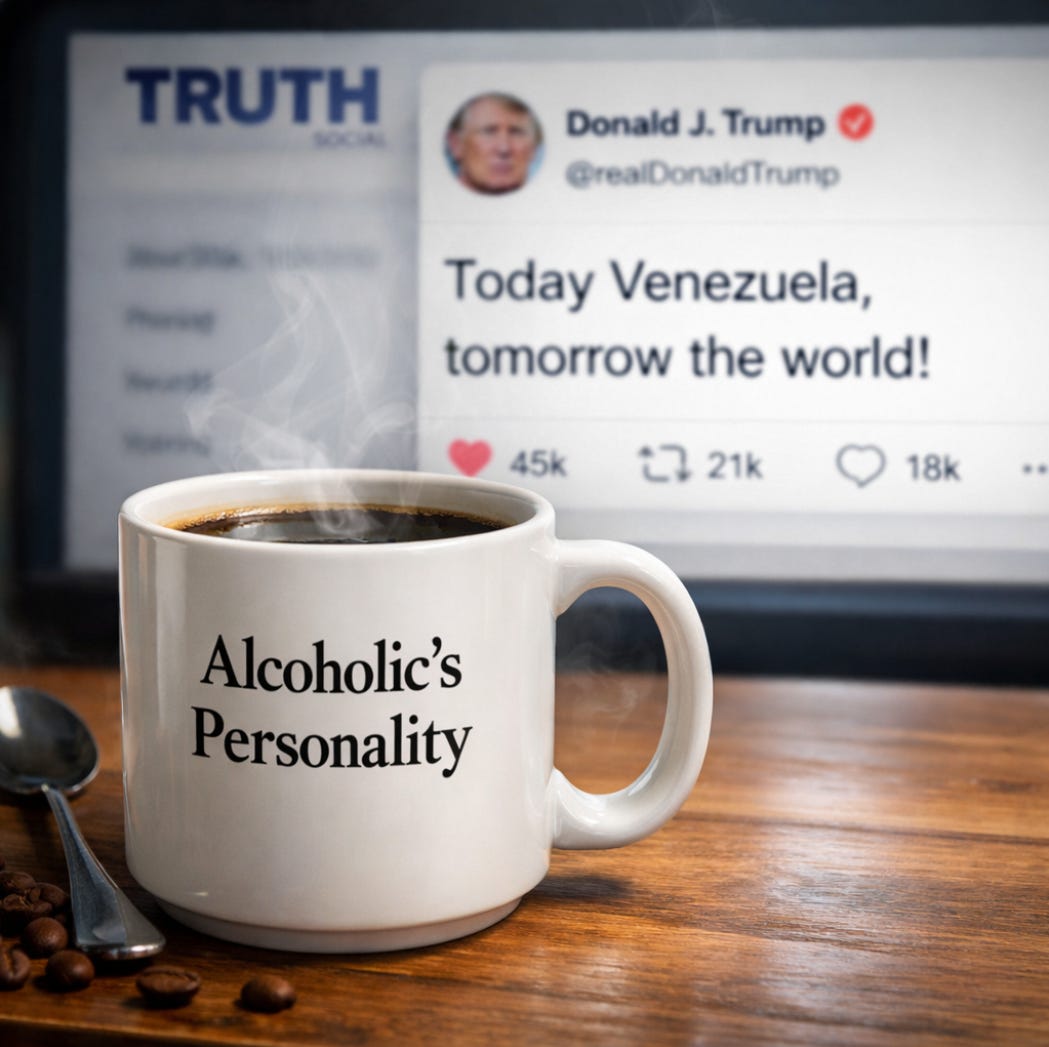
Which brings us to the real escalation that hit last night, the one that doesn’t come with catering and applause lines. Trump announced what he called a “total and complete blockade” of sanctioned oil tankers entering or leaving Venezuela and declared the Maduro government a foreign terrorist organization. The blockade language is not a rhetorical toy; a naval blockade is widely understood as an act of war. The FTO claim is not something presidents typically get to declare by vibes and punctuation; it normally runs through the State Department and carries sweeping legal consequences well beyond U.S. borders.
Yet, if you listened closely to Trump’s speech at the Hanukkah reception, this latest escalation makes perfect sense inside his operating system. It’s declaration first, legal clarity never, and everyone else scrambling afterward to make the reality fit the headline. That governing posture was spelled out almost word for word in Susie Wiles’ recent interview, where she described a White House designed for speed, not deliberation, a presidency intentionally stripped of friction.
In Wiles’ telling, Trump doesn’t want process, paperwork, or dissenting expertise slowing him down. She described him in almost clinical terms, likening his behavior to what anyone who has lived with addiction would recognize: the impulsivity, the grandiosity, the demand for constant stimulation, the conviction that intensity itself is clarity. Trump, in this framing, isn’t a planner; he’s a momentum addict, driven by escalation and allergic to restraint.
Around him, Wiles sketched a supporting cast built to reinforce that dynamic rather than counterbalance it. Elon Musk, whom she described openly as a ketamine user, was presented as a kindred spirit, disdainful of institutions, impatient with limits, convinced that speed and scale excuse recklessness. And then there is Stephen Miller, not a manager or a pragmatist but a zealot: ideologically rigid, relentlessly focused on enforcement, and willing to push policies to the outer edge of legality and then lean harder.
Put together, it’s not chaos, it’s a system optimized for compulsion. Trump supplies the impulse, Musk supplies the contempt for guardrails, and Miller supplies the ideological machinery to turn obsession into policy. Decisions move faster than laws, norms, or institutions can absorb them, and the cleanup is always someone else’s problem.
In that model, loyalty substitutes for expertise, and restraint is treated as sabotage. Trump’s intuition becomes the final authority, not guided by law so much as retroactively justified by it. The point isn’t whether the designation exists, whether Congress authorized it, or whether international law allows it. The point is that Trump said it, loudly, in public, and the rest of the system is expected to contort itself around that fact.
Pair that with the emerging crypto pardon economy we’ve been tracking, where regulatory relief, DOJ discretion, and even presidential mercy itself begin to look transactional, and a coherent model snaps into focus. Power isn’t exercised on behalf of institutions; it’s exercised as personal property. Law isn’t a boundary; it’s either a weapon to deploy against enemies or a coupon to redeem for allies. Justice becomes selective, enforcement becomes optional, and access becomes everything.
Seen through that lens, the Venezuela announcement isn’t reckless improvisation; it is consistent behavior. It’s the same muscle flexed at the White House ballroom, where a restricted court ruling instantly becomes “we won the case,” and a $300 million project inflates to $400 million because bigger numbers feel more dominant. It’s the same instinct on display when Trump boasts about deporting “foreign jihadist sympathizers at record levels” at a religious celebration, or turns a menorah lighting into a war story about “obliterating” Iran.
While Trump is narrating armadas and inventing legal categories from his phone, the Pacific Northwest is dealing with the kind of reality that doesn’t care what you call it. Washington state is now facing profound damage from record flooding after more than a week of heavy rain, close to two feet in parts of the Cascades, with more high water, mudslides, and power outages in the forecast. More than 600 rescues across ten counties. Hundreds of assisted evacuations. At times, up to 100,000 people under evacuation orders. State Route 2 may be closed for months. People pulled from apartment windows as the water surged in faster than alerts could keep up. One confirmed death, a man who drove past warning signs into floodwaters, and first responders warning that the casualty count could easily have been worse.
Our northern neighbors are right in the path of these storm systems too. British Columbia and western Canada aren’t treating Washington’s disaster as a contained incident. They’re bracing for the same atmospheric rivers, the same landslide risks, and the same compounding damage. Sitting here on the relatively calm Southern Oregon Coast, it’s hard not to feel both grateful and faintly guilty.
So that’s the morning: a president who can’t light a menorah without also auditioning for a war movie, boasting about deportations, praising a quarter-billion-dollar donor, and calling a restricted court ruling a “win,” followed by a brand-new foreign escalation announced like a product launch, all while the Northwest deals with the physically unavoidable consequences of a destabilized climate.
Marz and I are playing elf today, getting errands done while the lights are still on and the roads still cooperate. My wish list has shifted accordingly: a solar system sooner rather than later, and maybe an EV, less indulgence than adaptation at this point.
As you continue to track and write about Twump's daily audaciousness, your readers continue to fall deeper into a reality that is impossible to navigate. Yesterday I thought of something awful that he did a week ago (can't recall) and I thought, he's getting away with everything. When does this end, because it will. He will die or fall off the stage or throw up on Rubio or something will happen where there is regime change. Then, perhaps, people will wake the f up. When Maga sees their boy JD Vance and his fatfaced meanboy disdain for everything that is not Thiel-sanctioned, they might, just might begin to realize that the world is not what they thought it was and if they don't change their mindset, they will be left behind. Why they choose as their earthly God a man like Twump is still beyond my brain's ability to figure. Maybe because, as I write this, my brain is not damaged, I got a great education and I truly believe in my country. This right now is an aberration; it is not my country: this is a fatal takeover. And I will do whatever it takes to undo this mess.
Will someone take away his access to the nuclear launch codes, like now!