


Good morning! We should begin where it matters most. In Tumbler Ridge, British Columbia, a town of just 2,400 people tucked into the foothills of the Rockies, nine people are dead after a shooting at the local secondary school and a nearby home. Twenty-five others were injured. Students and teachers barricaded themselves inside classrooms and workshops for hours. A mechanics teacher and 15 students locked garage doors, shoved metal benches against entryways, and stared at a wall clock waiting for police to knock. In a town where fewer than 200 students attend the secondary school, everyone will know the names of the victims. The mayor said it plainly: he will know every one of them.
Canada has faced mass violence before; the Nova Scotia massacre in 2020 reshaped national gun policy. But these events remain rare enough that when one happens, it ruptures something fundamental. Schools are closed for the week, trauma counselors are on the way, and families are still waiting for notifications. World leaders have reached out in solidarity. As of this writing, there has been no public statement from President Trump. Our hearts are with the people of Tumbler Ridge and with Canadians across the country who are grieving. There’s nothing clever to say here. Just solidarity. Love you, Canada.
Back to the United States, where events like Tumbler Ridge are all too commonplace and the phrase “rule of law” has started to sound like a vintage collectible.
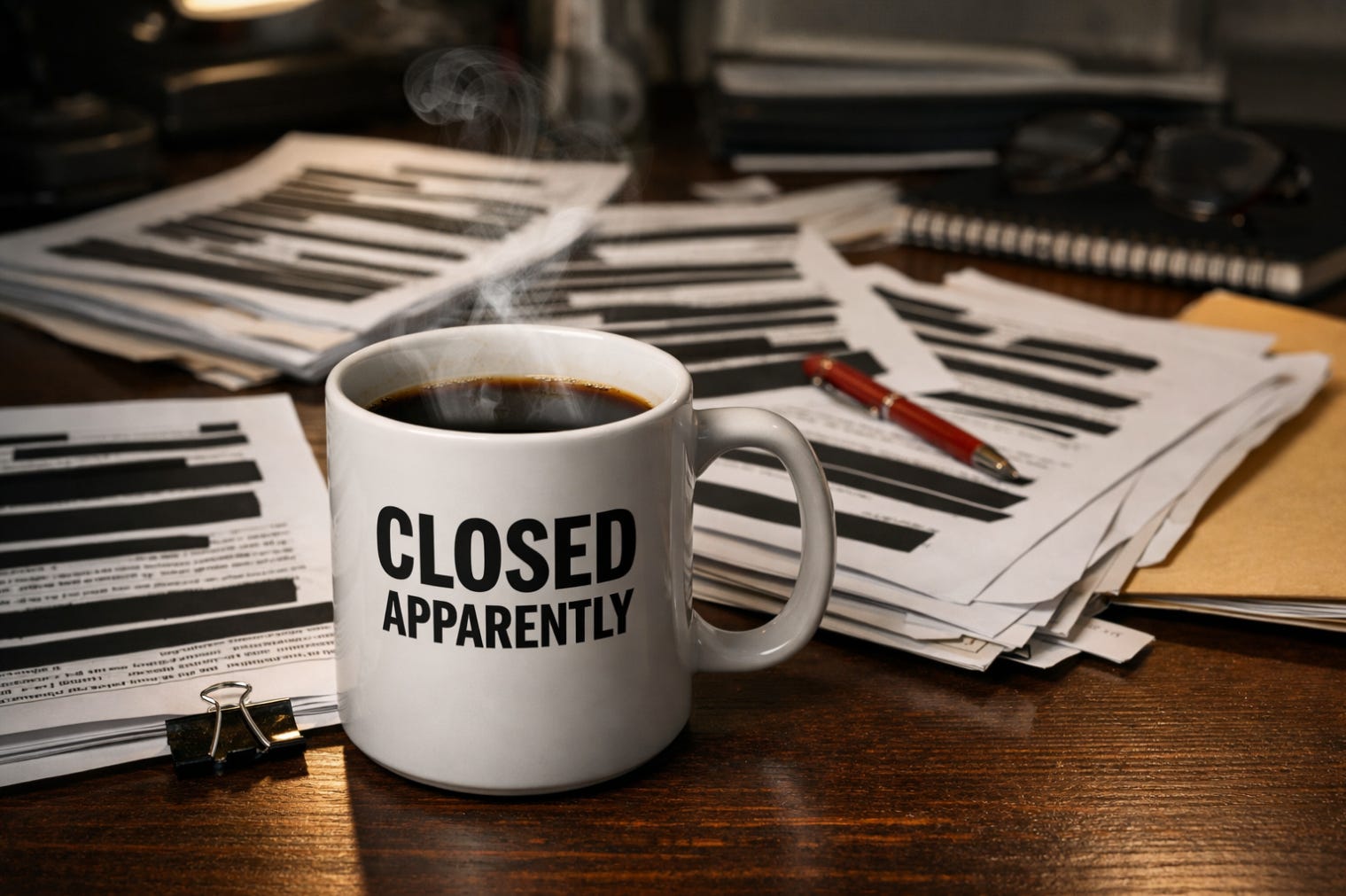
The Justice Department is once again assuring everyone that it has been fully transparent in releasing the Epstein files. Fully transparent, except for the parts that are blacked out. And the parts that were “inadvertently” redacted. And the parts that may have been scrubbed upstream by the FBI before DOJ ever uploaded them.
This week, Representatives Ro Khanna and Thomas Massie went to the Department of Justice to review what were described as “unredacted” Epstein files. According to Khanna, 70 to 80 percent of the material remains blacked out. In just two hours, they identified six wealthy men whose names had been withheld “for no apparent reason,” including billionaire Les Wexner and Sultan Ahmed bin Sulayem. Only after lawmakers pressed the issue were those names formally unmasked. Khanna’s question on the House floor now hangs over the entire process: if they found six in two hours, how many more are buried in three million pages?
Representative Jamie Raskin told Axios that when he searched the DOJ database using the terms “Trump,” “Donald,” or “Don,” the system returned more than a million results. He acknowledged he did not review each entry and that not every reference to “Donald” would necessarily be Donald Trump. But among the documents he did review was a 2009 email exchange in which Jeffrey Epstein recounted a phone call involving Trump and Mar-a-Lago, an account that appears to conflict with Trump’s public narrative about the circumstances of Epstein’s departure from the club.
Representative Melanie Stansbury, emerging from her own review visibly shaken, described the files as “dark, disgusting, and disturbing,” and pointed again to decades of institutional failure beginning with the 2006 non-prosecution deal that allowed Epstein to continue abusing girls across properties and continents. She also renewed alarm about Zorro Ranch in New Mexico, arguing that the FBI never conducted a full forensic investigation before the estate was sold. A crime scene liquidated and accountability deferred.
Attorney General Pam Bondi is set to face the House Judiciary Committee today, where lawmakers, including some Republicans, are increasingly frustrated that the redactions in the Epstein files appear to stretch well beyond the narrow exemptions allowed under the Epstein Files Transparency Act. The Justice Department insists it has been transparent. It also insists it must protect victims. It’s a remarkable balancing act: exposing some victims’ names while claiming to hide nothing, all beneath layers of black ink.
This is where we are: Congress reading names aloud because the Justice Department won’t. Lawmakers alleging that the FBI scrubbed files before compliance with the transparency law. A department that once guarded its independence now defending prosecutions of the president’s adversaries while fumbling its way through disclosures about the president’s former social circle. Elite accountability remains theoretical.
And while we’re on the subject of theoretical governance, let’s talk about the FAA. Earlier this week, the Federal Aviation Administration abruptly shut down the airspace over El Paso, Texas, for ten days due to “special security reasons.” Three hours’ notice. A ten-nautical-mile no-fly zone up to 18,000 feet. Flights grounded, airport employees confused, air traffic controllers telling baffled pilots, “Apparently” the airport would be closed. Then, a few hours later: never mind. Airspace reopened. No threat, all flights resume as normal.
It’s like someone in the Trump kakistocracy accidentally hits “reply all” and then tries to recall the email. When “special security reasons” dissolves into “there is no threat” before lunch, public trust erodes just a little more.
Trump stood in Davos and decried the rise of a “nation of renters.” His new executive order is supposedly meant to stop large institutional investors from buying up single-family homes and renting them back to Americans. A populist applause line. A crackdown on Wall Street landlords.
But buried in the fine print is the familiar twist: corporations may be barred from acquiring existing single-family homes, yet they remain perfectly free to build entire neighborhoods designed exclusively for rent. And build-to-rent communities are booming. Tens of thousands were completed last year. The same Wall Street firms that once snapped up foreclosures now cut deals with homebuilders to pre-purchase entire subdivisions before a family ever has a chance.
Brand-new homes, white picket fences, freshly poured driveways, and “For Rent” signs out front. America will not become a nation of renters except, apparently, in the brand-new rental-only subdivision with the pickleball courts and dog park.
It’s governance by slogan, or even platitude. The problem is framed as corporate buying, and the solution quietly encourages corporate building. Homes are for people, not corporations, unless the corporation builds the home, keeps the deed, and rents it back to you forever. Then it’s policy.
This dovetails neatly with the economic undercurrent we’ve been tracking. Consumer credit spiking. Retail sales flat. Households leaning on plastic while asset prices remain out of reach. The American dream, now available in subscription form.
The reshaping continues abroad. Sarah B. Rogers, the State Department’s undersecretary for public diplomacy, has been meeting with Europe’s far-right parties, criticizing hate-speech laws in Germany and Britain, and placing visa sanctions on individuals accused of belonging to a so-called “censorship-industrial complex.” Germany has designated the Alternative für Deutschland as a confirmed right-wing extremist force. Washington, under this administration, calls that designation “tyranny in disguise.”
Public diplomacy once meant strengthening alliances among liberal democracies. Now it means amplifying nationalist grievance narratives and attacking allied governments over speech and migration policy. Culture export as power projection.
So here we are. A school shooting in a Canadian town that will carry the grief for generations. A Justice Department tangled in its own redactions. An airspace closure that lasted less than a workday. A housing order that outlaws corporate buying while greenlighting corporate renting. A foreign policy posture that treats illiberal movements as partners and democratic constraints as nuisances.
Is it kakistocracy? Incompetence elevated? Or is it something more deliberate, the steady normalization of systems that protect the powerful, distract the public, and keep the rest of us renting the future?
t’s a chilly blue-sky morning here on the Southern Oregon Coast. Marz and I have some work to do on our little radio station while the weather is clear: salt air, cold fingers, and a to-do list that doesn’t care about geopolitics.
I am a Canadian living in Canada. Thank you, Mary, for your warm and sincere condolences regarding the school shooting in British Columbia. You do note that it's a far more common occurence in the USA but still a horribly shocking and fairly rare occurence in Canada. Our Prime Minister Carney was heartfelt in his message about it today. While trump (just can't call him President and can't even capitalize his name) has not shown any grief toward the families, he HAS been looking at Canada from the perspective of wanting half ownership of the new bridge joining Windsor and Detroit or he won't allow it to open, causing big troubles for business & industry on both sides. It's not a warranted demand, but when do his claims ever carry legitimacy?
"accountability remains theoretical" MG