


Usually, when I sit down to write about hope for humanity, there’s something alive at the center of the story. An animal someone stopped to help. A forest people refused to surrender. Some frightened, breathing thing that survived because another living creature recognized its life as important and accepted responsibility for what happened next.
I love those stories. I need them. There are weeks when someone gently lifting an injured bird feels like the only news my heart has room to receive. But this week, I keep thinking about the people who reach out their hands knowing that helping will cost them something they may never get back. The ones who have their own families to protect, their own bills to pay, their own carefully assembled futures, and still find themselves looking at a line they can’t cross.
Kathleen Walters was one of those people.
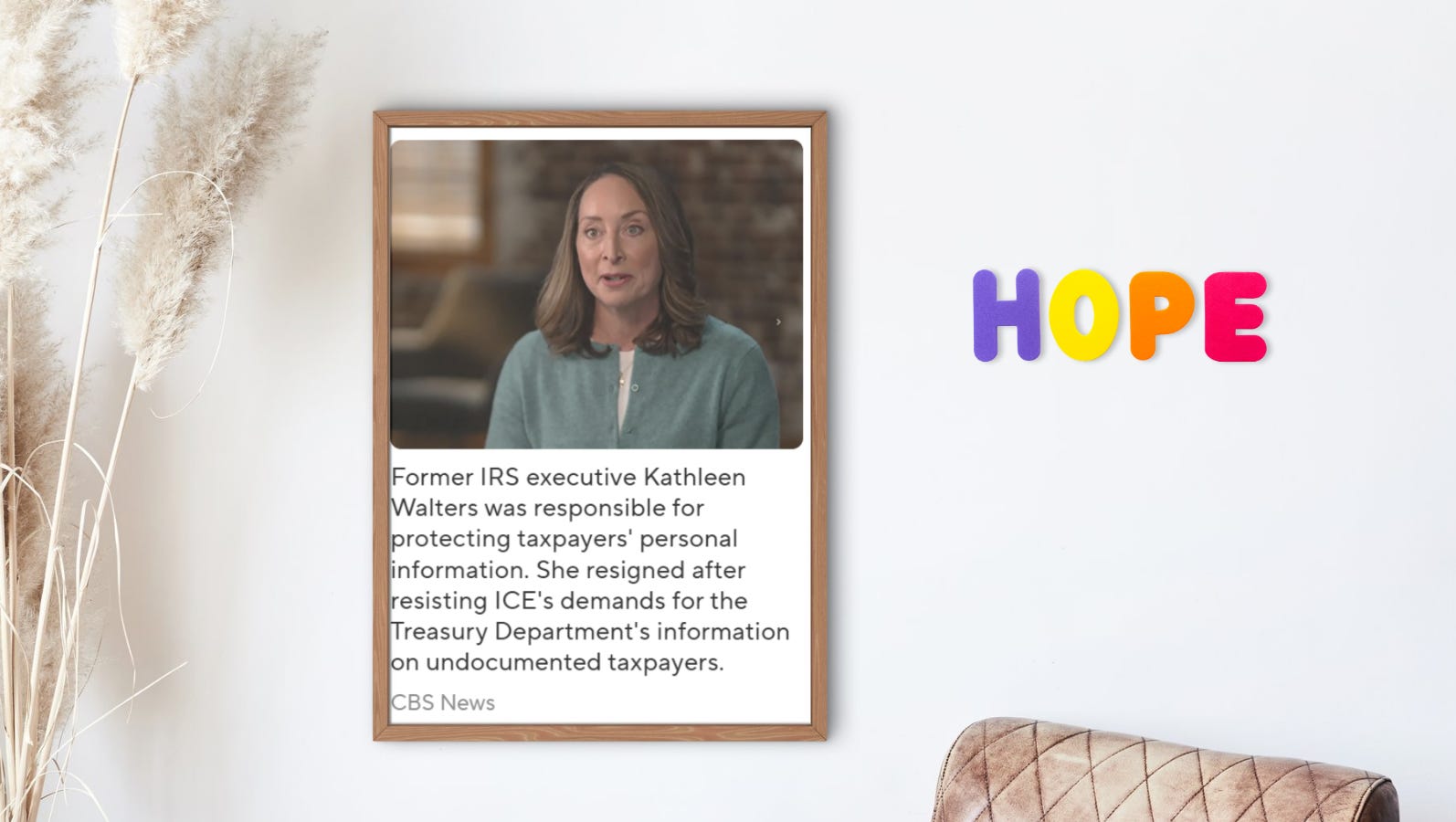
As the chief privacy officer at the IRS, she was responsible for safeguarding information people had entrusted to their government. Michael Lewis tells her story in Blockers: Rebels in the Deep State, his new book about public servants who stood in the way of the Trump administration’s demands. In Walters’s case, those demands involved confidential taxpayer information sought for immigration enforcement.
These are the kinds of words that can make a story feel very far away. Confidential information. Data disclosure. Administrative responsibility. You can almost hear the fluorescent lights giving everyone a migraine. But an address is where someone sleeps. It’s where a child knows which cupboard holds the cereal. Where someone takes off their shoes after work, where the grocery bags land, where a family has arranged its small collection of ordinary things around the belief that tomorrow will happen.
There are people inside the information. Protecting it means remembering them. Walters said the agency’s attorneys had determined that the requested disclosure was unlawful. She refused to facilitate it and ultimately resigned. Lewis described her hiding in darkened conference rooms while officials looked for her to fire her.
I keep trying to hold those two things together. The enormous machinery of the federal government, and a human being sitting in a room with the lights off because she’d taken her responsibility seriously.
In a movie, this is where the music would change. We would recognize the moment immediately. Someone’s been told to stand aside. Someone powerful wants access to the people behind her. The person at the door understands what opening it could mean, so she continues to hold the line.
Watching from the couch, we would know whose side we were on. Living inside that moment must be something else entirely. There’s no soundtrack to assure you that history will understand. You still have to go home afterward and whatever you decide will follow you through your own front door.
Walters has a daughter. Speaking with The Atlantic, she recalled explaining that leaving meant they would have to spend less. Her daughter told her, “Mom, even if we have to live in a tent in someone’s yard, you made the right decision.”
That’s a child who deserved to have both: a mother she could be proud of and a family whose security was never threatened by her mother doing the right thing. I want to stay with that for a moment, because it’s easy to make someone’s sacrifice beautiful once we’re safely outside it. We admire the courage and pass along the story. Meanwhile, the person who made the choice has to keep living with its consequences. Admiration doesn’t pay the electric bill. Being on the right side of history is a considerable comfort with a remarkably poor prescription plan.
Her courage moves me. The fact that she needed it makes me angry. And somewhere inside those two feelings is the hope I want to talk about. We’ve spent so much time watching powerful people fail us that it becomes possible to mistake them for the whole of humanity. Their faces fill the screens. Their decisions enter our homes. They can make cruelty feel enormous and conscience feel like a small, increasingly inconvenient thing.
Then we learn the name of someone who refused. Someone who understood that an instruction from above didn’t erase the people below. Someone who could have made her own life easier by deciding that whatever happened next was somebody else’s responsibility. People like her are part of the reason we still have a chance.
Trump’s election didn’t automatically turn every person inside the government into an extension of his will. Carrying out an abuse requires people to participate. It requires signatures, access, cooperation, and silence. At each of those points, there can be a human being who remembers what the work is for.
Without those people, an election victory could become an immediate surrender of everything the winner wants to take. Their resistance gives the rest of us something to work with: time, knowledge, evidence, an example, and another person willing to speak. We owe some of our remaining room to fight to people whose own room to maneuver became terribly small.
That doesn’t mean every refusal succeeds. Walters’s departure didn’t end the threat to the people whose information she’d worked to protect. There’s real grief in that. A person can do something brave and still be unable to stop what comes next.
But what she did is still reaching people. It reached me. Here I am, a mother in Oregon, learning her name and finding a little more strength for something that has felt exhausting and frightening for a very long time. She couldn’t have known me when she made her decision. She couldn’t have known my daughter. And yet something she did for the people she was responsible for protecting has traveled far enough to become hope in our home.
There is something painful about admitting that. The risk another mother took with her own family’s security has become part of my belief that I can still give my daughter a fighting chance. I wish she could have given us that courage without having to carry so much of the cost herself. I wish doing right by other people’s children had never put her ability to provide for her own in question.
But I feel what she has given us. When I imagine the future my children will have to live in, I have one more reason to believe there will be people willing to defend it. And when I wonder whether anything I do can matter against something this large, I can think about a woman whose decision reached all the way into my life.
That is how courage becomes hope. Someone acts, and another person discovers they have a little more strength than they had before. A refusal becomes an example. The example becomes a reason to try. Somewhere farther along, someone facing a choice remembers that another person stood where they are standing and found a way to hold the line.
We can’t know how far that will travel. We can only recognize that it has already reached us.
Trump’s power depends, in part, on persuading people that resistance is useless, that everyone can be frightened into compliance, that eventually we will all accept the future he wants to give us. Every person who refuses leaves the rest of us with evidence that something else is possible. There are still decisions being made. There are still people who can make them differently. There is still a future being formed, and people like Kathleen Walters are helping us find the courage to have a hand in it.
I find that almost unbearably tender. There are people we’ve never met whose strength has become part of our own. They may never know which of us needed their example, which frightened person tried again because of it, which parent found a little more faith in the world their child will inherit.
And we have a responsibility to let that strength keep moving. To stand beside the people taking these risks, to help carry their costs, and to bring the courage they’ve given us into the choices that belong to us.
I still need the stories about forests coming back and frightened animals reaching safety. I need reminders of what our tenderness can save. This week, I needed this reminder, too: the courage of one person can reach another, and another, until more people are willing to defend a future they had begun to think was lost.
My daughter deserves that future. So does hers. And because her mother held the line, I feel a little stronger holding mine.
Wonderful post. Kathleen Walters' courage is indeed inspirational. Thanks for writing about her and giving us a little hope.
“A refusal becomes an example. An example becomes a reason to try.” Shanley, this essay choked me up. Beautifully written and yes, tender. Kathleen Walter is a hero and a role model. Firing her was a nasty, cruel, cowardly, and unnecessary act. The tyrant is a phony. Thank you for your beautiful essay.