


Good morning. Forty-nine to fifty. That was the number that mattered in Washington yesterday, when the Senate rejected yet another attempt to make Congress exercise the war power the Constitution assigned to Congress.
The measure before the Senate, H.Con.Res. 89, directed the president to remove U.S. forces from hostilities with Iran absent congressional authorization. It failed by a single vote, 49–50. Republicans Susan Collins, Lisa Murkowski, Rand Paul and Thom Tillis joined Democrats and independents in voting for it. Democrat John Fetterman voted against it. Angela Alsobrooks was absent. Both of Oregon’s senators, Ron Wyden and Jeff Merkley, voted yes.
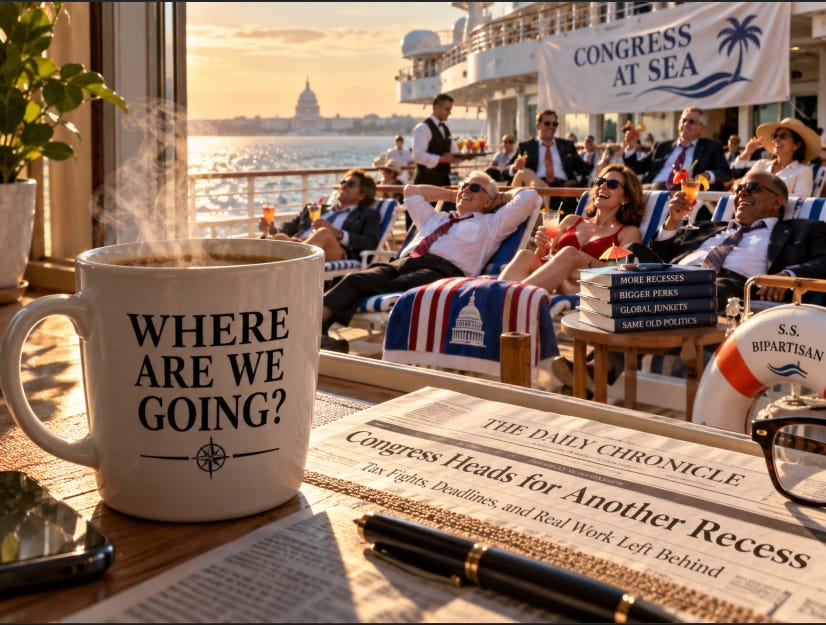
There is a small Washington procedural absurdity tucked inside the larger Washington procedural absurdity: the Senate was voting on the House resolution passed back in July, not the newer Iran war-powers resolution the House passed September 15 by 220–204.
Congress has reached the stage where it can vote again and again on whether to exercise its constitutional authority over war while the war itself carries on regardless. It’s tempting to say the war is running on autopilot, but even autopilot implies a flight plan. And our service members are the ones paying the price.
The conflict has passed the 200-day mark. The Pentagon has publicly acknowledged 19 U.S. military deaths associated with the war and more than 800 wounded, though internal figures may be higher. The Congressional Budget Office estimates that combat operations cost the Defense Department about $38 billion through August 1. A later CENTCOM estimate put the bill at $43.6 billion through September 3, with weapons expenditures accounting for much of the increase.
CBO estimates another month of fighting could cost roughly $2 billion at the comparatively lower intensity seen in May and June, or about $3 billion at July’s intensity. Those estimates come with an extraordinary footnote: the Defense Department did not respond to CBO’s requests for information, so Congress’s own budget analysts had to reconstruct the costs using government databases and public reporting.
Even the damn receipt is classified from the people paying the bill.
Those costs are not confined to the Treasury. CBO found that disruption to oil markets and refining is feeding through into consumer prices and now expects year-over-year PCE inflation in early 2027 to run about half a percentage point higher than it projected before the war. Meanwhile, analysts tracking U.S. missile-defense stocks estimate that Patriot and THAAD inventories have been significantly depleted, creating risks for other contingencies, particularly in the western Pacific.
Then we have the human ledger. Acting Navy Secretary Hung Cao has now acknowledged in a letter to Sen. Kirsten Gillibrand that eight sailors assigned across the USS Abraham Lincoln carrier strike group attempted suicide during its extraordinary deployment. The figure includes the carrier crew, air wing, strike-group and destroyer-squadron staffs, escorting destroyers and embarked aviation squadrons. None of the sailors died by suicide.
That disclosure arrived after months of reporting from military families and journalists about exhaustion, food shortages, problems with toilets and laundry facilities, extraordinarily long stretches at sea and growing concern about sailors’ mental health.
When those stories surfaced publicly, Defense Secretary Pete Hegseth said the situation had been “completely misrepresented.”
Now the Navy is supplying some of the numbers itself. That should be enough to stop treating deployment length as an abstraction on a Pentagon PowerPoint.
This is where yesterday’s Senate vote becomes something more than another piece of congressional parliamentary furniture. If lawmakers choose not to restrain a war, they inherit responsibility for what continuing it requires.
That responsibility covers the money, the missiles and the 19 military deaths publicly acknowledged so far. It extends to the people sleeping in racks below the flight deck while the people who sent them there argue about whether Congress technically needs to participate in the decision.
If you or someone you love is in crisis, call or text 988. Veterans and service members can press 1 to reach the Veterans Crisis Line.
Which brings us to a rather remarkable cover story from The Economist this week.
The headline is “When America walks away.”
The subtitle is even less coy: “For decades America has enjoyed hegemony over the Middle East. That is about to end.”
The Economist’s argument is not that the United States will disappear from the Middle East. America will retain bases, alliances, intelligence relationships, naval power, counterterrorism capabilities and the ability to use enormous military force when presidents decide American interests require it.
What The Economist believes is ending is something larger: Washington’s attempt to serve as the architect of the regional order.
And if you look closely at what the administration itself is doing, you can already see pieces of that retrenchment taking shape.
This month, Saudi Crown Prince Mohammed bin Salman repeatedly asked Trump to strike the Houthis as they threatened Saudi interests near the Bab al-Mandeb. Trump declined and offered intelligence and targeting help instead. American diplomats then met Houthi representatives in Oman to preserve the U.S.-Houthi ceasefire and keep Bab al-Mandeb open. Trump later reviewed strike options and held off again.
So Washington is at war with Iran, Iran’s proxies are at war with Saudi Arabia, and Washington is negotiating with those proxies to protect its own ships while trying not to inherit Riyadh’s fight. Each decision may be defensible on its own. What’s missing is the strategy connecting them.
Trump stood before the United Nations this week issuing fresh threats against Iran and dismissing concerns about American weapons stocks. Meanwhile, military planners are husbanding scarce interceptors, American diplomats are negotiating with an armed militia, the president is declining an ally’s request to open another front, American bases have suffered significant missile and drone damage, and a carrier strike group is finally making its wat toward home after a deployment that seems to have been measured using geological time.
“Where does this end?” deserves an answer considerably more sophisticated than we’ll know when we get there.
A strategy tells you where you are going and how you will know when you have arrived. Instead, Washington has offered escalation, negotiation, redeployment, threats, restraint and escalation again.
That may explain why The Economist now treats the decline of American hegemony in the Middle East not as some distant possibility but as the premise of its argument.
There is another piece of arithmetic underneath it.
For much of the postwar period, protecting Persian Gulf oil could plausibly be described as protecting a vital American energy lifeline. The United States today is one of the world’s largest oil producers, and Gulf crude accounts for only a small share of what we import. China, meanwhile, is the world’s largest crude-oil importer and one of the region’s most important customers.
And this week, while American ships and service members continue carrying much of the military burden of maintaining order around those energy routes, Trump has been rolling out the red carpet for Xi Jinping personally greeting him at Joint Base Andrews, staging a military arrival ceremony and flyover, and hosting him at a White House state dinner.
Diplomacy is cheaper than war, but the juxtaposition is hard to miss.
China has an enormous commercial stake in Gulf stability. The United States continues paying a disproportionate share of the military cost of providing it. And Xi gets to arrive in Washington for dinner while American sailors patrol the sea lanes that help keep Chinese refineries supplied.
China may have discovered one of history’s great geopolitical bargains: if somebody else insists on paying for the aircraft carriers, perhaps do not interrupt him.
Stepping back carries risks. But seven months of war haven’t solved any of those problems. Iran’s ambitions, the rivalries and the chokepoints were all there before February and will still be there when this ends. The obvious counterargument to retrenchment is formidable. Iran remains a regional power with nuclear ambitions. Israel, Turkey and Iran have competing interests. Gulf monarchies have structured their security around American protection. Hormuz and Bab al-Mandeb remain indispensable arteries of global trade. Terrorist organizations have not disappeared merely because Americans have grown weary of the neighborhood.
What political objective does continued military engagement achieve, what price is the country prepared to pay for it and what measurable condition would permit the people aboard ships like the Lincoln to finally come home? Something like a plan or strategy would be helpful.
Amid all this, something rather beautiful happened at the United Nations yesterday.
Dutch Prime Minister Rob Jetten took the podium. He began with Anne Frank as a teenage girl with no office, no army and no power beyond a pen and a diary. Jetten used her belief in the ability of ordinary people to change the world as the doorway into an argument about the institutions created after the catastrophe that killed her.
The United Nations. International law. The International Court of Justice. The International Criminal Court.
He spoke about Gaza, Sudan and Ukraine, and argued for giving middle powers and underrepresented countries more responsibility. He talked about climate change not as an ideological loyalty test but as a problem humans possess the technology to address if governments can summon the cooperation to use it.
Then he addressed recent attacks against the ICC.
“International law either works for everyone, or for no one,” he said.
Two days earlier, Donald Trump had stood before the same United Nations and called on every country belonging to the International Criminal Court to quit it immediately, describing the ICC as a “rogue institution” and its officials as an “evil group of people.”
Jetten did not need to mention Trump.
The ICC is headquartered in The Hague, in Jetten’s country. He reminded the assembly that the court grew from the legal inheritance of Nuremberg and Tokyo, created around the revolutionary proposition that even the gravest crimes should be answered with law rather than vengeance.
“Hands off the ICC,” he said.
Then Jetten remembered Americans. He returned to Anne Frank and reminded the room that liberation from fascism arrived too late for her and millions of others. But when it finally reached the Netherlands, it came with American, Canadian, British, Polish and other Allied soldiers, many of them barely older than Anne.
Some of the Americans never went home.
They are buried at the American cemetery at Margraten in the southern Netherlands.
A wall stands over their graves bearing the words:
“To you from failing hands we throw the torch. Be yours to hold it high.”
America does not have to dominate the world in order to remain engaged with it. Those soldiers did not die so that succeeding generations of Americans would be required to police every shipping lane, arbitrate every ancient rivalry or permanently station themselves inside every regional conflict.
They helped create something after the war: alliances, courts, treaties, international institutions, and a belief, frequently violated, imperfectly applied and maddeningly slow, that nations might occasionally settle disputes without sending another generation of young people to kill one another.
There is a vast distance between hegemony and isolation. Somewhere inside that distance is strategy and Congress ought to be capable of discussing it.
Citizens are entitled to demand that discussion.
If Washington is improvising a war with no clear end, then Congress has an obligation to stop behaving like a spectator. Lawmakers should define the mission or end it, account honestly for the costs in lives and dollars, explain what success would look like and protect the people we have sent to fight. Indefinite war should not be the default setting of American foreign policy.
Thursday’s vote gives every American something concrete to ask about. Call your senators and representative to find out how they voted and why. Press them on what American forces are supposed to accomplish in Iran, what authority permits the war to continue without explicit congressional authorization, and what measurable conditions would allow those forces to come home.
Then take those questions to your local newspaper and your next town hall. Listen to military families and veterans. Support organizations demanding honest casualty figures, realistic deployment schedules and adequate mental-health resources for the people carrying out decisions made thousands of miles away.
Write to your local newspaper. Ask those questions at town halls. Listen to military families and veterans. Support organizations demanding honest casualty figures, realistic deployment schedules and adequate mental-health resources for the people carrying out decisions made thousands of miles away.
When a senator says, as Dan Sullivan did Thursday, that a war-powers resolution means “removing American forces from the region,” read the resolution yourself. It does not order America out of the Middle East. It directs the president to remove American forces from hostilities against Iran unless Congress authorizes those hostilities.
Fight for our troops like they fight for us.
That the need for oil and the wealth it provides underpins all of this adds to my disgust.
From the outside, the United States (aka, incorrectly, as "America') looks more and more like a caracature of a real country.