

In the space of a few hours, Donald Trump sat beside three leaders and sold the same victory three different ways.
With Emmanuel Macron, it was a triumph of statesmanship: “the deal’s all signed,” the Strait was already partially open, ships were moving, oil was falling, markets were rising, and the text would be released “pretty soon.” With Qatar, it was a story of bravery and friendship, the Gulf on the front line, Iran subdued, the nuclear threat supposedly settled. With the United Arab Emirates, it became a promise of permanence: the Strait of Hormuz would be open, toll-free, beyond the 60 days, forever. The deal, Trump said, was so clear he might hold a press conference and read it to the press “word by word.”
But the document was not public. The second stage was still ahead. The central nuclear questions had not been resolved. The ceasefire was temporary. The enforcement mechanism was opaque. The enriched uranium was still a matter for later discussion. And the more complete Trump declared the deal to be, the more conspicuous its incompleteness became.
This was the tell. Not the boast, but the gap inside the boast. The performance of victory was loudest precisely where the substance was thinnest.
General Sir Richard Shirreff, NATO’s former Deputy Supreme Allied Commander Europe, supplied the counter-narration. Shirreff points out, this is not a deal, but a memorandum of understanding, a framework for discussing a deal. The Strait of Hormuz was not magically secured; it still required mine clearance, shipping confidence, and the forbearance of the same Iranian state that had just demonstrated its ability to hold the global economy at risk. And then Shirreff reached for the analogy that turns the episode from a diplomatic scramble into a historical warning: Suez.
In 1956, Britain and France did not merely fail to seize a canal. They discovered, in public, that they no longer commanded the world they thought they commanded. The canal was the setting. The revelation was the event.
The claim is not that Hormuz is Suez in exact miniature. It is that both crises reveal the same class of fact: command of the global commons is not proven by the ability to destroy, but by the ability to secure, deter, and sustain order without bargaining from panic. A superpower can bomb. It can blockade. It can threaten “ultimate consequences.” But if the result is an unreleased MOU, a closed-and-then-reopened strait, deferred nuclear terms, nervous allies, and a president touring the G7 selling a settlement whose text he has not shown, then the real story is not triumph.
Hormuz is not the whole story. It is the first place the illusion failed to hold.
The first reversal was the Strait.
Trump described it as the simple restoration of order. Ships were moving. The Strait of Hormuz would be open by Friday. It would be toll-free, free sailing, permanently open. He congratulated the Navy for an “unbelievable” blockade and for the reopening that followed.
But this was the indictment hidden inside the celebration. The United States was congratulating itself for restoring a freedom of navigation it had helped forfeit. The Strait had not closed because Iran had become stronger than America. It closed because the war Trump and Netanyahu launched gave Iran the one form of leverage it did not need a blue-water navy to wield: geography. A state that could not defeat the U.S. fleet could still threaten the valve through which global energy markets breathe.
The hegemon was celebrating the return of a freedom it had converted into a bargaining chip.
And even that restoration was provisional. Mines still had to be cleared. Commercial shippers still had to believe the route was safe. Insurers still had to price the risk. Iran still retained the ability to test the same pressure point again. The Strait was not secured in the deeper sense. It was being reopened under the shadow of the actor that had just shown how easily it could make the world care.
The second reversal was the uranium.
This was the object around which the war was supposedly organized. Iran could not be allowed to have the material basis for a bomb. That was the justification, the emergency, the line that made all the rest necessary. Yet by the time Trump was explaining the settlement, the material itself had somehow become almost trivial. It was “probably half a million dollars’ worth,” he said. “Not very valuable stuff.” The mountain had collapsed on top of it. The United States had cameras on it. There was no rush.
But the known stockpile was not trivial. The IAEA reported that, before access was constrained after the strikes, Iran had accumulated about 440.9 kilograms of uranium enriched up to 60 percent, material near weapons-grade and, if further enriched, enough for multiple nuclear weapons. The agency has since been unable to verify the present size, composition, or whereabouts of the enriched uranium stockpile at affected facilities because Iran has not provided the necessary access and reporting. Independent nuclear analysts have warned that Iran may have moved much or all of its highly enriched uranium inventory to Isfahan before earlier strikes, while other reporting has described that site as difficult to access and potentially booby-trapped.
That is the sharpest contradiction in the whole episode. The man who started a war to stop bomb-making material was now calling the bomb-making material worthless, and could not publicly say where it was.
Let those facts sit next to each other. The war did not resolve the nuclear question. It made the question harder to verify.
The third reversal was the arsenal.
The administration sold the campaign in the language of abundance. At MacDill, Pete Hegseth said there was “no shortage of munitions” and that America’s offensive and defensive stockpiles allowed the campaign to continue “as long as we need to.” Trump went further, speaking of a “virtually unlimited supply,” then of “unlimited” ammunition, as aides worked to explain what “middle and upper” ammunition was supposed to mean. Karoline Leavitt and Sean Parnell denied shortage after shortage. The public line was not merely confidence. It was plenitude.
Then came the memo.
The administration invoked the Defense Production Act for the munitions industrial base, citing “limited production capacity, fragile supply chains, long-lead dependencies, and related production bottlenecks” — the bureaucratic prose of scarcity. The same government that had been telling the public there was no shortage was now using emergency industrial authority on the premise that the supply chain was too brittle, too slow, and too constrained for the demands being placed on it.
The specific systems story belongs beside the memo, not inside it. The production push involved contractor efforts to expand output of the missiles the war had made newly precious: Patriot, THAAD, Tomahawk, Standard Missile variants. But that is the response to the bottleneck, not evidence that the bottleneck does not exist. The memo is the confession. The contractor push is the scramble.
The denials made it worse. Officials insisted the production campaign predated the Iran war, that Hegseth’s “Arsenal of Freedom” tour had begun before the crisis and that the administration had already been working the problem. But that defense cuts both ways. If the emergency authority was not caused by Iran, then the arsenal was already fragile before Iran. If it was caused by Iran, then the war consumed the margin faster than the public was told. Either way, the abundance story collapses.
This is where “peace through strength” curdles into its opposite. Strength that must deny scarcity in public while invoking emergency powers in writing is not strength in the strategic sense. It is the appearance of strength managing the discovery of its own limits.
The audience for that discovery was not limited to Tehran. Beijing did not have to guess whether American precision fires were impressive. They are, and everyone knows that. The more useful question was how fast the magazine emptied, how long the replacements took, how fragile the suppliers were, and how quickly the language of unlimited supply gave way to the machinery of emergency production.
A strike package can demonstrate reach, precision, and will. It can also demonstrate consumption rates, bottlenecks, and the fragility of deterrence when deterrence depends on weapons that cannot be made quickly enough.
The fourth reversal was the bomb itself.
Not the nuclear bomb, the American bomb.
As ordnance, it worked. Mountains collapsed. Sites were hit. Leadership cadres were killed. Trump boasted that the first group was gone, the second group was gone, and parts of the third were gone too. Then, in the next breath, he described the remaining Iranian interlocutors as rational, smart, strong, and easier to deal with.
The campaign killed its way to a counterpart it could praise as an improvement.
That is not, however, the same thing as strategy. Bombing can destroy facilities, kill commanders, and shock a regime. What it usually cannot do, by itself, is produce the political outcome imagined by the people ordering the strikes. Shirreff’s point was not sentimental but historical. Bombing often hardens the state it is meant to break. The Blitz did not collapse Britain. Allied bombing did not, on its own, break German morale. In Iran, the same logic applied: the regime was damaged, but not dissolved; threatened, but not made pliable; bloodied, but still able to bargain over Hormuz, inspections, uranium, sanctions, and time.
Might worked as ordnance and failed as strategy, which is the distinction the whole enterprise missed. The people running the war understood impact, spectacle, and punishment. They did not understand coercion, and mistook the ability to hit Iran for the ability to make Iran do what they wanted. They mistook a collapsed mountain for a solved nuclear problem, a reopened strait for maritime command, a depleted arsenal for strength, and a temporary MOU for victory.
This is the folly of bringing Iran to its knees: it assumes that if enough force is applied, the adversary’s political will buckles in the desired direction. But Iran did not need to win the war. It only needed to survive the punishment, hold a few valves, preserve enough ambiguity, and wait for the hegemon to need an exit.
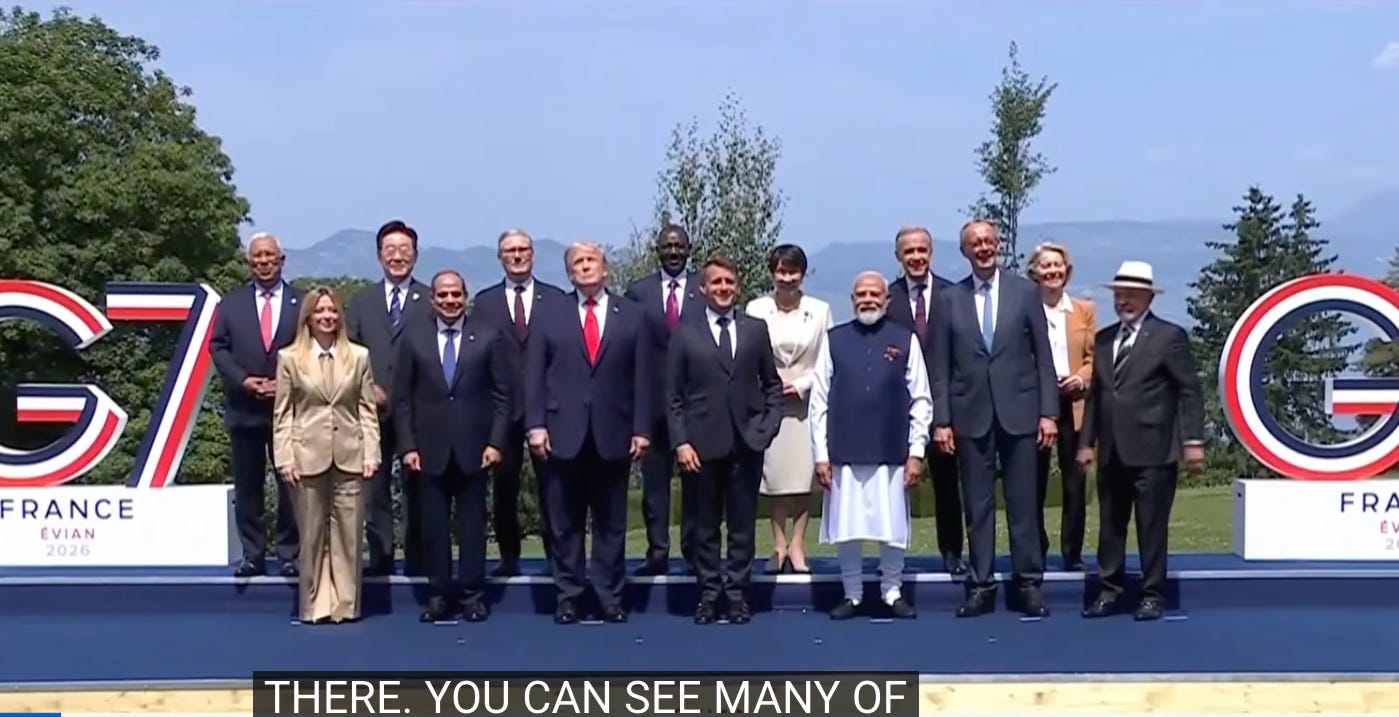
That is where the G7 becomes the hinge. Until then, the story is mostly about the failed mechanics of the Iran campaign: the Strait reopened but not commanded, the uranium bombed but not verified, the arsenal displayed but depleted, the regime hit but not broken. At the summit, the question now is whether anyone will say what happened to Trump’s face.
The Wall Street Journal described the choreography plainly. America’s allies were using the G7 to force Trump’s attention back to Ukraine, a war he had allowed to drift while Iran consumed the administration. Macron put Ukraine near the center of the agenda. Zelensky was brought in to make the case in person. The Europeans understood the opportunity created by Trump’s own sales pitch: if Iran was finished, if oil was flowing, if the Strait was reopening, then the excuse for indulgence toward Russia was disappearing with it.
Trump himself supplied the linkage. Asked about sanctions on Russia, he said they could come soon because “the oil is now flowing.” The waiver logic had been energy logic: do not squeeze Russian oil while Hormuz is unstable. But if Hormuz had been stabilized, or at least declared stabilized for political purposes, then the Europeans had their opening. Iran had been the distraction. Now they would try to make Ukraine the bill.
Shirreff put the necessary message in the bluntest possible terms: tell him, in words of one syllable, that he screwed up, that Europe can help him get off the hook, but that he has to play ball on Ukraine. That is the hard version of alliance management. Not flattery. Not ceremony. Not another performance staged around Trump’s need to be seen as the man who ended the crisis. A bargain: we will help turn your MOU into something less dangerous, but you stop trying to force capitulation on Kyiv and start pressuring Moscow.
That was one possible G7. The other was the one Shirreff feared: the summit dissolving into the familiar theater of managing Trump, praising him enough to keep him in the tent, softening the criticism until the criticism disappears, converting allied alarm into public deference. This is the danger of the G7 as court ritual. Everyone knows the king has blundered. Everyone knows the rescue operation is underway. But the price of keeping him cooperative is pretending the rescue is a tribute.
The pivot of the summit, then, was not Iran alone and not Ukraine alone. It was whether the allies still possessed the confidence to tell the American president that American power had been misused and that the repair bill would not be paid in applause.
This is where the Suez analogy completes itself. In 1956, Britain still had ships. It had officers, weapons, plans, and imperial habits of command. What it no longer had was the political capacity to make those instruments produce the world it wanted. Suez revealed that the instrument and the order had come apart. The British could still act, but they could no longer command the consequences of action.
Hormuz is not Suez in exact miniature. America is not postwar Britain. Its military power remains immense. That is not the question. The question is whether power still translates into order when the people wielding it misunderstand what the instrument is for.
A hegemon is not simply the country that can bomb a mountain. It is the country that keeps the sea-lanes open without having to relearn their importance by losing them. It is the country whose threats reduce uncertainty rather than multiply it. It is the country whose allies organize around its reliability, not around contingency plans for its impulses. It is the country whose adversaries see depth behind the first strike, not a magazine being emptied for the cameras.
At Hormuz, the United States demonstrated might. It also demonstrated something more damaging: that might could be spent without securing the commons, without resolving the nuclear problem, without preserving the stockpile needed elsewhere, and without keeping the central war in Europe from sliding down the agenda.
The bill for that distinction comes due in influence. It comes due in allies who learn to manage Washington rather than follow it. It comes due in Beijing watching not only the explosions but the replacement rates, the shipping panic, the waivers, the scramble, the need to declare victory before the text exists. It comes due in a Europe that begins to plan not toward American reliability, but around American volatility.
This is what superior force looks like in the hands of people who mistake the performance of victory for the achievement of it. Ships return, cameras roll, and a president says the deal is done. Behind the curtain, the uranium is unverified, the interceptors stockpiles are depleted, the Strait is a hostage that has learned its value, and the allies are left trying to turn a spectacle of strength into something that can still pass for strategy.
Two lessons, both mostly well understood by people who operate at a professional level. 1: Amateurs plan tactics, professionals plan logistics. 2: Civilian control of the military is essential, but it is equally essential that the civilians know what they want to achieve and listen to professional advice on how to achieve it. Too bad these lessons have to be relearned so often.
There is no winning strategy of appeasing an 80 year old sadist and megalomaniac for whom nothing is true but what his mind improvises in the moment. Have the G-7 leaders not learned this? Every kiss on Trump’s ring is another nail in the coffins of truth, decency and sane policy.