

Good morning! Donald Trump kept busy Friday explaining America to America.
First, the United States is now a “minerals superpower.” Mines are reopening faster than at any time since the 1950s, tariffs have transformed the country, and more than $20 trillion is supposedly pouring into America, a number Trump said no country in history has come close to matching. He also informed his audience that the government’s stake in Intel had produced $82 billion in profit. “Do I get credit for that? No,” Trump complained. “Did anybody say great job?” Then came the necessary clarification: “It’s for the country. It’s not for me.” A few seconds later, $82 billion had become “about 80 billion,” with Commerce Secretary Howard Lutnick enlisted to certify that it was “pretty close to 80.” Friday’s Trump contains multitudes, and also multiple sets of arithmetic.
The mining announcement then took its customary scenic route, because no infrastructure milestone in this administration is permitted to end where it began. A discussion of rare-earth magnets in Minnesota prompted “Minnesota. Whoa. What the hell happened to Minnesota?”, followed almost immediately by Trump’s assessment that “the governor is totally corrupt” and, for good measure, incompetent too. Somewhere in there, mining schools got a real and fairly notable $100 million commitment, ten times what they had asked for. Trump explained the largesse in his own way: “I’m not doing that because I’m a nice person. I’m doing that because it’s great for the country.” The sort of policy substance that used to be the headline now arrives as an appetizer between riffs. A few minutes later, visibly eager to wrap, he asked the assembled dignitaries to keep their remarks short because “we have a war to prosecute.” Nobody in the room asked which one.
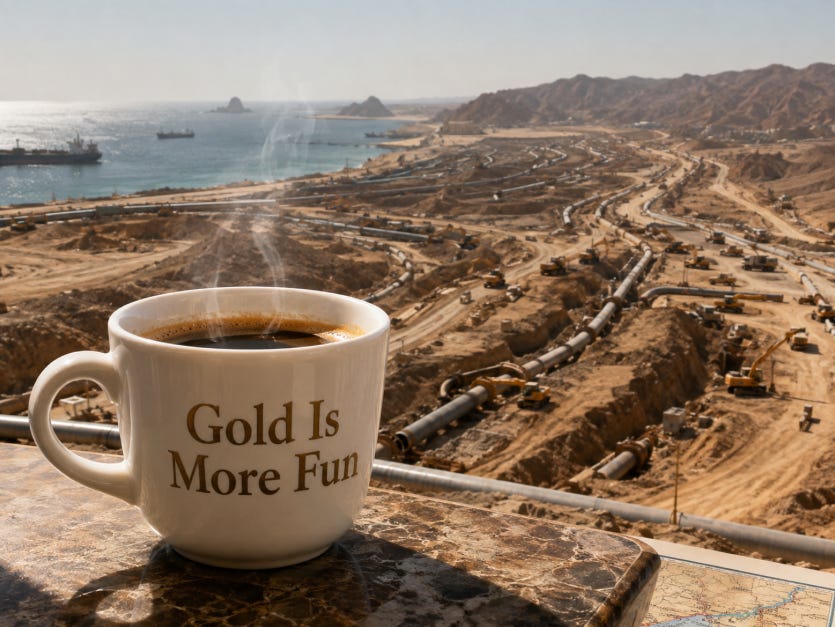
There was also gold. Presented with a solid-gold replica of a deep-sea mineral nodule, the commander-in-chief immediately perked up: “Where’s the gold? Come on. Bring it over. I want the gold.” He inspected it, pronounced it satisfyingly heavy, and concluded, with the clarity of a man who has found his true north, that “the gold is more fun.”
Then came coal. It must always be called “clean, beautiful coal,” Trump explained, recalling that Doug Burgum had once made the mistake of simply saying coal. Trump corrected him, after which Burgum apparently overlearned the lesson: “He mentioned coal about 40 times and he kept saying ‘clean, beautiful.’ I said, ‘Okay, that’s enough. That’s enough.’” China, meanwhile, is smart because it builds coal plants, while the wind turbines it supposedly sells the rest of the world but wisely declines to use itself “never work.” “They sell us wind turbines, but they don’t use too many of them,” Trump said. “It’s because they’re smart.” A claim that will be news to the country that installs more wind capacity than anywhere else on Earth. With that, “we’re back in the mining business,” and the tour of American energy policy by free association drew to a close.
Trump also sat down with Punchbowl News.
There, the president explained that American elections are rigged, that Republicans should abolish the Senate filibuster, and that failure to do so carries unusually high stakes: “If the Senate doesn’t get smart, I may be the last Republican president.” Democrats, he predicted, would eliminate the filibuster the moment they’re back in power, admit new states, seat new senators, and eventually expand the Supreme Court to, naturally, inevitably, 23 justices. He did not pause to note that he was, in the same breath, requesting the very filibuster termination he warned would be catastrophic in the other party’s hands.
The approaching midterms are a concern, although not, in Trump’s telling, because voters are unhappy with Donald Trump. His diagnosis is more precise: Republican voters are angry at Republicans. “They’re angry at Republicans, but they’re not angry at me.” The larger problem is whether the enormous Trump electorate bothers to show up when Trump himself is not on the ballot. “If I don’t run, will those people go out and vote?” he wondered, before conceding, “That’s the one thing I can’t tell.” He has been asking pollsters and Nevada crowds variations of the same question ever since, apparently in the hope that repetition might produce an answer he prefers. Or, as Trump himself put it while explaining his continued campaign travel: “Wait a minute. You don’t understand. I won. I’m not campaigning.”
On Iran and gasoline, the reassurance was similarly calming. Gas prices, Trump said, would only rise “if we have to do another hit.” Otherwise, apparently, down they go, a promise that treats another round of airstrikes on Iran as a rounding error in a commuter’s fuel budget, delivered in roughly the same conversational register as a weather forecast.
There is, however, a rather larger problem with “another hit.” Trump’s own chairman of the Joint Chiefs, Gen. Dan Caine, has reportedly been warning senior administration officials that the aerial campaign “won’t be enough to make Iran capitulate” and that further escalation could backfire. Caine’s public formulation was more decorous: “Air power’s got limits.”
Former deputy director of national intelligence Beth Sanner supplied the translation: “There is no military solution alone to this problem.” She described the military approach as having reached “a dead end.” So at almost precisely the moment Trump is talking breezily about “another hit,” his top general is reportedly looking for an off-ramp from a war the military itself no longer appears to believe can be won from the air.
Treasury Secretary Scott Bessent supplied what may have been the most consequential admission of the week. After weeks of assurances that an agreement to reopen the Strait of Hormuz was imminent, Bessent abruptly changed the horizon altogether. “The strait is never going back to the way it was,” he said, predicting that over the next two years most of the energy now passing through Hormuz will instead be rerouted through underground pipelines until the waterway becomes “just another body of water.” In other words, the administration’s emerging solution to Iran’s new leverage over one of the world’s most important shipping lanes appears to be not so much to reverse it as to spend the next several years building around it.
That is not merely a geopolitical inconvenience. Simon Marks noted that accounting giant EY has warned that a prolonged closure could push British inflation to 6.4 percent by Christmas and leave the UK economy shrinking by 0.2 percent next year rather than growing. His reaction was appropriately understated: if you were running Britain’s Treasury, “you’d have your hair on fire over this.” And Bessent’s proposed answer, build enough underground pipelines over the next two years to make Hormuz irrelevant, struck Marks as fanciful on its own timetable: “You’re not going to build those underground pipelines in two years. There’s no chance of that.”
At the end of the day, America is experiencing a “golden age.” The economy is doing so spectacularly that Trump said his economic polling should be “150 percent, not 100 percent.”
So there you have Friday according to Donald Trump: America is richer than any country has ever been, coal is beautiful, wind is a disaster, elections are rigged, MAGA is furious but not with him, Democrats may end Republican presidencies forever unless he ends the filibuster first, Iran may require another “hit,” and the government has apparently made both $80 billion and $82 billion on Intel, simultaneously, from the same stake.
Also: he wanted the gold.
For Dessert: What the Rest of the World Heard
Strip away the gold and the coal, and Friday’s real story is one that American coverage keeps almost saying and foreign commentary keeps saying outright: the words themselves have stopped functioning as information.
Simon Marks, closing out his weekly recap the same week, put it more bluntly than most American outlets are willing to: Trump was “unable to stipulate to or even recognize reality,” a week defined not by any single lie but by his flat refusal to hold two versions of an event, the reflecting pool’s actual contractor, his own past praise of that contractor, in the same story at once. It is the same failure mode on display Friday: two profit figures on the same Intel stake, offered seconds apart, neither one flagged as replacing the other. An inability or unwillingness to notice the contradiction, yet delivered with the same confidence either way.
Professor Ali Ansari, discussing the Iran standoff on the same day, offered the sharper diagnosis: Trump’s repeated threats have become “a burglar alarm going off all the time. You begin to ignore it.” That’s the throughline connecting the gas-price aside to the wider Hormuz story Al Jazeera has been tracking hour by hour this week, IRGC officials now saying reopening the strait is conditional on the US “fully accepting Iran’s conditions,” Iraq reporting a 75 percent drop in oil exports through the waterway, traffic down 96 percent year-over-year by IMF PortWatch’s count. “If we have to do another hit” is not a hypothetical anymore so much as a threat that has already been made, repeatedly, and increasingly resembles Ansari’s alarm: audible, constant, and no longer trusted to mean what it says.
There’s a version of Friday that’s just funny, the gold, the coal, the arithmetic. There’s a version underneath it, the one former State Department official Marlin Hardinger gestured at this week when he warned that America’s credibility as a “good faith ally” had suffered, as Saudi Arabia, Türkiye and Pakistan signed a mutual-defense pact of their own. Both versions are true at once. Increasingly, that is the whole point.
Great piece, as usual. But, you know, the biggest problem with Trump's claim of $80 billion or $82 billion in profit for Intel is not that the numbers diverge a bit. It is that both numbers are completely baseless and, in fact, completely impossible. None of it can be remotely true. Intel is not that big, profits cannot possibly be that high, and the whole thing is just complete gaslighting BS.
He has just cried Wolf too many times. Liar liar pants on fire!