


This week, at our house, the children have been staging a quiet little coup against despair, which is rude of them, frankly, because I had already made several plans to worry myself into a decorative household object.
Our oldest, my ADHD buddy, has been doing so well with his emotions lately that I have found myself stopping in the middle of the day just to admire him. In the amazed way you admire someone who is doing the difficult private work of becoming more himself. Emotional regulation is not exactly the glamorous frontier of childhood. There are no medals, no theme music, no small-town parade with a banner that says, “Congratulations on pausing before you reacted.” There should be, I’d attend, I’d even bring snacks.
But he has impressed me deeply. He has been trying, really trying, and I know what it costs to live in a brain that sometimes receives the world like every radio station has been turned on at once. I know what it means to feel something before you have had time to name it. I know how much courage it takes to come back to yourself after the ecosystem inside you changes too quickly. Watching him learn how to do that, watching him grow into the tools that will help him carry himself through this life, has been one of the great privileges of being his stepmother.
My daughter, meanwhile, is preparing for her first ever ballet class at the end of this month, and she is overjoyed in the way only a four-year-old can be overjoyed, which is to say, with the full force of a tiny monarch receiving her crown. Her leotards arrived in the mail, and she immediately insisted on wearing one around the house, despite the fact that for a four-year-old, going pee by yourself in a leotard is less a bathroom break and more an engineering crisis. There are straps, panic, fabric betrayal, and one small ballerina standing in the hallway with the haunted expression of a person who has discovered the dark side.
She’s also still my garden forewoman. She makes sure I don’t forget to water the plants, not with judgment, not with exasperation, but with the sweetest possible certainty that I am a person who loves the plants and also a person who may need to be reminded that the plants are not, despite my hopes, watering themselves. She’s so emotionally intelligent and so in tune, just like her dad. Somehow, with her tiny body and her tiny hands and that enormous old soul living behind her eyes, she understands that reminders can be acts of love. She doesn’t make me feel managed, she makes me feel known.
And then there is Ezra. Where do I start with Ezra? He is my mister boy, my little man, my heart walking around outside my body with two teeth and a suspiciously powerful commitment to joy. He finally got his turn on the tractor this week, which means my husband did the brave and beautiful thing of donning a baby carrier and taking him for his first ever tractor ride. I took more pictures of that moment than I did of our wedding, which says nothing against the wedding and everything about the profound documentary importance of a baby in a carrier on a tractor with his dad.
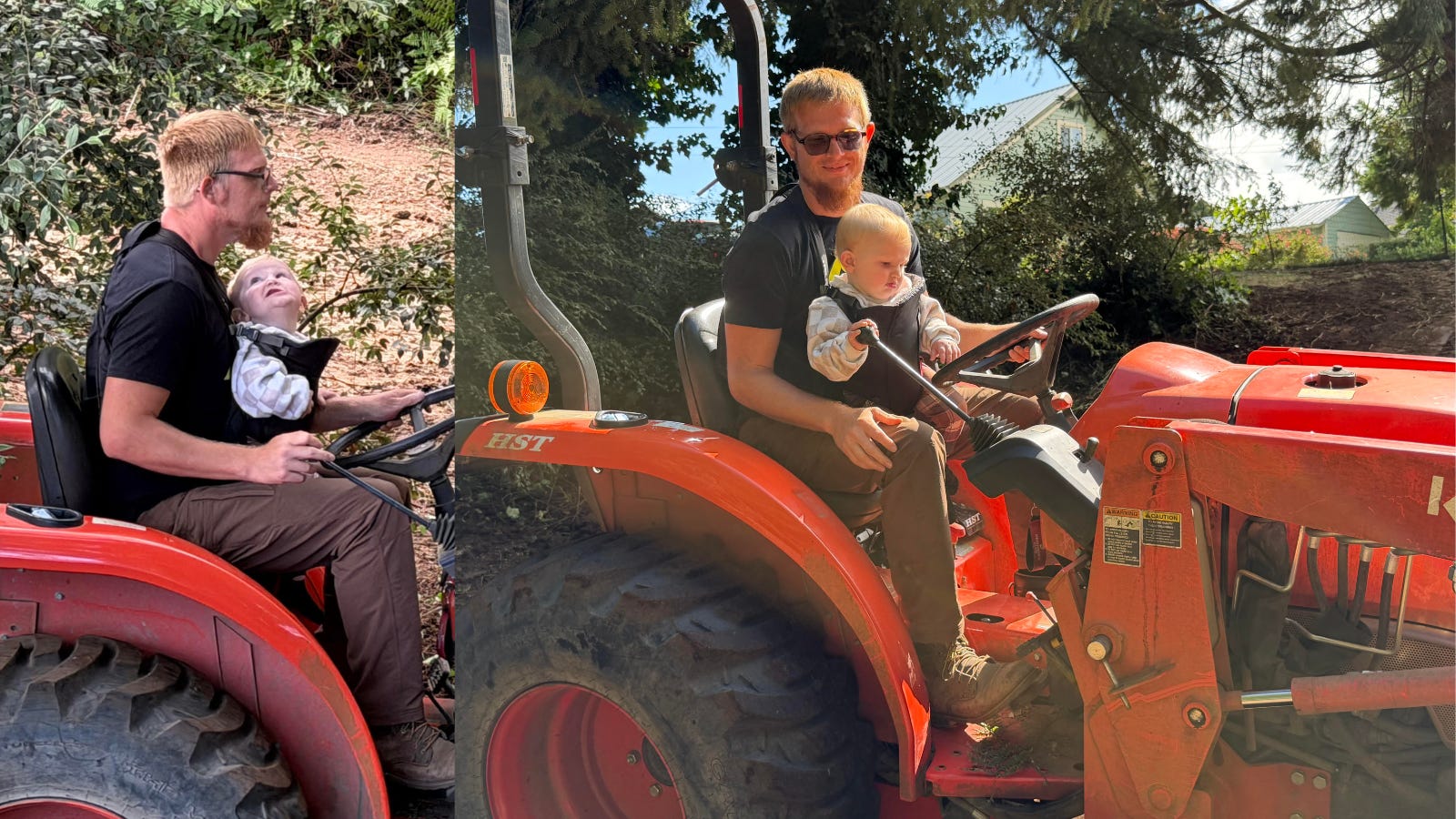
It was beautiful. It was one of those moments that felt like a little flag planted in the ground of our new life. Here we are, here are the children, the land, and the man I love, carrying our baby while shaping the earth. Here is the small boy who has been waiting with his whole body for his turn, and here is happiness, not polished, not staged, and not waiting until everything is resolved before it arrives.
We are still waiting to hear back from insurance on the second MRI request and on the appeal we filed. We are also on the waiting list for an out-of-pocket MRI, though his doctor is hoping insurance agrees to pay before that becomes necessary. So, we wait, which is one of the most irritating spiritual practices ever invented. We wait, and in the meantime, Ezra is smiling, bright eyed, two-toothed, and full of laughs. He is here, he is growing, he is beloved, and he is very busy being impossibly cute while adults do paperwork around him like peasants.
So that is where I’m beginning this week, with children, plants, ballet leotards, tractor rides, insurance limbo, emotional growth, and a four-year-old who has apparently appointed herself Assistant Minister of Hydration for the Garden Department.
And from there, naturally, I bring you two completely unrelated stories because they were both too good to pass up. This is journalism, sometimes there is a theme, sometimes that theme is, “Look at these people being wonderful, and don’t ask me to choose.”
The first story comes from Tennessee, where a 22-year-old engineering student named Connor Gibson has been using 3D printing to make free dentures for people who couldn’t otherwise afford them. Gibson was studying engineering at Walters State Community College when he began volunteering with Remote Area Medical, a nonprofit that provides free medical, vision, and dental care through mobile clinics. While volunteering, he saw a need that was both painfully simple and absurdly neglected: people needed teeth. Not cosmetic upgrades, or vanity dentistry, teeth, the ability to chew, smile, speak, work, interview, laugh, and exist in public without hiding their mouths behind their hands.
Because this is America, the country where we have somehow placed teeth in the luxury category, this problem is enormous. Dental care is treated like an optional side quest in the health care system, as if the mouth is not attached to the body but merely renting space near the face. You can have pain, infection, trouble eating, trouble talking, trouble finding work, and still be told, in the most bureaucratic language possible, that your suffering is technically located in the wrong billing department.
Gibson looked at that gap and didn’t mistake it for inevitability. He didn’t have a background in dentistry, and he didn’t begin as an expert in 3D printing. He taught himself, studied the software, the anatomy, the process, the machinery, and the whole strange little kingdom where engineering meets the human mouth. Then he helped create a mobile digital denture lab, using grant-funded 3D printers to produce dentures for patients who had been waiting, suffering, and going without. According to People, the process can reduce delivery time from months to just a few hours, and Gibson has helped outfit thousands of people with free dentures.
There is something almost biblical about that kind of work, someone sees a person whose dignity has been treated as optional, and instead of building a brand around their pain, he builds a solution. He brings a printer and the stubborn belief that technology should occasionally do something more useful than help a refrigerator judge us. If you haven’t heard of the new refrigerators with AI to remind you to buy eggs, welcome to the age of shopping list by surveillance.
And the part that got me, of course, was the mirror. Gibson has talked about the “mirror moments,” when patients see themselves with their new smiles for the first time. People cry, grown men cry, elderly people cry, and people who have been living without a part of themselves look up and see something returned.
That’s the word that stays with me: returned. Because a denture is not just a denture, it’s a person being handed back some portion of themselves that poverty, illness, neglect, or a broken system had taken away. There is a cruelty in the way poverty makes people disappear by degrees. First the appointment is too expensive. Then the repair is delayed, the pain becomes normal, the normal becomes shame, the shame becomes isolation, and eventually, the world begins to treat absence as if it were character, as if missing teeth mean missing discipline, missing worth, or missing humanity.
And then here comes a 22-year-old engineering student with a 3D printer and the audacity to disagree. That is hope, the kind of hope that plugs into the wall, calibrates the machine, loads the resin, learns the software, secures the grant, shows up at the clinic, and says, “Open wide, we are going to give you something back.”
The second story takes us to Bradshaw Animal Shelter in Sacramento County, where volunteers signed up to comfort shelter animals during Fourth of July fireworks. The shelter’s Comfort Sessions have been running for six years, and this year volunteers were invited to come in during the loudest part of the evening to sit near the animals, read books, strum guitars, sing songs, and bring a calm presence while the sky outside did what the sky does every July Fourth in America, which is apparently reenact a small regional conflict.
I am not here to start a war on fireworks, mostly because fireworks seem to have already started one on every dog in the nation. Some people love them, children love them, and neighborhood dads love them with a spiritual intensity that should probably be studied. But animals don’t understand that the explosions are decorative, they don’t see patriotism as a series of bangs, and they don’t know that the terrifying thunder outside is supposed to symbolize freedom, togetherness, and the annual suburban commitment to making sure nobody sleeps.
For shelter pets, the fear can be even worse. They aren’t tucked safely beside their people on the couch, they don’t have their familiar blankets, their favorite corners, their known smells, or their person whispering nonsense into their ears. They are already in transition. Already waiting, already confused by the strange acoustics of abandonment, rescue, illness, intake, loss, and hope.
So, Bradshaw Animal Shelter asked people to come sit beside them. Bring a book, a guitar, a soft voice, and the humble human offering of presence. It’s reported that the sessions were fully booked, with volunteers eager to spend part of their holiday helping frightened animals get through the noise. This is the kind of thing that breaks me open because it is so small and so large.
Nobody solved every problem, nobody ended animal homelessness, and nobody fixed the American fireworks industrial complex, which I assume is run by a committee of golden retrievers’ enemies and men named Kyle who own folding chairs. But people came, they sat down on floors and camp chairs and yoga mats, read stories to dogs, played soft music for cats, and made themselves available to creatures who couldn’t understand what was happening except that it was loud and scary.
What a tender, ridiculous, beautiful thing. There’s no speech, no podium, no billion-dollar pledge, and no ribbon cutting ceremony with elected officials pretending they personally invented kindness. There’s only a volunteer with a book, a dog with worried eyes, and a simple agreement between species: I can’t stop the noise, but I can sit with you.
That may be one of the truest sentences we have. I think about that with my children all the time. I can’t stop every hard thing from reaching them. I can’t make the world gentle enough for their nervous systems, their hearts, their bodies, or their dreams. I can’t remove every ache from my oldest as he learns to live inside the beautiful electrical ecosystem of his mind. I can’t keep my daughter from discovering that ballet attire has logistical consequences. I can’t make Ezra’s insurance company suddenly develop a soul, though I remain open to miracles and strongly worded paperwork. But I can sit with them.
I can remind my oldest that trying counts, help my daughter out of the leotard, water the plants when she reminds me, and take too many pictures of Ezra on the tractor because some moments deserve to be documented with the fervor of a national archive. I can wait for the MRI answer without letting the waiting become the only story, and I can sit beside the fear, the uncertainty, the noise, and say, we’re still here.
That’s what these stories have in common after all. A young man making dentures and volunteers reading to shelter pets may seem, at first glance, like they belong in different rooms of the human spirit. One is engineering and medical access, the other is animals and fireworks. One involves 3D printing and dental anatomy, the other involves camp chairs, nervous dogs, and someone softly reading aloud while America conducts its annual celebration of explosive patriotism.
But both stories are about presence made practical. Connor Gibson didn’t simply feel sad about people needing dentures; he learned how to make them. The volunteers at Bradshaw didn’t simply feel bad for frightened shelter animals, they showed up with books. In both cases, compassion became physical. That, to me, is the good news worth keeping.
Not that the world is suddenly easy, the systems are suddenly just, or that every frightening sound stops because we ask it to. But that again and again, people choose to become the answer nearest to them.
Sometimes hope is a 22-year-old who realizes engineering can restore a stranger’s smile, a volunteer reading to a dog while fireworks crack open the sky, a four-year-old reminding her mother to water the plants, or a baby on a tractor, grinning with two teeth, carried safely against his father’s chest.
And sometimes hope is the old, stubborn, ordinary miracle of sitting with the ones who need us. Happy Fourth of July weekend to all, I hope your pets were happy, and your smiles were big.
perfect and touching. While I wouldn't be so bold to say kindness is unique to America--it isn't. But it is an essential and redeeming quality of our country. A door held open. A friendly smile. The courtesy given in a pay forward moment. And our children.
Thank you so much for this posting. Five beautiful stories; six if you count your husband and seven if you count yourself. I am so proud of you and how you see the world. This is the way I want all of us (and our country) to go each day. Without, of course, having to be troubled by insurance companies that are not paying for needed MRI for a baby😞