


My oldest brother and I are eighteen years apart in age, so I never had the privilege of watching him grow into the young man who crossed the Iraqi border from Kuwait in March of 2003. I was only four years old, learning to write my ABCs, when he enlisted in the Marine Corps. What I remember most from before the day he shipped out is Chinese food, as strange as that sounds.
Before he left, we went out to dinner at a Chinese restaurant and laughed more than usual. What I couldn’t understand then was the heaviness that settled over the table, the quiet grief carried by those who knew exactly what that night meant. I sat in blissful ignorance, laughing freely, storing the memory as a happy one, while everyone else wore practiced smiles to mask the pain lodged deep in their hearts.
As I grew older and his tours drug on, things slowly came into focus. Every static-filled phone call carried the possibility of being the last. My single mother, working endlessly to support the children still at home, rarely slept. And my brother, the same brother who dressed up as a ninja and played in the woods, the same brother who defended a little girl from bullies in grade school, was now risking his life in the name of “patriotism,” for the wealth and power of men he would never know.
As I began my journey into elementary school, my brother began his own, one far darker and far more unforgiving. While I learned to read and write, he learned to shoot and to kill. As I stood with my classmates, hand over heart, pledging my allegiance to the flag, my brother drove over active IEDs. And while I laughed with friends on the playground, my brother wept over the slow loss of his soul.
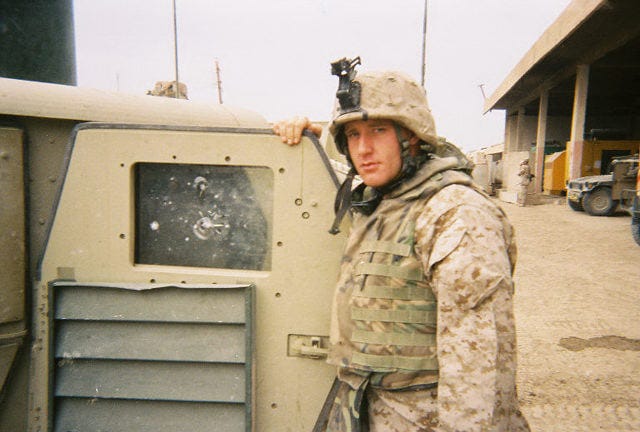
“Marines don’t leave Marines behind. Marines don’t desecrate corpses. Marines don’t rape, plunder, or pillage.”
The warrior code of the U.S. military is meant to separate warriors from killers and occupiers. It exists to give structure and meaning to acts that would otherwise be unbearable, to help those who serve live with the taking of a life. What is difficult to understand from outside a war zone is that the line between innocent and combatant is rarely clear. In Iraq, civilians were woven into the battlefield, and the distinction became harder and harder to make.
One day, my brother and his sergeant mistook the actions of a father, who loved his daughter enough to give his life for her, for a threat to their comrades. That day, my brother lost a piece of his heart, and a young girl lost her father. A girl not far from my own age, not far from the age of the girl my brother once protected from bullies on a grade school playground. He carries her image with him still, a quiet and permanent reminder of what war truly costs, and of who its real victims are.
In 2007, my brother was honorably discharged from the U.S. Marines and returned home to Oregon after two tours in Iraq. I remember the day we learned he was coming home. My mother was overjoyed, nearly skipping out the front door to tell my sister and me as we played in the yard. We were ecstatic at the thought of having our big brother back.
When he moved in, it slowly became clear how much damage had been done. The brother who once laughed and played with us as children now drank heavily and screamed at us for leaving our backpacks on the floor. The brother who carried me on his shoulders to watch fireworks on the Fourth of July now had his hands around our other brother’s throat for leaving boots in his room. The pain he endured on the battlefield became pain he unwillingly inflicted on his family at home.
Little did he know, the day he enlisted, that his siblings would one day live in fear of him. Little did he know that my sister would not speak to him for more than ten years, out of fear and an inability to forgive. Little did he know that even after I believed I had moved on, I would still flinch when he raised his voice a decade later. Little did he know.
We build memorials for those we lose to war but quietly forget our other losses. While I still catch brief glimmers of the brother I once knew, the one full of hope and wonder, we lost him in Iraq. We lost him to a war for oil, to the building of wealth for powerful men. My brother enlisted to earn money for college, but the damage done to him delayed that dream until he was thirty-five. He spent ten years burying his grief in alcohol and drugs, trying to survive the man he had been made to become.
Today, my brother has just completed his master’s degree at forty-five years old, and I could not be more proud. He is working toward becoming an LPC specializing in PTSD, offering mental health care to others who have suffered similarly how he has, while building a future for himself. He found his way to a healthy and happy life, but the cost was heavy, and the losses were real.
When I heard the news of the U.S. invading Venezuela, it felt like déjà vu. A quiet memory of that Chinese dinner surfaced as I held my baby son and watched my other two children play during winter break. My oldest, bursting with energy, laughter, and creativity. My daughter, bright, empathetic, and thoughtful. And my youngest, still small enough to find wonder in grasping a toy or hearing his own laughter.
I looked at them and thought of my mother once watching her own children this same way, unaware of how completely her family would be altered by a needless war. I wondered what I would do if one of my children chose, or felt compelled, to fight in this “war.” I am grateful mine are still too young, but so many sons and daughters are not. So many are being sent overseas as I write this. And my heart breaks for their mothers, the mothers who will lie awake at night, the mothers who may one day hold their child as he sobs over what he has done, the mothers who will lose pieces of their hearts long before they ever lose a body. When you look at war through this lens, how could it possibly be worth it? How could any of us condone these actions and still sleep at night?
So today, I ask only one thing: please see. See clearly what this could mean for your sons and daughters, for your families, for your friends. See clearly that this invasion is unjust and unnecessary. Because, as my mother so eloquently says, “clarity itself is an act of resistance.”
Tears shed with this one, bless you and yours.
I'm so glad your brother has healed enough to get his degree. What a nightmare for all involved. Vietnam was 'our war' and as a young Army wife, it was sad to see soldiers come back with no joy in their hearts nor child in their eyes. You wrote this so very well, thank you for your sacrifices as well.