

Good morning! April Fool’s Day arrived with Donald Trump doing what he does best: hovering around institutions he wants to dominate. He is set to attend Supreme Court arguments in the birthright citizenship case, because it is no longer enough for this administration to assault the Constitution from the executive branch; now it must also loom menacingly over the judiciary while the justices consider whether the 14th Amendment still means what it has meant for generations. The case itself is no small procedural scuffle. It goes straight to Trump’s executive order aimed at ending automatic citizenship for children born in the United States to undocumented immigrants and some temporary visitors, which means the Court is being asked, in essence, whether one man’s anti-immigrant obsessions can override a constitutional guarantee written in the aftermath of slavery and Dred Scott.
Really, unless Trump planned to stroll up to counsel table and deliver the oral argument himself, his presence serves no legal purpose at all. It reads instead as one more act of presidential intimidation theater, the political equivalent of a mob boss turning up in the back row to remind everyone whose interests are on the line. No sitting president attends Supreme Court arguments because presidents are not supposed to loom over the judiciary like they are checking on renovations at one of their casinos. Trump has never understood the difference between democratic institutions and buildings he would like to slap his name on.
Abroad, the administration’s Iran debacle was acquiring the full hallucinatory texture of a world that now arrives pre-satirized. Markets were rallying on hopes the conflict might soon wind down even as the bombs kept falling, tankers were being hit, Tehran was under fire again, and Trump was off insulting NATO allies as though the central problem in the Middle East were insufficient European gratitude for his chaos. The Financial Times live coverage had the usual fever-dream quality of war reporting, financial reporting, and Trump coverage all crammed into the same bloodstream: investors cheering on whispers of de-escalation while the region remained on fire and global shipping still hung in the balance.
The New York Times made the deeper problem impossible to miss. Trump is now openly saying the United States will be out of Iran within two or three weeks, with the White House promising an evening address so he can no doubt stand before the cameras and attempt to sell strategic confusion as statesmanship. But the reporting shows an administration that looks like it is frantically workshopping a surrender speech with extra explosions. Rubio has apparently been sketching a narrower list of war aims that would allow Trump to declare success and crawl toward the exit, while Trump himself continues blurting out larger fantasies about regime change, total victory, and other strongman bedtime stories.
That gap between rhetoric and reality is where the rot really shows. Trump keeps claiming he has neutralized Iran’s nuclear threat, but the reporting says there is no evidence the stockpile of near-bomb-grade uranium has actually been removed or destroyed. The administration appears to be doing what it always does when reality intrudes: quietly shrinking the definition of winning until it is small enough to fit inside the available lie. The original case for war was the nuclear threat. Now that the nuclear material apparently remains, aides are redefining success downward so Trump can strut away from the wreckage in one of those grotesque made-for-TV exits he mistakes for history.
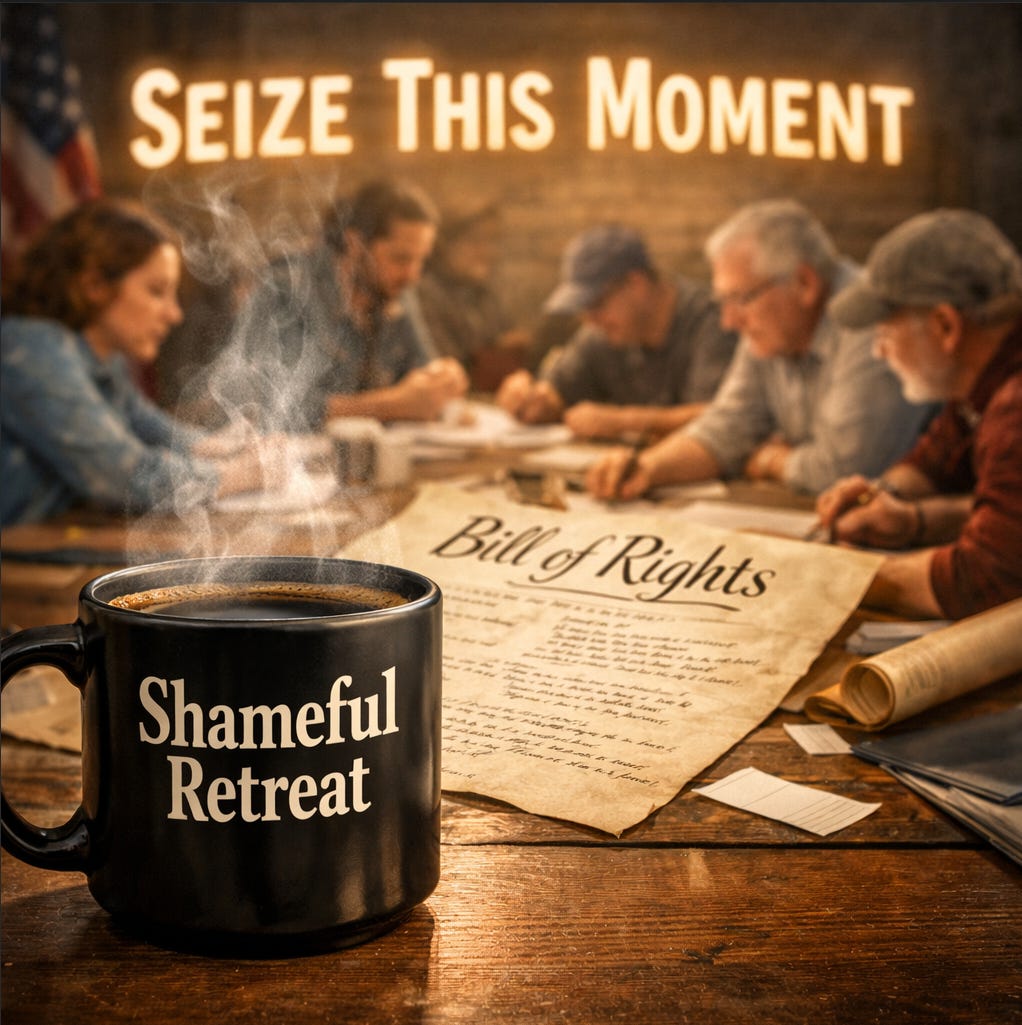
This is beginning to look exactly like what it is: a shameful retreat spray-painted gold and sold as victory. Just a disorderly climb-down wrapped in patriotic stage lighting. Trump appears desperate to claim he has already won, while the facts on the ground suggest a region still destabilized, core objectives unmet, and allies left to deal with the fallout. The old con remains intact: create a disaster, fail to achieve the original goal, then announce success while backing away from the smoking crater.
And what makes it worse is that this crisis did not spring from nowhere. One of the more useful pieces circulating today argued bluntly that the real beginning of this war was not the latest bombing campaign, but Trump’s decision to tear up Obama’s Iran deal in 2018. That agreement, whatever its imperfections, imposed real constraints, real inspections, and real limits on Iran’s program. Trump trashed it because Barack Obama’s name was on it, promised a bigger and better replacement because of course he did, delivered absolutely nothing, and now appears eager to retreat from a conflict made more likely by his own vanity and sabotage. That is the deeper scandal is not that he is just fleeing a war, but trying to flee the consequences of his own earlier wrecking spree while still demanding applause on the way out.
In Europe, the message is being received with all the enthusiasm of dinner guests watching the host set the curtains on fire and then hand them the extinguisher. Britain is now reportedly hosting talks among 35 countries on how to reopen the Strait of Hormuz after Trump signaled the United States may simply leave the war without securing the waterway. Imagine setting the neighborhood ablaze, insulting the fire department, and then announcing that everyone else should probably go get their own hoses. That is roughly where American leadership now stands. It is not the posture of an empire at the height of its competence. It is the posture of an arsonist informing the block association that he will not be staying for cleanup.
Back home, the corruption machine kept humming in its usual key of grotesque absurdity. The Justice Department is reportedly struggling to figure out how to respond to Trump’s lawsuit demanding at least $10 billion from the IRS, an agency he oversees, over the leak of his tax returns to The New York Times in 2020. Trump argues the agency failed to stop former contractor Charles Littlejohn from disclosing the records, even though Littlejohn has already been prosecuted and imprisoned for the leak, and even though the disclosure itself plainly did not destroy Trump politically, since he went on to win the presidency anyway. The result is an exquisite ethical spectacle: the federal government must now decide how to defend itself against the man who runs it. Officials are reportedly debating delay tactics, conflict workarounds, and outside counsel possibilities, and may ultimately have to consult Trump himself on how the government should respond to Trump’s own suit. You would reject this plotline as too on-the-nose if it appeared in a mediocre streaming drama about democratic collapse. Yet here we are, watching the state get bent once again into a personal indemnity machine for one man’s grievances, appetites, and revenge fantasies.
There was also a small but satisfying hiccup in Trump’s ongoing attempt to redecorate the republic in his own image: a judge ordered work stopped on the $400 million White House ballroom he wants to build where the East Wing used to be. It turns out you cannot just tear chunks off a national landmark, funnel in money from loyalists and corporations, and call it statesmanship. Sometimes even authoritarian kitsch still has to clear permitting.
Taken together, these stories reveal something important about this moment. Trump is not strong in the way authoritarians like to project strength. He is loud, vindictive, theatrical, and still terrifyingly dangerous, yes. But strong? This is a presidency straining to maintain the image of domination even as the underlying machinery groans, sputters, and contradicts itself. Anyone who has to hover over Supreme Court arguments to project strength is not secure. Neither is a president who keeps shrinking his war aims so he can back away without saying he is backing away. And a regime whose own Justice Department cannot answer its leader’s personal shakedown without twisting itself into constitutional knots is plainly not at ease. These are the symptoms of a system under strain.
Moments of strain are when pro-democracy movements either find their courage or waste their opening. As activists, we should be honest about what this moment offers. Trump looks weak because he is weak, though not harmless. He looks cornered because he has created too many crises to manage cleanly. The temptation, naturally, is to answer that weakness with sheer energy: more marches, more outrage, more glorious talk of general strikes, more cathartic public fury. All of that has its place. But pressure without demands creates noise. Pressure with demands creates leverage.
That has been the missing piece in far too much of the conversation. What, exactly, do we want in return? What are the terms under which democratic resistance knows it is succeeding? If the answer is only “not this,” the opposition will always be reactive, forever chasing the latest outrage while power adapts. If, however, the answer becomes concrete and expansive at the same time, then resistance starts to look less like permanent defense and more like democratic construction.
The idea of a new Bill of Rights matters so much right now. This administration has shown us, in painful detail, where our old guarantees were too weak, too narrow, too conditional, or too easily ignored. It has exposed how fragile due process can become when cruelty is policy, how quickly equal protection can be narrowed by ideology, how vulnerable voting rights remain, how brittle truth itself becomes when propaganda captures institutions, and how utterly unserious our governing system still is about protecting the living world on which every other freedom depends. We should not be fighting merely to tape the old order back together and pray the leaks slow down. We have to build something stronger than what failed.
The answer to authoritarianism cannot simply be nostalgia for the old rules, because the old rules were already failing too many people and too much of the living world. A real democratic resistance should be bold enough to imagine a new Bill of Rights, one born from everything this administration has revealed about cruelty, impunity, ecological destruction, and institutional weakness, and one expansive enough to protect both human freedom and the rights of nature to exist, thrive, and naturally evolve. That would give the resistance a destination worthy of the danger of this moment. Not just endless triage, or just “please stop.” A clear destination.
That, ultimately, is how to take advantage of Trump at his weakest. Not by merely mocking him, though heaven knows he makes it easy. Not by staging resistance as a form of national group therapy. But by identifying peaceful tools that create pressure and tying them to clear democratic goals that the public can understand, measure, and rally around. Protest. Boycott. Strike where possible. Refuse normalization. Force defections. Demand accountability. Build institutions that can outlast the man. Name the concessions. Name the reforms. Name the future. In earlier posts, I’ve offered a draft framework for a new Bill of Rights as one possible starting place for that conversation, a way to think seriously about what must be protected, reaffirmed, and newly recognized if democracy is to survive this era. That framework is in the archives, and if it would help move this discussion forward, I’m happy to repost it simply as a conversation starter.
This is the part the authoritarians never fully understand: weakness at the top only matters if there is something organized below it, something morally serious enough and politically clear enough to exploit the opening. Trump is giving the country an extraordinary education in corruption, cruelty, and collapse. The question now is whether the resistance will settle for outrage, or whether it will seize this moment to articulate what democracy must become after him. Carpe momentum. Not someday, not after one more scandal, not after one more election cycle, not after permission arrives from the people who helped create this mess. Now. While the cracks are visible. While the performance of strength is faltering. While people can still be persuaded that a different future must be built. That is our real work now.
Mike Johnson declared 'holiday time' for Congress and they all went home. What a missed opportunity for Democrats!! Taking this from Adam Kinzinger's video ... Democrats could have, instead, stayed at work with constituents in mind and put out really strong messaging. Your point, Mary, is well put ... Democrats need to think about NEW ways rather than reinstating OLD ways. Time is getting short.
Yes, please repost the new Bill of Rights framework you suggest...I think you make an excellent argument for how we move from protest to a "new Reconstruction."