


Good morning! I laughed. Repeatedly. Donald Trump stood before the Lincoln Memorial on the eve of the midterm elections and delivered what may be the most elaborate presidential plumbing report in American history, complete with a seminar on the life cycle of grass, an ode to granite, and photographs of rusty pipes held aloft like evidence of a vast national conspiracy.
At one point, he glanced back over his shoulder at the water and pronounced it “a massive piece of pool.”
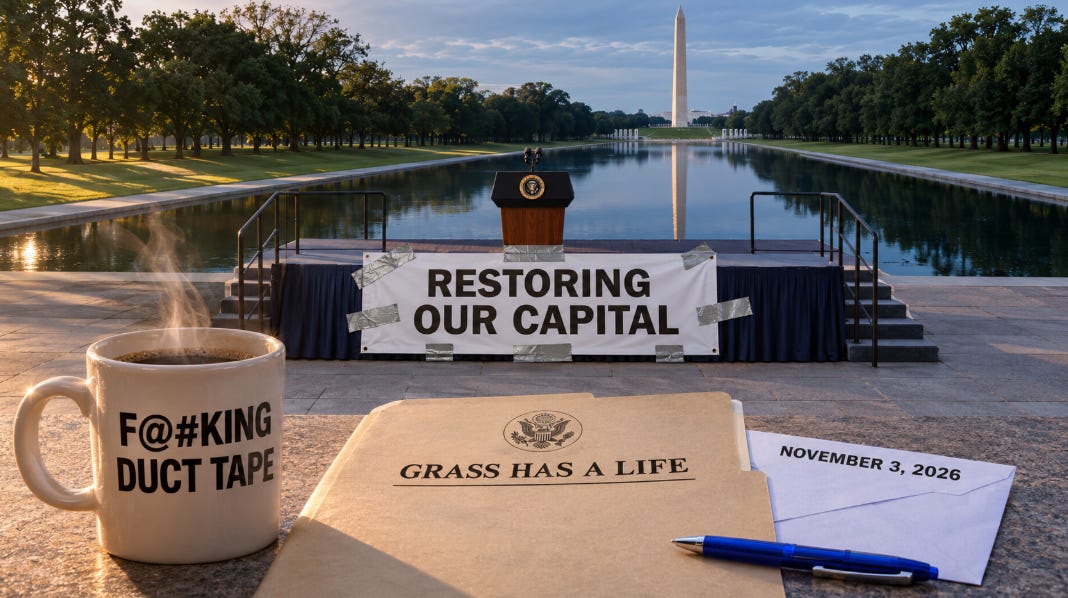
It was, indeed, a massive piece of pool.
The late-night hosts had a field day. The Financial Times invoked Rudy Giuliani’s infamous Four Seasons Total Landscaping press conference. The New York Times observed that Trump appeared more interested in discussing what brought him personal satisfaction than the issues driving the election.
There was plenty of material.
“Like the human being, grass has a life also,” Trump informed his audience.
Who knew? A few dozen people, most of them National Park Service staff, gathered on the National Mall for a presidential seminar in lawn mortality.
He discussed Bermuda grass, the White House helipad, the extraordinary durability of granite, and his plans for an enormous triumphal arch. That last project, he explained, would include elevated platforms suitable for military purposes, including sniper or shooter positions.
Welcome to the nation’s capital where a triumphal arch comes with a sniper platform.
My favorite detail came courtesy of the New York Times. As Trump celebrated his plans to transform Washington into an architectural wonderland of marble, stone, and gold, aides had attached large signs proclaiming “RESTORING OUR CAPITAL” to the stage with duct tape.
Duct tape is one of civilization’s genuinely useful inventions. But there is something irresistible about announcing a monumental architectural renaissance while relying on adhesive from the hardware store to keep the signs in place.
If the underlying story weren’t considerably more troubling, the whole performance might have been harmlessly ridiculous.
Yet, somewhere between the drainpipes and the grass, I began to feel uncomfortable. There is something sad about watching a person make himself an object of public ridicule before the entire world, even someone who has spent so much of his life ridiculing others. I can laugh at the absurdity without enjoying the spectacle.
The discomfort goes considerably deeper when the person at the microphone also commands the world’s most powerful military.
Standing at the extra special dark blue water on Monday, Trump assured the country that “we have not been doing fighting for months” and that “we have done very little fighting.” Iran, he said, had “asked us to please stop doing it. We will.” Asked earlier that day whether he’d considered resuming strikes after the election, he said no.
Vice President JD Vance was sounding similarly upbeat. “The president and I both feel pretty good about the prospects for potentially coming to a negotiated settlement,” he told reporters Monday.
Hours later, the U.S. struck Iran’s Qeshm Island at the mouth of the Strait of Hormuz. Officials called it defensive, aimed at surface-to-air missiles firing on American assets. That may well be true. What the Wall Street Journal reported next is the part that matters: this was one of a series of smaller strikes in recent weeks, kept deliberately quiet so as not to signal a resumption of the war. “Very little fighting” might survive a fact-check on a technicality. “Not fighting for months” does not.
Later, in an interview with Fox News, Trump was telling voters “there’s no war raging,” then mentioned, almost in passing, that the U.S. might still “have to go after Pickaxe Mountain.” It would be no “big deal,” he said, a job of “one hour.” Pickaxe Mountain is a heavily fortified underground complex near Natanz, buried deep inside a mountain, and one of the few Iranian nuclear facilities the U.S. has not yet attacked. An hour may be all the time Trump thinks he needs. It tells us nothing about how long the consequences would last.
Now set that beside what senators were shown behind closed doors. Last Wednesday, Sen. Chris Murphy said he had been briefed on the administration’s plan for restarting the war. He couldn’t share details. He could share his verdict: “Their plan is insane. It will lead to devastating escalation and the likely destruction of our commitment to the rule of law.”
Murphy did not disclose the operational details, and his warning does not establish that the administration has decided to carry out the plan. But it is a warning from a senator who says he has seen enough to be alarmed. Over the weekend, according to the FT, Benjamin Netanyahu pressed Trump to resume the war immediately after the midterms.
We don’t have to entertain unsubstantiated rumors about nuclear weapons to recognize the danger. Conventional bombs are quite capable of killing people, destroying infrastructure, and setting off consequences that cannot be controlled once the first strike is launched.
The Strait itself remains a graveyard of intentions. On one day in October, IMF PortWatch counted two transits through a waterway that used to see about 85 a day. Gas is $4.17 a gallon. Trump, at the pool, called Monday’s oil dip “the biggest drop in history.” It wasn’t. It wasn’t even the biggest drop this year.
This is what makes the drift dangerous rather than merely sad. A man who spends his last pre-election hour on drainpipes is not a man who has stopped governing. He is a man whose attention goes to granite in public while the targeting decisions happen in private, in secret strikes and classified briefings, with a foreign leader leaning on him and a plan a sitting senator called insane. The grass gets a press conference. Bombs receive no public announcement.
We are not watching an eccentric retired developer discussing landscaping at the homeowners’ association. We are watching the president of the United States, whose military decisions can alter the lives of millions who have no vote in an American election.
His remarks may be ripe material for comedy, but his decisions are not.
And the people surrounding him have responsibilities beyond applauding discussions of caulking. Military commanders must answer for the operations they conduct, and Congress’s obligations don’t end when the applause begins.
Their duties exist precisely because presidential power is so consequential.
Near the end, Trump offered what may be the most honest sentence of his midterm campaign. “We have a lot of great things planned for Washington,” he said, “and I could get into the nation, but for that you don’t have enough time.”
He’s right. There isn’t time for him to get into the nation because, well, grass.
Grass was as close as he came to the climate all afternoon. When he did get there, it was to mock it. The Democrats, he said, had a Green New Deal “where everybody was going to be dead in 12 years. Here we are. We are not dead.” Then came the slogan: drill, baby, drill. His interior secretary followed with a pitch for more oil, more gas, and more timber.
The policy behind the punchline is no joke. In February, his EPA rescinded the 2009 endangerment finding, a cornerstone of federal climate regulation, and eliminated greenhouse-gas standards for cars and trucks. The administration called it the largest deregulatory action in American history. In January, the United States completed its second withdrawal from the Paris Agreement and announced its departure from the UN climate convention and the international panel that assesses climate science. In September, the EPA repealed most of the 2024 carbon standards for fossil-fuel power plants and proposed eliminating the rest.
A president who believes grass has a life has spent two years dismantling protections for everything else that does.
Carbon doesn’t stop at the border, and neither do bombs. A rice farmer in Bangladesh, a tanker crew in the Gulf, a family in Tehran: none of them will cast a ballot today, and all of them will live with what Americans decide. The British broadcasters treating our midterms as a world event understand this better than some of our own pundits. That is a heavy thing to carry into a voting booth. It is also an extraordinary kind of power, and today it belongs to us.
The nation does not need his permission to get into itself. Congress holds the purse, the power to declare war, and the responsibility to investigate. The current Congress can demand answers about the undisclosed strikes now. Were they reported as federal law requires? What legal authority would support the plan Chris Murphy called insane?
Tonight’s election determines who will wield congressional power beginning in January. Whoever takes the gavels will inherit those unanswered questions, along with the responsibility to confront the dismantling of American climate protections.
If Democrats take control, I intend to hold them to the same standards. Hearings are not accountability. Speeches are not oversight. A new majority that follows the evidence, exercises its constitutional authority, and demands consequences where warranted will be doing its job. One that lets those responsibilities disappear into two years of positioning for 2028 will hear about it here.
The president couldn’t find time for the nation on Monday. Today the nation finds time for him, and the rest of the world is waiting to see what we do with it.
It's a great relief to know you're on the job--no matter who is running the show--even if no-one is running the show or constantly lying to all of us about what the show actually is)!
Thanks for the report.
But in hearings we gather and consolidate information. We must determine what the state of bi-partisanship will be January, first and foremost! The lynch-mob mentality of many on the left is counter-productive. The legislature works through compromise. We learned that originally at the Constitutional Convention