


Good morning! God made Trump. That’s what the introductory video at Friday night’s rally in Daytona Beach informed the faithful. The Almighty has taken up reality television.
By the time the president finished speaking, he’d claimed the United States had made roughly $250 billion from Venezuela, dismissed a $184 million request for Florida hurricane relief as the result of “a little drizzle,” and suggested that his attorney general, conveniently seated in the audience, ought to prosecute some political opponents. He repeated his promise to give every adult American citizen $5,000 if Republicans retain control of Congress.
The Golden Age comes complete with divine endorsement, creative accounting, and a postdated check.
There were the usual communists, criminals, transgender children, imaginary economic miracles, and enemies of the people. Trump even found time to revisit his television career and explain why the media had unfairly reported his interest in an Ohio senator’s backside.
All perfectly normal presidential behavior.
Something rather more interesting has been happening beyond the rally circuit.
Kansas farmers are staring at diesel bills, fertilizer costs and vanishing export markets, and some are reconsidering their political loyalties. Serbia’s students built a movement against corruption that toppled an entrenched governing party. Brazilian voters narrowly turned down another Bolsonaro presidency. And crowds in Venezuela have welcomed María Corina Machado home after ten months in exile.
For years we’ve been told democracy is in retreat, authoritarianism is ascendant, and the strongman is the future of politics. History is still taking suggestions.
To understand what’s happening in Kansas, it helps to stop thinking of MAGA as a single coherent ideology. A recent France 24 documentary treats it as something more fragile: a coalition of competing interests held together by loyalty to one man.
The documentary identifies the factions sheltering under the “America First” banner. Noninterventionists or advocates of restraint want American troops home and wars avoided; JD Vance is their most prominent voice. Economic nationalists want tariffs and factories. Religious conservatives want a larger role for faith in public life. Anti-woke activists want to fight about gender, race and schools. The MAHA crowd follows Robert F. Kennedy Jr. into battle against processed food and pharmaceutical companies. Libertarians simply want lower taxes and less government.
Shared enemies and loyalty to Trump made those differences easier to overlook. Governing has forced choices.
The war with Iran is the clearest example. A movement that cheered “no new wars” now finds itself eight months into one, with gasoline prices climbing and missile stockpiles depleted. Some in MAGA blame Israel for drawing the United States in; others attack Trump for pursuing a deal with Tehran. The Epstein files had already exposed another rift. Marjorie Taylor Greene, once among Trump’s most dependable allies, demanded their release, was branded a traitor, and resigned after a broader falling-out with the president. Then came the diesel deal with Vladimir Putin, announced this month to bring fuel prices down before the midterms. Trump announced that Russia would immediately supply 300,000 metric tons to American and global markets. One tanker loaded 40,000 metric tons and initially signaled a November 7 arrival in New York, four days after the election. Its operator has since said the destination hadn’t actually been confirmed.
The documentary’s central paradox is worth quoting in spirit: the man who brought these groups together is now the one whose decisions are pulling them apart.
The evidence is mostly quiet, and it suggests strain rather than collapse. Among self-identified MAGA voters, strong approval of Trump fell from 71% in the spring to 62% by early September, according to the NBC survey the documentary cites. Ordinary approval remains high. The allegiance remains, just the enthusiasm is less certain.
Republican candidates have noticed. A New York Times analysis found that less than one percent of GOP television ad spending on House and Senate races from Sept. 9 through Oct. 17 went to commercials mentioning Trump. Byron Donalds moved Trump’s endorsement off the front page of his campaign website in September, then stood beside him in Daytona on Friday night. Call it hedging, not a break.
Trump’s Daytona Beach speech offered a revealing contrast. In nearly an hour and a half at the microphone, he never mentioned Epstein, Israel or the Russian diesel deal. Instead, he turned foreign intervention into a business proposition. A critic had put the cost of the Iran war at $25 billion; Trump claimed Venezuela had earned ten times that amount. “We have to look at a balance sheet,” he said.
Indeed we do. Although no independent accounting has established anything approaching the $250 billion Trump implied, the premise itself was revealing. A movement built in part on promises to avoid foreign wars was now being offered a financial justification for fighting them. Forget restraint, the important thing is whether the war turns a profit.
The trouble with balance sheets is that eventually they reach real people. In Kansas, they show up in diesel tanks and fertilizer bills.
Kansas hasn’t sent a Democrat to the Senate since 1932. Now incumbent Republican Roger Marshall faces an unexpectedly competitive challenge from Adam Hamilton, a Methodist pastor and former Republican. The Cook Political Report moved the race to Toss-Up on October 6, and Sabato’s Crystal Ball followed eight days later. Republicans have held Marshall’s particular seat since 1919.
A BBC team went to Kansas to hear what farmers were saying.
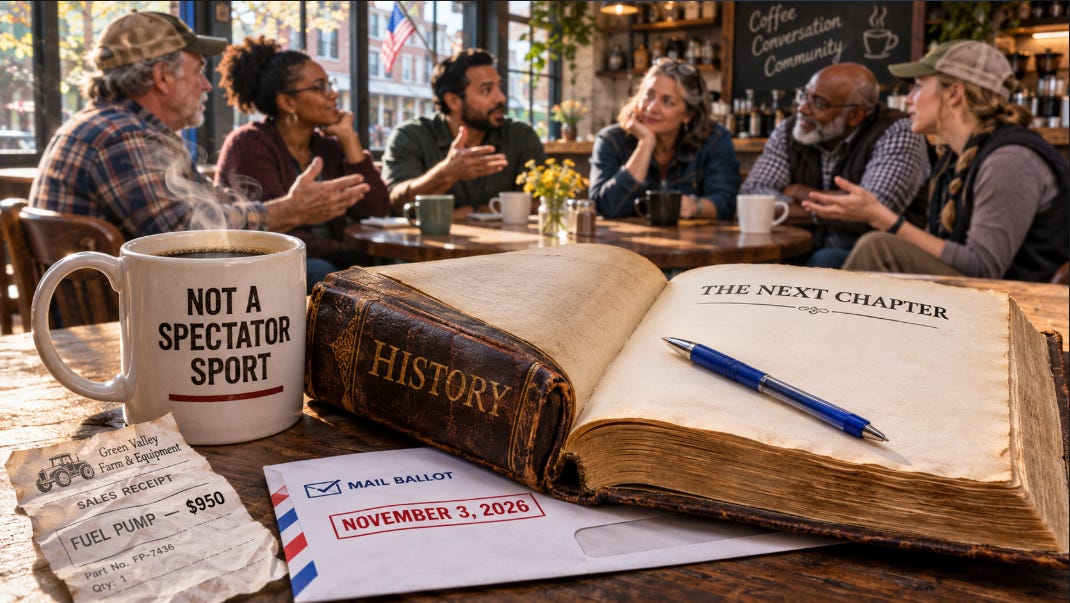
Nick Levendofsky, a crop and beef farmer who leads the Kansas Farmers Union, described the problem in miniature: a combine’s fuel pump small enough to fit in his palm, with a $950 price tag. Tariffs, fuel and fertilizer. He traced much of the pressure to decisions made in Washington. Soybean buyers in China went elsewhere during the first trade war and never fully came back. He voted on the second day of early voting and expects many farmers to vote “more with their pocketbooks” this year.
Merrill Nielsen farms the same land his great-grandfather did. He called 2026 “probably the worst year we’ve ever had financially.” Fuel costs have doubled. Drought took most of his wheat. Export markets that farmers spent decades building, partly with help from USAID, have shrunk or vanished. He has never been “a solid Republican,” he said, but in his part of Kansas Republicans are the majority, and his parents voted that way. This year, his senator’s loyal support for the administration “weighs on my mind.”
Nicole Frang, a fifth-generation cattle rancher, is the most interesting voice of all, because she hasn’t given up on Trump’s program. She still believes the tariffs are meant to help. She blames the four dominant meatpackers for leaving ranchers with too little of the retail beef dollar. But the diesel bill keeps rising, and she describes her whole operation as a gamble: borrowing money she doesn’t really have, hoping this year’s calves cover last year’s debt.
None of these people sounds like a convert. They sound like voters grading results. That’s a quieter kind of political change than a mass defection, and in a close race it may be enough.
Trump’s response came two weeks before the election, at a rally for Marshall in Park City. He announced an $8 billion “Harvest Fuel Relief” program, following a $12 billion farm assistance package the previous December. Then he raised the stakes. Year-round sales of E15, the ethanol blend that corn growers have wanted for years, would become permanent with Marshall in the Senate. “But if Adam Hamilton is in, I’m not doing it. That’s it. I’m only doing it for him.”
A Rice County farmer who lives six miles from an ethanol plant told local television what plenty of Kansans must have thought: the administration shouldn’t punish people for how they vote.
Put that beside Daytona. In Florida, Trump described hurricane relief as something he personally bestowed on a region where he boasted of receiving “98% of the vote.” In Kansas, he made future support for an agricultural policy conditional on which senator voters elect. Different programs, same troubling proposition: public benefits discussed as though they were presidential favors, granted or withheld according to political loyalty.
The race may yet go Republican. Kansas polls have overstated Democratic support before: in 2020, the final New York Times/Siena survey had Marshall ahead by four points, and he won by more than eleven. But the farmers the BBC interviewed reveal something the polls cannot fully capture. Nielsen is questioning what his senator’s loyalty to the administration has delivered. Frang still believes in the policies, even as she struggles with their consequences. Neither needs to undergo a political conversion to start asking harder questions.
The BBC found something else in Kansas, too. Not in a field, but in a coffee shop on the edge of Kansas City.
At the Grounded Soul coffee house, a handful of voters brought different politics to the table, and nobody pretended otherwise.
One woman said she was tired of political rhetoric so vile that it’s all about attacking a candidate’s character, with no substance behind it. What she cared about was health care, education and responsible spending. A liquor store owner said his customers were “trading down.” He noted, with a shopkeeper’s dry precision, that you can downgrade your vodka eight or nine times before you run out of options. Another woman said she never expected corruption to become a concern in this country, but it has. It now costs her $80 to fill a 2006 Toyota pickup. She’s a lung cancer survivor who never smoked, she credits Medicare with treating her well, and she called it unfair and un-American to deny coverage to low-income Kansans. A young man named Adam talked about housing he can’t afford, student debt in the tens of thousands, and full-time work that’s hard to find, and he worried the American dream was “going out the window.” A retired servicewoman spoke about racism she believes is encouraged from the top, and about a party unwilling to rein in its president.
Then Kevin offered what he called a different take. Friends of his had moved abroad to countries with free health care, he said, and still came home to see American doctors. Nothing is free; somebody always pays. He didn’t trust the government to run much of anything well.
The conversation got heated over immigration. One participant was distressed by deportations and by the killings of Renee Good and Alex Pretti in Minnesota. Kevin countered that people who come illegally have broken the law, and that families can go with them rather than be separated. Nobody walked out. Someone granted that Trump had sharply reduced border crossings, perhaps because people are now afraid to come, and then drew a firm line: killing people is wrong.
Not every disagreement was resolved. Not every claim would survive a fact-check. But nobody had to win the argument for the conversation to continue.
Here’s what came next. “I love this,” one of them said. “This is how we get better as a country.” Kevin agreed with Adam that they shared far more than divided them; the differences, he said, were at the fringes and in tactics. Asked why conversations like this are so rare, one participant gave an answer most of us will recognize: talk this way with most people and they end the friendship.
Compare that with Daytona Beach, where Trump warned that voting for a Democrat would put “deranged lunatics and extremists” into power. He said Black or Jewish voters who supported Michigan Democrat Abdul El-Sayed were “not smart.”
The coffee shop says otherwise. Six Kansans with different politics argued about health care, immigration and the economy and came out the other side still talking. None of them gave up a political identity. They found common concerns beneath their disagreements: the cost of living, access to care, opportunities for the next generation, and whether their leaders could work together.
Before the cameras left, the liquor store owner described his shop. The first thing you see when you walk in is an American flag. “Everyone is welcome in my store at all times,” he said. Then, quietly: he doesn’t feel the country is keeping that promise anymore.
That’s democratic culture: citizens arguing in good faith between elections. It’s essential, and it isn’t enough. A conversation in a coffee shop can’t subpoena a contract, audit an oil deal or challenge a president’s threat to make farm policy conditional on a Senate race. For that, democracy needs institutions that answer to the people even after the votes are counted. That’s where Francis Fukuyama comes in.Francis Fukuyama has spent three decades being misread. “The End of History” was never a claim that events would stop. His argument was that, after the Cold War, liberal democracy had no coherent ideological rival as a model for organizing a society. In an op-ed in the Boston Globe this week, he pointed to one Sunday in late October as evidence that the model still has fight in it. On Oct. 25, Serbia’s students defeated an entrenched ruling party, Brazil’s voters reelected Lula, and María Corina Machado went home to Venezuela.
None of these developments, he writes, means democracy is secure in any of these countries. And the distinction he draws matters more than the victories themselves: defeating an authoritarian government is one achievement, and building something accountable in its place is another. Serbia and Venezuela show how differently that second task can go wrong.
Serbia’s movement began with a disaster. In November 2024 a train station canopy collapsed in Novi Sad, killing 16 people, and the project’s ties to government corruption sent students into the streets. They organized deliberately without leaders, without a hierarchy, and without demands beyond an end to corruption, which left the government with no obvious target. They marched village to village across the countryside. The government enjoyed enormous advantages: friendly media, misuse of public resources, voter intimidation and an electoral environment international observers found deeply unequal. The students won anyway, and Aleksandar Vučić conceded.
But the qualities that won the election now become the problem. A movement built to have no leaders has to produce a prime minister. A slate that kept established politicians at a distance must now assemble a government without the benefit of experienced national leaders. Fukuyama recalls Ukraine’s Orange Revolution and Egypt’s Tahrir Square uprising, reminders that movements capable of dislodging entrenched rulers can struggle to translate that victory into durable democratic government.
Venezuela is a mirror image. The dictator is gone, but the people didn’t remove him. In January, American special forces seized Nicolás Maduro, and the Trump administration made a deal with his vice president, Delcy Rodríguez, to keep the country stable while Washington secured access to its oil. Trump made no pretense about the motive. “To the victor belong the spoils,” he told the United Nations General Assembly in September.
The administration chose North American Blue Energy Partners, controlled by Alejandro Betancourt, as its partner in an agreement covering 17 Venezuelan oilfields. Betancourt is under investigation in Switzerland and Spain over alleged laundering of funds connected to Venezuela’s state oil company. He denies wrongdoing and has not been charged. The arrangement provides for a 35 percent U.S. government stake in the company’s parent and sweeping preferential oil-purchase rights. ProPublica found provisions designed to protect the venture from interference by future governments, while key details of ownership and implementation remained obscure.
Machado, who led the opposition to the 2024 election that Maduro stole and later won the Nobel Peace Prize, was shut out of all of it. Trump dismissed her as lacking respect inside the country. On Oct. 25, after seven unsuccessful attempts to return, Machado crossed back into Venezuela and was greeted by enormous crowds. Trump professed ignorance of her arrival, although Reuters cited a person familiar with the arrangements who said the president had approved the trip and was kept informed.
So the United States negotiated extraordinary economic rights while Venezuelans still have no timetable for electing their own government. The regime remains; only its management changed. Removing a dictator, it turns out, is not the same as returning a country to its citizens.
Brazil offers a third test: whether democratic institutions can withstand a defeated candidate’s refusal to accept the result. Lula won reelection by roughly three and a half points. Flávio Bolsonaro called for the vote to be annulled, then left for the United States. An election can establish who won. Institutions must ensure that the result is respected.
Serbia, Venezuela and Brazil present three different tests of democracy: whether a popular movement can govern, whether removing a dictator actually returns power to the people, and whether institutions can enforce an election result against those who refuse to accept it. Elections matter. So does what happens afterward.
Polls suggest Republicans could lose the House, and possibly the Senate. Fukuyama calls it “the most important election of all,” and as a test of whether voters will check a president who governs as if no one can check him, he may be right.
A new Congress would inherit questions that have gone unanswered all year. Where is Venezuela’s oil money going, and on what terms did a company controlled by a man under investigation in two countries become Washington’s partner? Why does the president describe federal disaster relief as a personal favor? Why did he make his support for agricultural policy conditional on a Senate election? What happens to prosecutorial independence when a president publicly encourages his attorney general to pursue political opponents?
The tools for getting answers aren’t glamorous. They include subpoenas and committee hearings, inspectors general, financial disclosures, public records requests, and independent courts willing to rule against the powerful. They work only when officials are willing to use them and citizens keep demanding that they do. An election can open the door to oversight, but someone still has to walk through it, and keep walking through it long after the cameras leave.
That’s the real lesson of the past week, from Belgrade to Caracas to a farm in central Kansas. Strongmen can lose. Whether those defeats produce lasting change depends on what follows.
Winning an election changes who holds office. Restoring democracy changes whom that office serves.
Democracy is not a spectator sport.
Happy Halloween! One of my favorite days of the year. Tonight I’ll be gathering with friends and family for dinner by the bay, all of us in costume, of course.
After a week of political theater, I’m looking forward to an evening when everyone openly admits they’re playing dress-up.
Have a wonderfully spooky evening!
Thank you for this perceptive analysis. In my own mind, I had conflated removal of an authoritarian leader with the advent of democracy. You’ve addressed the huge hurdle that follows the removal, pointing out that it can take monumental effort to come to a solid foundation for ongoing democracy.
Last week, he said the receipts from the Venezuelan oil were $200 billion, now he says they are $250 billion, but the receipts for actual deposits in the foreign bank were about $13 billion. He’s confabulating. Again.