


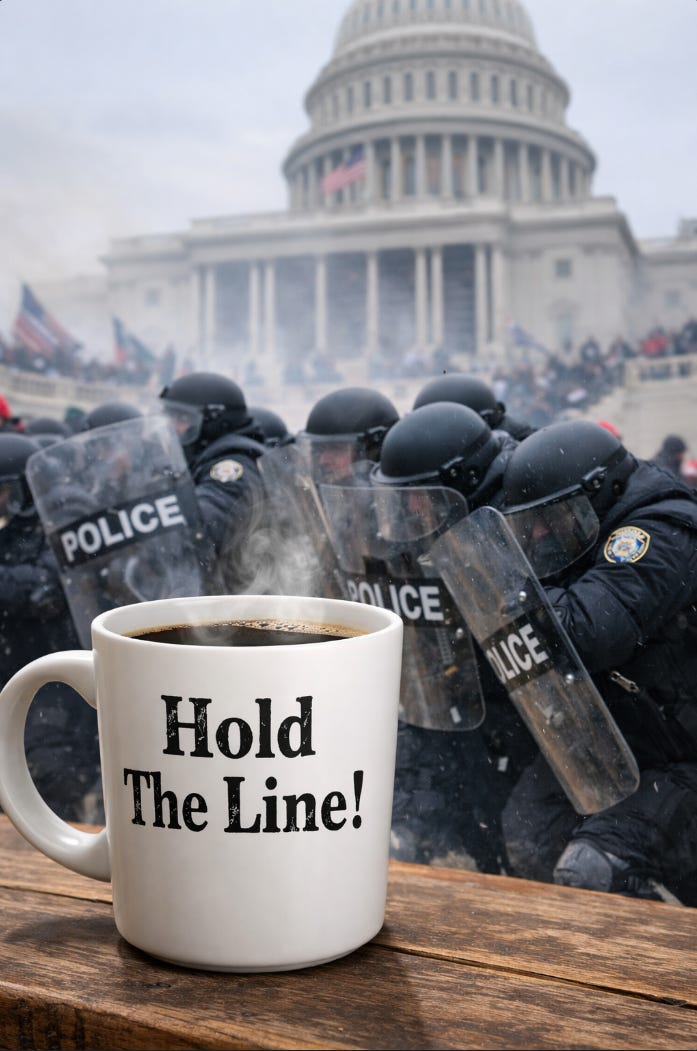
Good morning! Today is January 6, five years since Donald Trump pointed a mob at the Capitol, promised he’d march with them, and then sat on his hands while American democracy bled on live television. Five years on, there is no official memorial, no bipartisan acknowledgment of what happened, and still no plaque honoring the police officers who held the line while lawmakers fled. What there is, instead, is a president who returned to power not by reckoning with that day, but by burying it.
Jack Smith, before being forced to abandon his case under DOJ rules shielding sitting presidents, was explicit about what January 6 actually was: a coordinated effort by Trump to disenfranchise American voters and overturn a lawful election. Smith told Congress plainly that the attack on the Capitol does not happen without Trump. Not rhetorically, or atmospherically, but causally. Here we are, five years later, watching the man who tried to nullify millions of votes preside over the machinery of the state once again, this time with far fewer restraints and far less pretense. This matters, because once you accept the premise that voters are optional, everything else starts to make a kind of grim sense.
Trump, a convicted felon, spent the anniversary not commemorating the assault on democracy, but meeting privately with House Republicans at the Kennedy Center, an institution his administration has awkwardly attempted to rebrand in his own image, because even national memorials apparently need a Trump logo slapped on them. Outside, Enrique Tarrio, convicted of seditious conspiracy and later pardoned, announced a “patriotic and peaceful” reenactment march retracing the steps of the original insurrectionists. Nothing says accountability like turning an attempted coup into a civic reenactment. This is the context in which Trump now lectures the world about democracy while actively dismantling it at home, and why his foreign policy lawlessness feels less like a pivot than an export.
Over the weekend, the United States abducted Venezuela’s president, Nicolás Maduro, in a military operation the administration insists on calling “law enforcement,” apparently because if you say it slowly enough, the Geneva Conventions stop applying. The raid was fast, spectacular, and suspiciously easy, so easy that intelligence professionals like Malcolm Nance immediately asked the obvious question: why wasn’t there real resistance? Where was the military? Why did the system stay intact while one man disappeared?
The answer appears to be that the operation wasn’t about regime change at all. It was about regime management. Maduro is now shackled in a Manhattan courtroom, pleading not guilty and insisting he remains Venezuela’s president, a claim Trump may have helpfully strengthened by referring to him, repeatedly and publicly, as “President Nicolás Maduro,” potentially handing his lawyers a head-of-state immunity argument on a silver platter. When Trump talks, the DOJ ducks.
Back in Caracas, the Chavista state remains fully operational. The vice president, Delcy Rodríguez, a loyalist with deep ties to Russia, China, and Iran, has stepped into the presidency. Political prisoners remain behind bars. Journalists are being detained. Armed loyalists patrol the streets chanting about betrayal. In other words, the man is gone; the system remains.
That’s awkward for María Corina Machado, the opposition leader who genuinely won Venezuela’s stolen 2024 election and now finds herself praising Trump on Fox News, floating Nobel Peace Prize tributes, and begging for elections, while Trump openly says elections are “unrealistic” and signals he’d rather work with Rodríguez for the sake of “stability.” Gratitude is an audition tape with Trump, but definitely not leverage.
The oil motive, meanwhile, has slipped from subtext to headline. Trump now says American taxpayers may have to subsidize U.S. oil companies to rebuild Venezuela’s energy infrastructure, tens of billions of dollars, at the exact same moment his administration is refusing to extend health care subsidies for Americans. No money for insulin, but plenty for offshore drilling rigs. Freedom isn’t free, but apparently it is refundable.
International reaction has been swift and unusually blunt. France and Denmark condemned the seizure as a violation of international law. The UN Secretary General warned that “the power of the law must prevail.” China and Russia barely bothered hiding their delight, with Beijing stepping forward as the self-appointed defender of sovereignty while Washington explained at the UN that the Western Hemisphere is effectively its property. Announcing your imperial doctrine out loud will hardly reassure allies, assuming we still have any.
Mexico, which has bent over backward to cooperate with Trump on border enforcement, extraditions, and surveillance, is privately rattled. Officials and business leaders are openly asking whether Venezuela was a one-off or a proof of concept. Trump has already suggested the U.S. may need to “do something” about cartels “running Mexico,” language that sounds uncomfortably similar to the rhetoric that preceded Maduro’s removal. A Mexican business leader put it bluntly: They pulled the Venezuelan president out of his bed. My God, that could be us.
The White House confirmed those fears. A spokesperson explained that the administration is “reasserting the Monroe Doctrine” to defend the homeland. Translation: sovereignty is conditional, and compliance is the price of safety.
Zoom out far enough, and the pattern is unmistakable. A president who tried to void American votes now claims the right to decide which foreign governments are legitimate. His MAGA movement, which reframed an insurrection as tourism, now reframes invasion as policing. A political party that refused to convict now refuses to remember. January 6 wasn’t an aberration; it was a rehearsal.
The failure to hold Trump accountable left him believing there are no consequences. Five years later, the lesson has metastasized, from the Capitol to Caracas, from voters to borders, from ballots to bombs. Power treats democracy at home and abroad as an inconvenience, managing, delaying, or ignoring it depending on its usefulness.
And that’s the throughline worth sitting with on this January 6 anniversary: when a man who tried to disenfranchise Americans is allowed to reclaim authority without accountability, lawlessness doesn’t stay contained. It radiates outward, louder, bolder, and increasingly convinced that the rules are just suggestions for other people.
Marz joined me again last night for a soggy moonbeam vigil, the two of us doing our best to radiate calm, love, and peace into a world that feels increasingly allergic to all three. But I’ll admit it: a growing sense of urgency keeps intruding. The quiet rituals help steady the spirit, but they’re no substitute for action. If we are to avert a war of aggression, not just waged abroad, but turned inward against our own people, then we can’t stay still. We have to take to the streets today, tomorrow, and again after that, not in anger but in defense of something worth keeping.
The cruel irony is that Donald Trump is probably planning to use the Maduro playbook for the upcoming elections in the US.
You painfully capture the grim possibility of "the premise that voters are optional". Andrew Weinstein and Marc Elias are sounding alarms about election interference. The disgust and nauseating outrage at the actions and escalations of this Trump junta leaves us frustrated and apoplectic, waiting anxiously for some signs and acts of containment. The fate our republic is now in the hands of the 119th Congress. Will they hear us?!
Your steaming coffee with the backdrop of those few outnumbered DC law enforcement officers brought back those awful churning stomach moments five years ago.
Interestingly, I have those exact same feelings now...