

While Elon Musk was promising to chainsaw the federal government into submission with his Department of Government Efficiency cosplay, one mild-mannered tax economist quietly did what grown-ups do: he read the budget tables.
Alan Cole, a 37-year-old economist at the right-leaning Tax Foundation, looked at the prediction markets lighting up with Musk believers betting that federal spending would shrink in 2025, and saw what can only be described as free money. He wasn’t betting on vibes or ideology. He was betting on math.
When Musk’s Department of Government Efficiency (DOGE) stormed into Washington promising dramatic shrinkage, the newly booming prediction markets filled with believers willing to bet that federal spending would fall in 2025.
The wager was hosted on Kalshi, a federally regulated prediction market platform where people can trade contracts on the outcomes of real-world events. Think of it as a futures market for reality: instead of betting on a football game, traders buy and sell contracts on things like inflation rates, election outcomes, or government statistics. If the event happens, the contract pays out. If it doesn’t, it expires worthless.
The contract was straightforward and mercilessly objective. If federal spending in each quarter of 2025 exceeded spending in the fourth quarter of 2024, measured in annualized, seasonally adjusted nominal dollars, using official government data, the “government keeps growing” side would win.
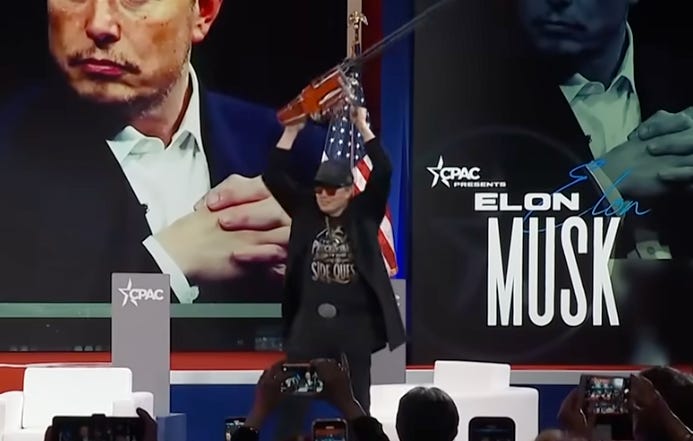
There was no interpretive spin or panel of judges. No viral X thread to massage the definition of “cut.” No Elon Musk on a stage, grinning and hoisting a chainsaw above his head as sparks fly and the crowd roars. Just the numbers as published.
The Bureau of Economic Analysis does not care about theatrics. The Treasury’s quarterly statements are immune to branding, and actuarial tables do not applaud. Cole wasn’t betting against a personality, but he took the other side of the Musk believers.
Then he went all in. Not “a little speculative position,” or “play money.” He moved $342,195.63, effectively everything outside retirement accounts and home equity into the bet.
Why? Because federal spending is not a discretionary tech startup that can be pivoted with a motivational speech. It’s Social Security checks. Medicare reimbursements. Interest on nearly 100% debt-to-GDP. An aging population. Healthcare inflation. Structural commitments that don’t evaporate because a billionaire tweets about efficiency.
As The Wall Street Journal’s Richard Rubin reports, Cole wasn’t dismissive or ideological about it. He was clinical. In what may be the most beautifully understated line in the entire story, Cole explained that even if Musk cut contracts and trimmed the federal workforce, there was “no plausible path” to meaningfully dent overall spending.
That phrase, no plausible path, is doing a lot of work. It’s not a moral judgment. It’s an actuarial assessment.
Rubin’s reporting makes clear what so many of the prediction-market traders seemed to miss: federal spending isn’t dominated by discretionary office budgets that can be axed during a dramatic on-stage moment. It’s dominated by mandatory programs and debt service that run on autopilot. Social Security, Medicare, Medicaid, and plenty of interest payments. You cannot fire compound interest.
The U.S. government has been described as an insurance company with an army. In 2025, it’s an insurance company with an army and a giant mortgage. You can’t DOGE that away, at least that is the way Cole saw it.
When the final 2025 figures dropped on February 20, it wasn’t close. The lowest spending quarter was $66 billion above the bet’s target. Cole collected $470,300.
Profit: $128,000.
Return: 37%.
Cause of death for the “Musk will shrink government overnight” fantasy: arithmetic.
What makes this story so perfect isn’t just that he won. It’s why he won. He wasn’t some ideological warrior betting against Musk. He’s a tax-policy nerd who specializes in things with acronyms that require hydration breaks to pronounce. He simply understood that structural federal spending doesn’t reverse on a dime because of swagger.
People on the other side of the bet were apparently wagering on vibes, not budget baselines. Cole’s wife reportedly read the Kalshi comments and felt reassured because the Musk backers “didn’t seem to understand what they were buying.”
There is something almost poetic about that. This was a triumph of basic public finance over magical thinking.
And it’s a reminder worth sitting with: the federal budget is not a startup burn rate. It’s a demographic machine that runs on entitlements, debt service, and healthcare costs. You can fire press secretaries and rebrand agencies, but you cannot meme away compound interest.
The analyst succeeded based on two criteria foreign to MAGA world: facts and logic.
More than ever, good decisions require stepping back and assessing what’s real and probable with clear eyes. It’s certainly more difficult when corrupt leaders and their powerful enablers rule by lies, delusions, and gaslighting.
My husband has followed this topic very closely. He is a a retired electrical engineer—NASA, Goddard Space Center, then many years at Lockheed here in CA—stealth bombers and many meetings with big wigs in the lower floors of the Pentagon. Yup. He manages his investments himself. Now he knows you really are a genius—numbers are like science and scientific facts. They are real…well DUH. He has been saying the same thing for months, and you really captured the essence of the situation. He will especially appreciate your article. Keep on keeping on! Sandy Forrest