


Let’s take a breath and step back from the noise, because what happened Friday was not just a tariff ruling. It was a stress test for the Constitution, followed immediately by an Olympic routine in political face-saving.
The Supreme Court, in a 6–3 decision, struck down Donald Trump’s sweeping global tariffs imposed under emergency powers. Not tariffs as a concept. Not trade policy in general. The specific maneuver of declaring a national emergency and unilaterally taxing the world. Effectively, they shut down rule by fiat.
The Court’s message was almost boring in its clarity: taxation belongs to Congress. IEEPA, the International Emergency Economic Powers Act, does not contain the word tariff. The Constitution very much contains the word tax, and it assigns that power to the legislative branch.
That is precisely why this ruling detonates. For months, tariffs have been Trump’s favorite blunt instrument. They were leverage, punishment, applause line, budget balancer, factory reviver, fentanyl stopper, war ender, and possibly a cure for male pattern baldness. If there was a problem, there was a tariff for it. Now the Court has said: not like that.
Outside the United States, the framing was strikingly consistent. This was not described as a clever statutory pivot or a technical adjustment. It was described as a defeat and a constitutional correction.
Al Jazeera called it “one of the most important Supreme Court decisions in decades” and described it as a reassertion of congressional authority. Their correspondent emphasized not just the economic fallout, but the constitutional message: the president had overreached. The phrase “undercut and subverted the powers of Congress” hung in the air.
France 24 highlighted something even more uncomfortable: two conservative justices appointed by Trump joined the majority. In Paris, the storyline wasn’t partisan persecution, it was institutional rebuke. The court, including his own appointees, said no.
The BBC treated it as a historic check on presidential power. They replayed “Liberation Day” footage, the Rose Garden theatrics, the poster boards, the tariff charts, and then contrasted it with the ruling that much of that display had rested on shaky legal ground. They framed it as a pillar of his agenda collapsing under judicial scrutiny.
Sky News called it “a huge blow” to Trump’s stature, not merely his policy. The phrase “test of presidential power” appeared repeatedly. The implication was clear: he had gambled on executive authority and lost before a court he was widely seen to have shaped.
Canada’s CTV emphasized the illegality of the fentanyl-related tariffs and the direct consequences for North American trade. In Ottawa, the tone was less outrage and more vindication.
Even CBS, hardly a foreign outlet, described it as a “major defeat.” Not a clarification or a procedural hiccup. A defeat.
Across Europe, Asia, and Australia, the themes converged: separation of powers reasserted, executive authority constrained, markets reassured that the system still functions.
What’s striking is the contrast between that framing and Trump’s response. Abroad, the narrative was institutional: a president constrained by law. A separation-of-powers correction. A reminder that Congress, not the executive, controls taxation.
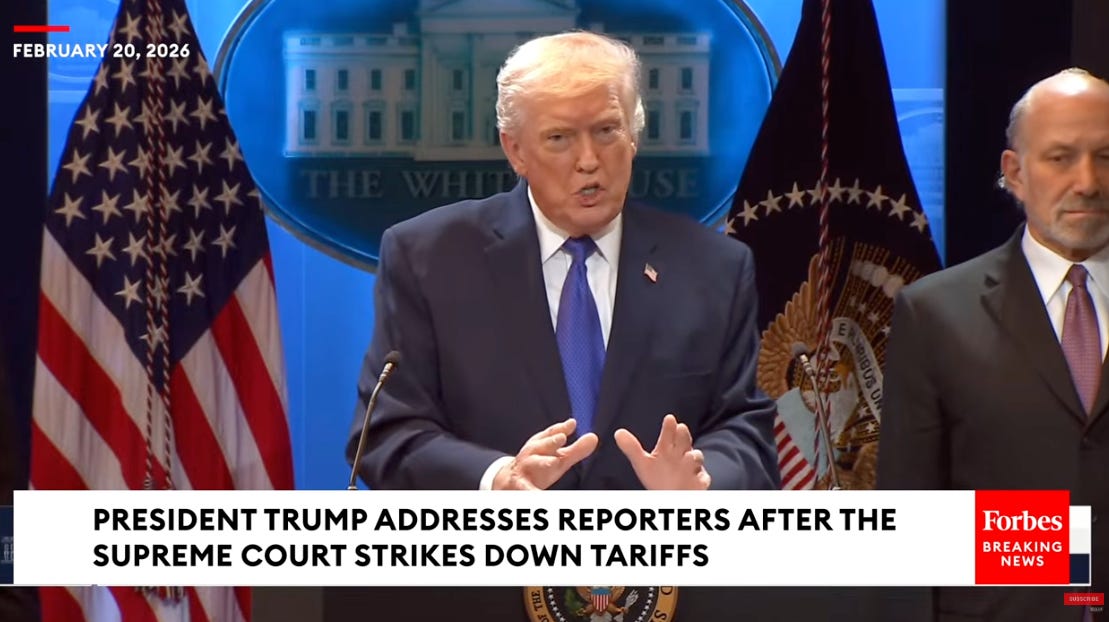
At the podium, the narrative was personal. Trump began with indignation. The ruling was “deeply disappointing.” He was “ashamed of certain members of the court.” The justices who ruled against him were “very unpatriotic and disloyal to our Constitution.” He suggested the Court had been “swayed by foreign interests.” The lawyers who challenged him are “sleazebags” and “slime balls.” He described members of the majority as “fools” and “lapdogs for the RINOs and the radical left Democrats.”
In Europe, commentators talked about checks and balances. In Washington, the president talked about betrayal.
Foreign coverage focused on the constitutional architecture. Trump focused on loyalty. He praised the three dissenters, Thomas, Alito, and Kavanaugh, for their “strength,” their “wisdom,” their “love of our country,” and said their dissents were so strong that “there’s no way that anyone can argue against them.” Of the majority, he said their decision was “terrible,” “defective,” “almost like not written by smart people,” and even suggested it was “an embarrassment to their families.”
He framed the decision not as a constitutional disagreement but as a moral failure, judges “afraid” of loud critics, catering to a small political movement, engaging in “politically correct” behavior. Yet, in the same breath, he insisted the ruling had made him stronger.
“In actuality,” he said, “the Supreme Court’s decision today made a president’s ability to both regulate trade and impose tariffs more powerful and more crystal clear rather than less.” He declared the Court had confirmed his ability to “block, embargo, restrict, license, or impose any other condition” on trade, and that there were “numerous other federal statutes” that would justify “even more tariffs.”
In Europe, commentators talked about checks and balances. In Washington, the president talked about betrayal.
Then, in the same breath, he performed the pivot. The decision, he insisted, actually made him more powerful.
“In actuality,” he said, the Court had made his authority to regulate trade more crystal clear. He could block, embargo, restrict, license, impose any other condition on trade. “They say I can do anything I want,” he argued, “but I can’t charge $1.”
This is the genius of it. Lose a 6–3 Supreme Court case and declare that you have unlocked hidden powers. You did not lose; instead, you leveled up.
The Court said he could not impose sweeping tariffs under IEEPA. So within hours, he cited Section 232. Section 301. Section 338. And, most importantly, Section 122 of the Trade Act of 1974.
Effective immediately, he announced a 10 percent global tariff under Section 122.
You have to admire the choreography. The Supreme Court narrows the emergency lane and he sprints into a statutory side street before the ink dries.
If the decision was Act One, the Section 122 pivot was Act Two. And this is where the policy reality starts to wobble.
Section 122 allows a temporary tariff surcharge for up to 150 days, ostensibly to address balance of payments problems. It is not indefinite, nor is it a blank check. It is not the economic equivalent of planting a flag and daring the world to blink.
Economist Justin Wolfers put it bluntly: what problem is a 150-day tariff the solution for? If the goal is leverage over China, Beijing can count to five months. If the goal is to pressure Europe, Brussels has entire departments devoted to waiting. If the goal is shoring up manufacturing, no serious company is building a multi-billion dollar plant protected by a tariff that expires before the concrete sets.
Leverage works when it is durable. A 150-day surcharge is not structural change; it is simply a timer.
Strip away the rhetoric about national security and economic patriotism and what remains is a broad 10 percent import tax for a few months. It is not a coherent industrial strategy. It is a revenue tool.
In fact, it is a regressive tax. Tariffs do not land gently on hedge funds. They hit importers first, then retailers, then consumers. They filter into the price of shoes, car parts, electronics, appliances, groceries, construction materials. People who spend a larger share of their income on goods pay proportionally more.
If you are wealthy, a 10 percent bump on imported consumer goods is an annoyance. If you are living paycheck to paycheck, it is a squeeze.
The president campaigned on lowering prices and fighting inflation. An across the board import surcharge moves in the opposite direction. It is a consumption tax layered onto a system that does not rebate it to the households who feel it most.
And then there is the refund question.
Companies paid the original tariffs. Not foreign countries, despite the applause lines. American importers paid them. Some absorbed the cost in thinner margins. Some passed it along in higher prices. Even when firms absorb the hit, it shows up in earnings reports and stock valuations, and therefore in retirement accounts. You may not have seen it itemized on a receipt, but you may have felt it in your 401(k).
If refunds are ordered, the money goes back to the importers. Consumers will not receive neat little restitution checks for the extra dollars folded into last year’s prices. There is no tariff dividend waiting in the mailbox.
Which makes the new 150 day global levy feel less like a masterstroke and more like a holding pattern. A way to maintain the narrative of strength and save face while the legal architecture narrows. A temporary tax that expires quickly and leaves ordinary households carrying the quiet end of the stick.
Abroad, the headline was simple: Supreme Court strikes down Trump’s global tariffs. Doha, Paris, London, Ottawa, Berlin, Sydney. The story was constraint. A president checked by law. Institutions functioning.
At the podium, the story was different. The Court was wrong. The majority was weak. The ruling was defective. And somehow, magically, it made him stronger.
If tariffs were meant to project inevitability, today projected something else. A reminder that even a president who prides himself on bending systems to his will still operates inside one. For a man who trades on dominance, that may be the most consequential part of all.
A hurt animal is a dangerous animal.
so which way will the wind blow? The economy is booming (looka that Dow, but don' say "fifty") or "we have been destroyed by those judicial traitors?
At least someone to blame other than Biden.