


The federal government’s case against eight protesters convicted of terrorism in Fort Worth last March rested on three categories of evidence: they wore dark clothing, they used an encrypted messaging application, and they held political views the prosecution characterized as anti-government. No jury instruction required the government to prove that the organization they allegedly supported existed. It doesn’t, as a matter of legal fact, have to.
The encrypted app was Signal. It is used by journalists, lawyers, congressional staffers, national security officials, and human rights workers worldwide. The prosecution’s own expert witness acknowledged he uses it himself. The dark clothing was black. The political views were anti-fascist, opposition to fascism, a position so uncontroversial for most of the last century that it required no particular courage to hold, let alone a label.
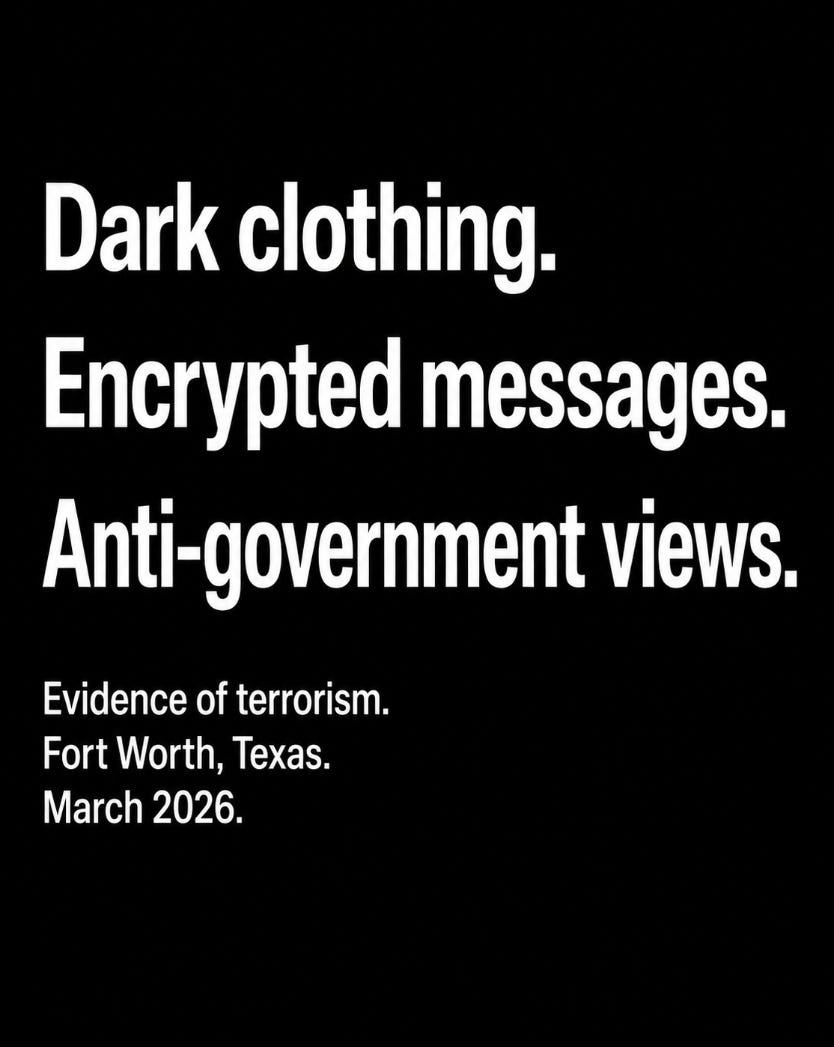
Eight people now face between ten and sixty years in federal prison for holding them.
Anti-fascism is a tactic, not an organization. Like protesting, like civil disobedience, like terrorism itself, it describes a method, in this case, the method of opposing fascism, not a membership structure with dues, hierarchy, and a mailing address. There is no antifa cell to join, no antifa leadership to surveil, no antifa headquarters to raid. This is not a legal technicality or a defense attorney’s sleight of hand. It is simply true, and the government knows it. The Trump administration’s own prosecution in Fort Worth did not require the jury to find that the “North Texas Antifa Cell”, the organization named in the indictment, actually existed. Prosecutors didn’t have to prove it because, as a matter of constitutional law, organizations operating within the United States are protected by First Amendment rights that make domestic terrorist designation a legally treacherous process. So instead, the administration designated antifa by executive order, bypassing the statutory process entirely, and then prosecuted eight people under a legal theory that required only that they be associated with a violent act, not that they committed it, planned it, or even knew it was coming.
The significance of that maneuver is difficult to overstate. “Antifa” is now whatever the executive branch needs it to be. It is a vessel, not a definition. And the Prairieland verdict is the precedent that fills it.
While eight protesters faced decades in prison for wearing black and using Signal, the President of the United States was executing roughly sixty stock trades per trading day.
The details emerged last week through mandatory ethics disclosures that the administration filed late, incurring fees for missing the reporting window. Between January and March of this year, Donald Trump’s portfolio recorded 3,642 securities transactions valued at between $220 million and $750 million, the imprecision is itself a feature of the disclosure system, which requires broad valuation bands rather than exact figures and operates on a thirty to forty-five day delay, meaning the public learns what the president traded only after the moment for accountability has passed.
The trades overlapped, with a precision that strains coincidence, with administration policy. Trump purchased significant positions in Nvidia and Boeing before their CEOs joined him on a diplomatic trip to China where deals involving both companies were announced. He bought into Coinbase, Robinhood, and SoFi during a period when his administration was issuing executive orders favorable to cryptocurrency, establishing a federal Bitcoin reserve, and launching a retirement program with Robinhood as its initial trustee. Most visibly, he built a multi-million dollar position in Dell Technologies beginning February 10th, then stood at a White House podium on May 8th and told the American public to go out and buy Dell. The stock rose twelve percent that day. The Dell family had donated $6.25 billion to the president’s signature program three months earlier. The White House has not said whether the endorsement was connected to the donation.
None of this is currently illegal. The president is exempt from the conflict of interest statutes that apply to every other federal official. The disclosure system that made these trades visible was designed for transparency, not accountability, and even that system, the administration managed to file late.
The Prairieland case did not begin as a terrorism prosecution. It began as a protest.
On the night of July 4th, 2025, a group of demonstrators gathered outside the Prairieland ICE Detention Center in Alvarado, Texas, a facility that at the time held nearly 900 people, the majority of whom had not been charged with any crime. They brought a megaphone. They brought sparklers and small fireworks. They spray-painted cars in the parking lot. One of them, Benjamin Song, a former Marine Corps reservist, brought an AR-15 with a modified trigger and shot a police officer in the neck. The officer survived.
Song was convicted of attempted murder. That conviction is not the story.
The story is what happened to the eight people who did not shoot anyone. Their conviction for providing material support to terrorism rested on a legal theory of guilt by association, that by being present in a group where violence was foreseeable, they had materially supported a terrorist act. The terrorist act in question was Song’s shooting. The terrorist organization in question was the “North Texas Antifa Cell,” an entity the government named in its indictment but was not required to prove existed. The evidence presented against the eight included their clothing, their use of Signal, anti-government internet memes, drawings, content from radical zines, and in at least one case, retweets of anti-fascist content on social media.
The trial itself was not without irregularity. The presiding judge, Trump appointee Mark Pittman, declared a mistrial during the first jury selection after deciding the initial jury pool showed insufficient sympathy for ICE. He then took personal charge of jury selection when the trial restarted, a highly unusual intervention. He also barred Song from presenting a self-defense argument.
Then Attorney General Pam Bondi called the verdict a landmark. The Justice Department pledged it was just the beginning.
That promise deserves to be taken seriously. The legal architecture the administration has constructed, executive order designation bypassing statutory process, material support charges requiring no proof of organizational membership, evidentiary standards that treat clothing and messaging apps as proof of criminal conspiracy, does not require another shooting to operate. It requires only a demonstration, a group of people in dark clothing, and a prosecutor willing to call them a cell.
These two stories, a president trading stocks at sixty transactions per day while exempt from the conflict of interest laws that govern everyone around him, and eight protesters facing decades in prison for standing outside a detention facility in dark clothing, are the same story told from two ends.
What the Prairieland verdict authorizes, and what the administration’s new counterterrorism strategy makes explicit, is a legal regime in which the definition of terrorism expands precisely as far as the executive needs it to. Anti-fascists today. Environmental activists tomorrow. Journalists who obtain and publish documents the administration would prefer to keep secret the day after that. The counterterrorism strategy released this month includes the line “We will find you and we will kill you.” It also targets, by name, adherents to what it calls “radical pro-transgender ideology.” It places antifa on the same threat level as ISIS and Al-Qaeda. For the record, it was written by Sebastian Gorka.
The disclosure system designed to let the public see what the president is trading was filed late. A legal opinion authorizing the extrajudicial killing of suspected drug traffickers in the Caribbean is classified. The list of domestic organizations designated as terrorist is secret. The evidentiary standard required to kill someone in international waters is lower than the standard required to detain them.
Consider what it means to live inside that architecture as an ordinary person. You have worn black. You use an encrypted messaging app, or you should. You have retweeted something the government might characterize as anti-government. You have perhaps stood outside a building and said, loudly, that something happening inside it was wrong. Under the legal theory that convicted eight people in Fort Worth in March, whether any of that makes you a terrorist is not a question a jury has to answer. It is a question the executive branch answers alone, in secret, with a list no one is allowed to see.
The warning embedded in the Prairieland verdict is not that the government will come for everyone who has ever worn black to a demonstration. The warning is that it can. The precedent is set. The architecture is built. The attorney general has promised more cases are coming. And the president, who is exempt from the laws that would prevent him from profiting from his own policy decisions, filed his trading disclosures late.
Democracy is lost in the accumulation of precedents, each one normalized before the next arrives. Prairieland is a precedent. The counterterrorism strategy is a precedent. Sixty trades a day, filed late, with a system designed to tell you only after it matters, that too is a precedent.
The question is not whether you and I are on a list, but whether enough people understand what the list is for before it’s too late to say so out loud.
Horrifying! Most Americans grew up assuming the Constitution’s Bill of Rights and laws protecting our core freedoms are inviolable. Most courts narrowly construed exceptions in order to preserve the intent and scope of our protections.
MAGA’s Project 2025 architects had a different agenda. Their playbook shows an exhaustive effort to dissect our laws for every weakness, opening for twisted arguments, loophole, etc., to retain the appearance of fidelity to our laws while ensuring outcomes never intended by the law’s drafters.
An implied covenant of good faith and fair dealing is fundamental to contract law. We’re learning our system cannot protect us - or the vision of our Constitution’s preamble - without good faith and fair dealing in the decisions and actions of our elected representatives.
Trump and his team do not exercise their vast powers in good faith and with fairness. They lie and self-deal with brazen contempt for those they harm and for laws that constrain them.
Massive voter turnout for every MAGA opponent must be part of our - the majority’s - Project 2026-28 agenda.
I have been reading and loving your columns for months but I have to say that this may be the most frightening of all. The potential scope of the ramifications of the Praireland verdict is so far beyond anything I would have thought possible in this country. God help us!