


Donald Trump held yet another one of those White House events that manages to answer a question nobody asked: what would happen if a campaign rally, a county fair speech, a grievance podcast, and an awards brunch were all locked in a room together and forced to produce a single presidential appearance?
This one was supposed to be about Women’s History Month. Mothers, working women, women making history, women holding families and communities together. In theory, it should have been simple enough even for him: say a few gracious words, let the honorees speak, sign the thing, move on. Instead, it turned into the usual grotesque one-man pageant in which every topic, every person, and every anecdote is eventually dragged into orbit around the same immovable object: Donald Trump.
He opened by sounding as though he had wandered in from one of his Iran war monologues, declaring that some “nation of terror and hate” was “paying a big price right now,” almost certainly a reference to Iran, and a reminder that Trump can turn even a Women’s History Month event into a warm-up lap for his strongman fantasies. Naturally, when you are honoring moms, the first order of business is a little apocalyptic chest-thumping. From there he launched into a long series of thank-yous to Republican women and administration figures, delivered in that familiar style of his: half compliment, half ramble, half self-congratulation. Yeah, I know that is three halves, but that is how Trump speeches work.
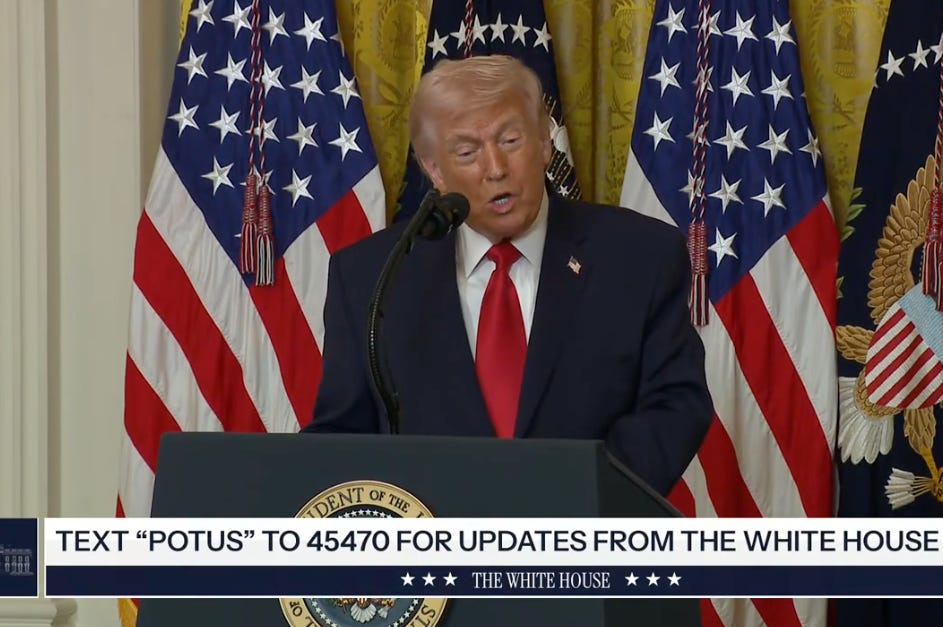
He praised Usha Vance as “an incredible person” and then turned to the matter he apparently considered most relevant, adding, “And your husband is doing a good job,” as though she had been anxiously waiting for a spousal performance review from the podium. He complimented Karoline Leavitt by calling her “perhaps the best press secretary in history,” then added, “She keeps me straight. She says, no, you can’t do this, you can do that, life would be so much more exciting,” which is about as close as Trump gets to admitting adult supervision is necessary. He drifted through shout-outs to senators, representatives, and assorted loyalists, telling stories that started with campaign rallies and ended in the usual swampy haze of self-mythology: He drifted through shout-outs to senators, representatives, and assorted loyalists, including Sen. Cindy Hyde-Smith of Mississippi. reduced simply to “Cindy Smith,” while telling the usual swampy stories of rallies, rescues, and landslides: “Cindy called me up years ago,” “We ended up with three of them and she won in a landslide,” and, inevitably, “She doesn’t need rallies.”
Then came the ceremonial invocation of great American women, delivered like a man speed-reading a decorative wall calendar in the gift shop of a colonial museum. “From Martha Washington, to Betsy Ross… to Rosa Parks, from Aretha Franklin,” he said, running through centuries of history in the tone of someone skimming a commemorative plaque before returning to the gift shop. The women he named did not appear as people with distinct lives, struggles, or accomplishments so much as items in a patriotic montage, arranged to bathe the occasion in borrowed grandeur.
Trump’s own contribution to this section was less historical reflection than the usual mush of flattery and self-display. “They are the heart and soul,” he said, before adding that women are “so powerful and so important and so beautiful.” Then came the inevitable little Trumpian martyr routine: “I’m not allowed to use the word beautiful but I’m using it anyway.” Because apparently even at an event meant to honor women, he cannot resist recasting himself as the brave truth-teller defying the cruel forces of etiquette. In Trump’s world, women may be powerful and inspirational, but they are never far from being reduced to symbols, scenery, or compliments he is terribly proud of himself for delivering.
From there the event became an infomercial for his policies, especially his beloved “one big beautiful bill,” a phrase he repeated with the glazed devotion of a man who has become romantically attached to his own branding. “Thanks to the one big beautiful bill,” he said, before immediately deciding even that was not sufficiently enshrined and announcing, “I want to say a great big beautiful bill because I like it better.” Women were then brought up one after another to testify that his tax cuts and economic policies had changed their lives. One waitress said she “did do my taxes twice to make sure this was real” after receiving what she said was a $4,000 refund. A sheet metal worker and mother of seven described how “with the big beautiful bill” her family was able to buy “a five bedroom home on an acre of land.” A farmer’s wife thanked him for “changes and updates” to estate tax relief that would help preserve the family farm for the next generation. These were, on their own terms, perfectly fine stories. Some were even genuinely moving.
In Trump’s hands, each became less a human experience than a product demonstration. He could not simply let their stories stand; he had to stamp each one with his logo. “We passed the largest tax cuts in American history,” he declared. “We decided to lower taxes.” He boasted of “no tax on tips, no tax on overtime and no tax on Social Security,” then veered into tariff mythology, bragging, “We get 12 billion, we took in tremendous amounts of money because of the tariffs and jobs are coming in through the roof.” Every woman who spoke was treated like a living Yelp review for Trumpism, her life story folded neatly back into his sales pitch: my bill, my tax cuts, my tariffs, my jobs, my miracle. The people on stage may have been real, but the event treated them like testimonials in a late-night ad for the Big Beautiful National Renewal Package, now available in gold trim.
He then lurched into crime and immigration, because no Trump event is complete until the original subject is shoved aside to make room for the darker compulsions. He claimed zero illegal immigrants had been admitted for ten straight months, bragged about dramatic crime reductions, and painted Washington, D.C. as having gone from dangerous to one of the safest capitals in the world thanks to his interventions. Nothing says “celebrating women” quite like a detour into border panic and fantasy crime statistics. A Florida sheriff spoke glowingly about law enforcement and overtime pay, after which Trump, sounding less like a president than a talent scout for a pro-wrestling league, complimented how tough she looked.
Then came one of the most bizarre pivots, which is saying something in a speech that had already wandered from working moms to tariffs to murder rates. Trump launched into a long, self-satisfied monologue about prescription drug prices, claiming that he had essentially bullied foreign countries into paying more so Americans could pay less. In his telling, he was on the phone personally forcing world leaders to comply, cutting drug prices by astonishing percentages, and being criminally ignored by the press for what should have been the biggest story in the country. Listening to him explain this was like being trapped next to a man at a wedding reception who has cornered you to describe the international pharmaceutical system through the lens of his own unverified heroism.
Because the speech had not yet drifted far enough from its stated purpose, Trump then steered directly into culture-war territory: trans kids, women’s sports, voter ID, mail ballots, and the old election lie dragged out yet again like some taxidermied beast his audience is expected to applaud on sight. By this point the event was no longer even pretending to center women in any meaningful way. Women had become scenery for the familiar Trump performance, a performance in which every issue is flattened into grievance, every policy into slogan, and every public appearance into a campaign stop conducted under the chandeliers of government.
The one moment that sounded recognizably human came from Olympic bobsledder Kaillie Humphries, who spoke about her IVF journey, becoming a mother, being told she would never return to the Olympic podium, and proving everyone wrong. It was brief, sincere, and rooted in an actual life rather than a branded myth. Naturally, even that was eventually rerouted back into Trump’s ego when she presented him with a medal recognizing his support for women’s sports and IVF access. Trump’s response was pure Trump: delighted, pleased with himself, instantly convinced that his instinctive affection for her had been vindicated by events. He did not so much receive the honor as consume it.
Finally, he signed whatever ceremonial measure had been prepared for the occasion, making a point to joke about not using an autopen, because even a simple signing ceremony must now serve as one more little performance of macho authenticity. Pens were handed out. Applause followed, some music played, and the spectacle ended as it began: with Trump trying to turn the machinery of state into a variety show built around his own reflection.
The most offensive thing about these events is not just the narcissism, though there is always plenty of that. It is the way he reduces every other person in the room into a supporting actor in his personal myth. Even at an event meant to honor women, he cannot imagine women except as extensions of his story: beautiful symbols, grateful beneficiaries, useful validators, decorative witnesses to his own greatness. Genuine stories are swallowed by self-worship. Earnest moments are sprayed with campaign lacquer. Public office becomes one more stage for a man who has never understood the difference between governing and performing dominance badly.
Which brings us, appropriately enough, to one of the most revealing phrases on Trump’s official schedule: “Executive Time.”
If that term sounds familiar, it should. During Trump’s first term, “Executive Time” became the polite bureaucratic euphemism for large blocks of unscheduled presidential time reportedly spent watching television, calling friends, freelancing grievances, and generally existing in a soft-focus cloud of self-directed presidential cosplay. In a normal administration, private schedule time is just that, private schedule time. Under Trump, it became almost metaphysical, as though loafing itself had been elevated into a doctrine of governance.
Now the phrase is showing up again, repeated on public schedule trackers with the deadpan simplicity of official Washington trying not to laugh in its sleeve. “The President participates in Executive Time.” It is such a wonderfully antiseptic phrase for what it almost certainly means: the republic is on pause while the old man putters, fumes, flatters himself, rage-scrolls, rage-bleats on Truth Social, or marinates in cable news.
Trump approaches the presidency as atmosphere. A set. A gold-plated backdrop against which he can continue playing the role he has always preferred: strongman, host, victim, salesman, king of the brunch buffet, emperor of Executive Time.
I read fast but I don't think you mentioned 'the little woman' ... was Melania there? It was a night for women, right? I doubt she cares a hoot about any other woman but an icy smile directed at the gathering would have been appropriate.
I’ll bet there were more, if not all, MAGA women in attendance.