


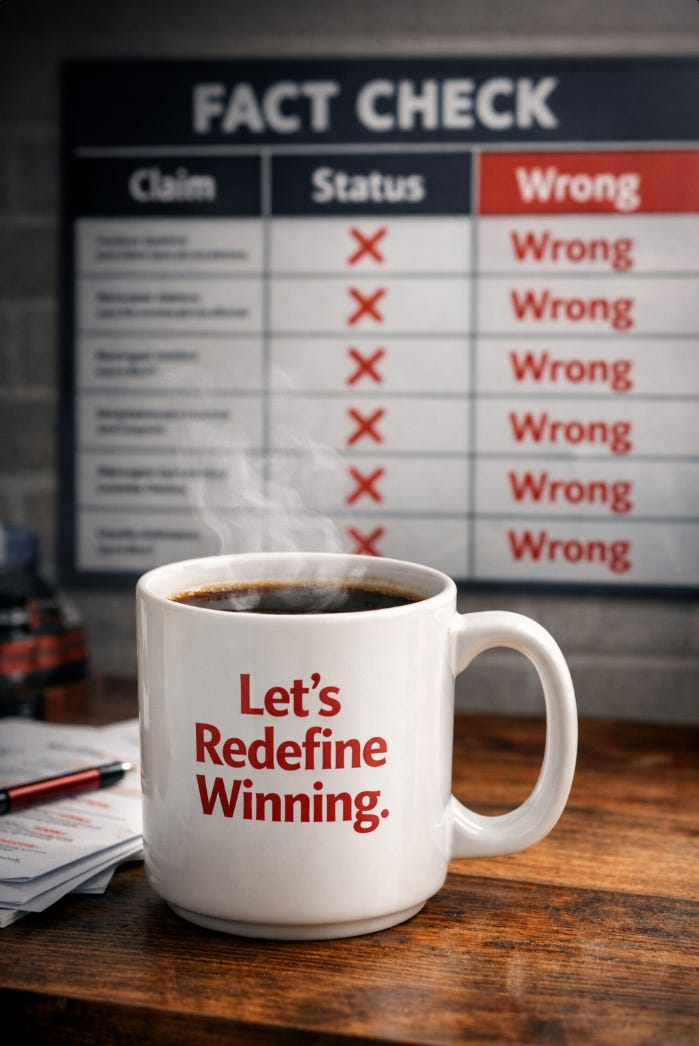
Presidents have always been fact-checked. What felt different this time was the scale and speed. Major outlets came armed with live verification pages, statistical rebuttals, and real-time corrections. It is notable that so many news organizations were prepared to fact-check the speech in real time. That’s not standard for a ceremonial address. It suggests that, at this stage, even the most formal presidential setting no longer carries a presumption of factual stability.
Because we’ve all heard the brags before, the “greatest ever,” the “like nobody has ever seen,” the “golden age” refrains, I’m choosing to focus on the lowlights. The boasts were familiar. The slips, exaggerations, and tells were far more illuminating.
If the theme of the night was that America is “the hottest country anywhere in the world,” the thermostat must be broken. Donald Trump opened his marathon address by declaring, “Our nation is back. Bigger, better, richer, and stronger than ever before,” before assuring lawmakers that “this is the golden age of America.” Not content with ordinary prosperity, he insisted that Americans are “winning so much” they’re pleading with him to stop. “Please, please, Mr. President,” he said, imagining the chorus, “we’re winning too much. We can’t take it anymore.” This will come as surprising news to the millions still squinting at grocery receipts, rent hikes, and insurance premiums, but apparently we are all simply too dazzled by prosperity to notice.
The numbers came next, delivered with the usual flourish. He claimed gasoline “is now below $2.30 a gallon in most states and in some places $1.99,” a price point that appears more aspirational than average. He announced that “in 12 months, I secured commitments for more than $18 trillion pouring in from all over the globe,” a figure so vast it rivals the size of the U.S. economy itself. There is no publicly available evidence supporting anything near that scale, but in this speech, magnitude often substituted for verification.
Tariffs were once again portrayed as genius-level statecraft. Despite the Supreme Court’s recent rebuke, he assured the chamber that the tariffs “will remain in place” under “fully approved and tested alternative legal statutes,” and even floated the idea that the revenue collected could one day “substantially replace the modern-day system of income tax.” It was presented as pain-free patriotism, foreigners paying, America prospering.
What went unmentioned was the growing body of economic analysis suggesting those tariffs have not been absorbed overseas so much as passed along at home. Independent estimates from academic and policy groups have suggested the average American household bore between roughly $1,100 and $1,700 in additional annual costs tied to tariffs last year, a quiet surcharge embedded in everything from appliances to groceries to auto parts. In other words, the “foreigners are paying” line doesn’t quite survive contact with the checkout line.
Also absent from the victory tour: the roughly $175 billion in tariff revenue now under legal cloud after the Supreme Court ruled the underlying emergency orders unlawful. Senate Democrats are calling for refunds, with some budget models estimating the total equates to about $1,300 per household. The administration’s position is that any repayment should wind its way through years of litigation. In a speech celebrating tariffs as pure upside, war-ending leverage, revenue windfall, and inflation-proof masterstroke, the possibility that Americans might be owed some of that money back was treated as an awkward detail best left offstage.
Absolutism did much of the heavy lifting. “In the past nine months, zero illegal aliens have been admitted,” he declared. The border is “the strongest and most secure in American history.” He boasted, “In my first ten months, I ended eight wars,” including conflicts that were, in some cases, brief flare-ups or long-running disputes without formal declarations. Iran’s nuclear program, he said, was “wiped out,” though inspectors and analysts continue to report otherwise. When every achievement is total and every problem is solved, nuance is simply escorted out of the room.
One of the more jarring moments came when he claimed that “members of the Somali community have pillaged an estimated $19 billion from the American taxpayer.” The figure far exceeds publicly reported fraud totals tied to specific cases, and the framing collapsed individual defendants into an entire ethnic community. In a speech warning about imported lawlessness, collective blame became a rhetorical shortcut.
Economic triumphalism returned when he announced, “In one year, we have lifted 2.4 million Americans, a record, off of food stamps.” It’s a comforting image, prosperity so strong that assistance is no longer needed. But enrollment declines tied to benefit cuts and stricter eligibility rules tell a more complicated story. Being removed from SNAP is not necessarily the same as escaping poverty or filling empty bellies, but in this telling, subtraction equals success.
Perhaps the richest irony of the night arrived when he called on Congress to “pass the Stop Insider Trading Act without delay.” The applause was bipartisan. The optics were less so.
For years now, ethics watchdogs and investigative reporters have documented how the Trump brand has not exactly suffered from proximity to power. Financial disclosures and public reporting show that since returning to office, Trump-linked ventures, from licensing deals to media holdings to branded real estate and, more recently, crypto-related enterprises, have generated substantial new revenue streams. Family members have continued to pursue business projects, investment vehicles, and partnerships whose visibility and valuation are, at minimum, enhanced by their surname’s occupant in the Oval Office.
There have been multimillion-dollar legal settlements flowing into Trump-controlled entities, fundraising structures that double as brand-building operations, and renewed attention to properties that serve both as private businesses and political backdrops. Even absent allegations of criminality, the blending of public office and private enterprise has remained a defining feature of the Trump era. The presidency may not come with a salary worth bragging about, but the ecosystem around it has proved far more lucrative.
All of this makes the sudden adoption of the ethics-reformer mantle feel… aspirational. When a president whose tenure has coincided with hundreds of millions in reported personal and family financial gains tied to brand expansion and political visibility stands at the podium to scold Congress about profiting from privileged information, the moment does not require exaggeration. The contrast is built in.
And then there was the aside that may outlive many of the policy claims. After awarding the Congressional Medal of Honor to decorated service members, he quipped, “I’ve always wanted the Congressional Medal of Honor, but I was informed I’m not allowed to give it to myself.” It was delivered as humor. But in a speech steeped in superlatives and self-congratulation, even the joke felt on brand.
In the latest episode of Diplomacy, But Make It Petty, Trump’s ambassador to France, Charles Kushner, father to Jared Kushner and recipient of a presidential pardon from his son’s father-in-law, had to sheepishly ring up the French foreign minister after Paris threatened to freeze him out for twice blowing off an official summons. Apparently, when you’re a pardoned felon turned ambassador by way of family connection, “RSVP: Mandatory” reads more like “soft suggestion.”
The dust-up began after Kushner amplified a State Department post barging into France’s domestic political turmoil, blaming “violent radical leftism” for the death of a right-wing activist. The French response was crisp and devastatingly polite: when you represent the United States, you follow basic diplomatic rules and you show up when summoned. Instead, Kushner sent a junior official, the geopolitical equivalent of sending your assistant to parent-teacher conferences.
France didn’t escalate. They simply hinted he’d lose access to ministers. Suddenly, there was a “frank and amicable call” celebrating 250 years of friendship. Funny how respect for protocol blossoms the moment the perks are threatened.
It’s the whole Trump doctrine in miniature: nepotism dressed up as statecraft, culture-war trolling exported abroad, and a loud show of defiance followed by a very quiet climbdown once consequences materialize. Diplomatic strategy, Mar-a-Lago style.
Abroad, the reaction was less about applause lines and more about arithmetic and tone. British outlets zeroed in on the claims, calmly dismantling the $18 trillion investment boast, the gas price assertions, and the “eight wars ended” tally with the sort of dry understatement that feels more cutting than outrage. The BBC, for example, simply noted there was “no publicly available evidence” for some of the larger figures and that several of the cited “wars” were either brief flare-ups or disputes that never rose to formal armed conflict. It was less a rebuttal than a quiet recalibration.
Elsewhere, coverage focused on the visible partisan divide and the sharper rhetoric. Middle Eastern networks highlighted the warnings toward Iran and the president’s assertion that its nuclear program had been “wiped out,” juxtaposed against ongoing international inspections and regional tensions. European commentary leaned into the economic implications, particularly tariffs and trade instability, noting that while the president described America as “the hottest country anywhere in the world,” markets and allies are still navigating policy whiplash. From a distance, the speech looked less like a triumphant victory lap and more like a high-stakes domestic performance with global consequences.
With midterms just months away, it was striking that the president chose not to soften his approach on deportations or tariffs, two areas where recent polling shows erosion among independents. Rather than pivot toward the middle, he leaned into the themes that animate his base. It may prove energizing, or it may also prove self-limiting.
As the applause faded and members lined up to congratulate him on a “home run” and a “grand slam,” one contrast lingered. The president found time to summon the U.S. men’s hockey team into the chamber, praise their overtime victory, and promise the goalie the Presidential Medal of Freedom after a show-of-hands vote. He reveled in the spectacle, and basked in the glow of athletic triumph.
Survivors of Jeffrey Epstein’s abuse have spent years pleading for accountability from powerful men, some of whom orbited Trump’s own social and political universe, there was no acknowledgment of them. Not a word, nor a nod to those in attendance. Not even a passing reference to the young women whose lives were shattered in the very circles of wealth and influence he now presides over. In a speech that paused repeatedly for ceremony, for medals, for standing ovations, the silence was conspicuous.
As I was wrapping this up, Marz was stretched out on the floor beside me, supervising in the way only a dog can, equal parts moral support and quality control. Between fact-checks and caffeine refills, we’ve also been working through some logistical and technical details for something new: our community radio station. There are transmitters and antennas to sort out, software to test, schedules to map, and yes, cables (who knew there were so many different types of coax?). It’s early days, but it’s real, and it’s coming together.
More news on that in the next few weeks. For now, just know that while Washington debates who’s winning the most, we’re quietly building something grounded, local, and a little more connected to the real world. Marz approves. And that’s the only endorsement I’m chasing this morning.
so glad that I did not have to watch it myself!
A different class of corruption is not really mentioned: wholesale transfer of funds to Qatar, under whose control and subject to what review? Two instances of no doubt very large sums: money from the sale of Venezuelan oil (how does he get to do that?) and funds paid for his crypto scams. (I have in mind there is another large unaccountable sum sitting in Qatar too .... is that right?)
And of course there is that 747 from Qatar that the U.S. taxpayer is spending a billion dollars to bring up to security standards for U.S. 1 ... though after his term it gets transferred to the future presidential library. Just what every well-equipped library needs, a secure jumbo jet ... .after all, one can hardly associate Trump with books. (And we thought that the idea of a G.W. Bush library was not credible!)
I love the notion/actuality of a "community radio station." I hope it will be capable of reaching across the country, the world.