


Good morning! While Donald Trump was telling Americans that the gravest danger facing the republic was an election he lost six years ago, American aircraft were entering another night of attacks on Iran.
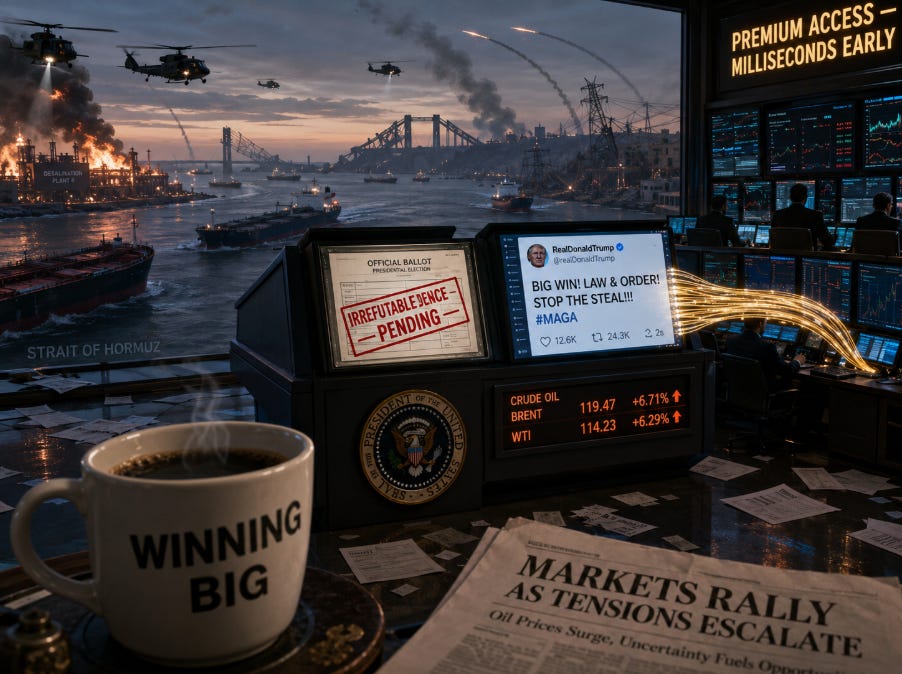
By morning, bridges connecting Iran’s largest port to the rest of the country had been reduced to rubble. Electrical infrastructure was damaged as temperatures in southern Iran climbed above 100 degrees. Iranian missiles and drones were flying toward American bases across the Gulf. A power and desalination facility in Kuwait was burning. A child in Qatar had been injured by falling debris. Commercial traffic through the Strait of Hormuz had nearly stopped, and United States Marines were boarding merchant vessels to enforce a naval blockade.
The president called this “winning big.”
He had more important matters to discuss with the American people, however. Namely, Joe Biden.
Trump’s primetime address Thursday night was ostensibly called to announce the release of critical intelligence concerning American elections. The networks were asked to clear their schedules for a presidential address, the ritual traditionally reserved for wars, national emergencies, major policy changes and moments when the commander-in-chief would like the country to know something it does not already know.
Trump instead delivered a fresh theatrical production of The Election Was Stolen, now entering its sixth season with most of the original cast, several new villains and no supporting evidence.
We dealt with the speech at length in this morning’s standalone analysis, but its collapse was even faster than expected. Simon Marks, speaking Friday on LBC, described it as “entirely fact-free” and noted that the thousands of pages released by the administration failed to substantiate Trump’s central claim that foreign interference changed the outcome of the 2020 election.
That awkward little detail followed Trump out of the building.
John Solomon, the former journalist who has spent years promoting Trump’s election theories and now serves as a presidential adviser, was stopped by reporters in the White House driveway. They asked whether the intelligence showed that China or Venezuela had flipped a single vote.
Solomon acknowledged that the intelligence community says it did not. He added he was still, six years on, researching the matter.
This is how irrefutable proof works in the second Trump administration. First, the president announces the conclusion in prime time. Then his investigator steps outside and admits he has not yet found the evidence. The Justice Department can begin selecting defendants while Solomon continues looking under the cushions.
Trump’s supposed revelations did not show that China altered vote totals, hacked voting machines or manufactured enough fraudulent ballots to elect Joe Biden.
One might also ask why the international conspiracy capable of seizing the American presidency in 2020 apparently took Election Day off in 2024. The same machines existed. The same state systems counted the ballots. Many of the same election officials remained in place. Yet Trump won, which in Trumpian constitutional theory automatically proves that the election was immaculate.
Foreign governments, voting machines, mail ballots and election workers are capable of breathtaking fraud whenever Trump loses. When he wins, they become the gold standard.
That contradiction does not weaken the theory because the theory was never designed to explain an election. It was designed to delegitimize an outcome. As Marks put it, “The only elections this man recognizes as free and fair are the ones that Republicans win.”
The larger danger, Trump’s attempt to preemptively discredit any midterm result he dislikes, was the subject of our earlier full analysis. For this morning, Solomon’s driveway concession tells us enough. The evidence remained missing. The accusation had already received prime-time distribution.
And the president’s social-media platform was about to put a price on the next announcement.
It was fitting, then, that the Trump family business chose the same twenty-four-hour period to unveil a new method of converting presidential communications into private revenue.
Trump Media & Technology Group announced Truth API, a paid data service designed to give large trading firms and other financial customers extremely fast access to posts from Truth Social’s most influential accounts. The company says the feed will deliver posts in milliseconds and become available August 1. Customers have already signed up.
Trump has the platform’s largest following and routinely uses it to announce or discuss tariffs, military action, energy policy and other decisions capable of moving global markets. The company has not said that his posts will be excluded.
This means the family company of the president of the United States plans to sell Wall Street a faster route to information issued by the president of the United States.
The public gets the rally speech. The algorithms get the wire service.
The distinction may amount to milliseconds, but high-frequency trading firms spend enormous sums gaining advantages measured in considerably smaller units. A Trump post delaying an attack, announcing a tariff or threatening a country can add or erase billions of dollars in market value before most human beings have finished reading the first sentence.
In March, traders placed roughly half a billion dollars in oil bets during the fifteen minutes before Trump announced on Truth Social that he would delay attacks on Iranian energy infrastructure. The post sent oil prices plunging. Reuters did not establish who placed those trades or whether anyone possessed advance knowledge, and there is no basis to claim that the activity was illegal. But the episode demonstrated precisely why immediate access to Trump’s posts can be worth a fortune.
Trump Media has now identified that volatility as a proprietary asset.
The company’s interim chief executive described the service as part of a strategy to monetize its holdings and predicted a recurring revenue stream. An ethics expert told the Associated Press that Trump was effectively selling expedited access to information about what he was doing as president. The president and vice-president are exempt from the principal federal conflict-of-interest law applying to other executive officials, a statutory omission Trump has converted from an exception into a business plan.
Previous presidents divested assets, used genuine blind trusts or otherwise tried to avoid profiting directly from decisions made in office. Trump has taken the more entrepreneurial view that every public duty contains an unrealized licensing opportunity.
The presidency provides the content. The family company owns the distribution platform. Wall Street purchases the faster feed. Trump’s decisions create the market movement that makes the product valuable. It is a vertically integrated conflict industry.
The arrangement also clarifies the emerging information hierarchy of the second Trump administration. Election propaganda is distributed freely to the public. Actionable presidential information is placed behind a premium data connection.
Democracy gets the speech.
The trading desks get the news.
While the family company prepared to sell access to Trump’s words, the military under his command was demonstrating just how market-moving those words can become.
The United States has expanded its strikes across southern Iran to include bridges, energy facilities, rail and road connections, an airport and facilities serving major ports. Iranian state media reported at least seven deaths near bridges in Hormozgan Province, and Iran’s health ministry said the renewed American campaign had killed at least 38 people and wounded more than 400 since the latest truce collapsed. Those casualty figures come from Iranian authorities and have not all been independently verified. The physical damage to bridges and other infrastructure, however, has been documented in imagery carried by international news organizations.
CENTCOM says it struck military targets, including coastal surveillance systems, air defenses, military logistics and maritime capabilities. It has not publicly explained the military purpose of each bridge, rail connection or electrical facility reportedly hit.
Bridges and transportation networks can lawfully qualify as military objectives when they contribute effectively to military operations and their destruction offers a definite military advantage. Civilian use does not automatically make every piece of infrastructure immune from attack.
Trump has not described infrastructure attacks solely as narrowly tailored military operations. He has repeatedly presented them as instruments of coercion, ways to inflict enough suffering and economic damage that Iran’s leaders will submit to his demands.
Iran’s Energy Ministry asked residents in the southern provinces to reduce electricity consumption and turn off air conditioning during peak hours because American attacks had strained the power network. Temperatures around Bandar Abbas were expected to exceed 100 degrees. Residents described daily outages, damaged roads and destroyed fishing boats in communities whose livelihoods depend upon access to the sea.
“Energy infrastructure” sounds antiseptic in a military statement. In practice, it means an elderly person without air conditioning during extreme heat. It means a hospital running on backup power. It means water pumps, refrigeration, communications, transportation and every mundane system that prevents a modern city from becoming uninhabitable.
Using the same savage logic, Iranian forces launched attacks toward American military sites and host countries including Bahrain, Kuwait, Qatar, Oman and Jordan. Some of Tehran’s more dramatic claims, including destroyed aircraft and American casualties, remain unconfirmed or have been denied. Syria denied Iran’s assertion that it attacked an occupied American base at al-Tanf, noting that American forces had already departed.
Other consequences are confirmed. Kuwait said Iranian strikes damaged a power-generation and water-desalination facility, igniting fires and damaging generators. The country receives approximately 90 percent of its drinking water from desalination. Qatari authorities reported that a child was injured by debris falling during aerial interceptions. Kuwait’s military said several personnel were wounded in attacks on its facilities.
The war has therefore crossed a dangerous threshold. Washington is attacking infrastructure Iran needs to move goods, generate electricity and sustain its coastal cities. Tehran is retaliating against infrastructure America’s Gulf partners need to generate electricity and produce drinking water.
Each side calls the other’s targets civilian. Each invokes military necessity when selecting its own. Around them, countries that did not begin the war are absorbing missiles, drones, falling debris and the growing possibility that a single successful strike on a water plant, fuel terminal or crowded neighborhood will force them deeper into it.
The maritime situation is no less alarming. The United States formally resumed its blockade of traffic entering or leaving Iranian ports on July 14. CENTCOM says it will enforce the blockade against vessels of all nations traveling to or from Iranian ports and coastal areas. American forces have redirected commercial ships, disabled vessels accused of noncompliance, and boarded the M/T Wen Yao in the Gulf of Oman.
Before the war, more than 130 ships a day traveled through the Strait of Hormuz. The New York Times reported that only eight navigated the waterway Thursday, the second full day of the renewed blockade. Oil prices rose, as did American gasoline and diesel prices.
Iran has reportedly told its Houthi allies in Yemen to prepare to threaten the Bab el-Mandeb route if the United States continues attacking Iranian energy infrastructure. Hormuz connects the Persian Gulf to the Arabian Sea. Bab el-Mandeb connects the Red Sea to the Gulf of Aden. Severe disruption at both would place two of the world’s most important energy and commercial corridors under simultaneous threat.
Trump calls this winning big. The Strait he promised to reopen is nearly empty. American Marines are rappelling onto commercial vessels. Iran remains capable of striking multiple American partners. A desalination plant has been damaged. Oil prices are climbing. Diplomacy is receding. The list of potential targets has expanded from missile launchers and radar sites to bridges, electrical networks, ports and water systems. Trump sees rubble and assumes it is a plan.
The Pentagon, meanwhile, has offered remarkably little public explanation of the strategy governing a war now in its fifth month. The Times noted that Defense Secretary Pete Hegseth has found time recently to discuss testosterone testing for troops, a task force against leakers, and disciplinary reviews involving helicopter pilots, but has said comparatively little about the renewed escalation with Iran. During the first five weeks of the Iraq war, the Pentagon held more than 30 briefings. During the first six weeks of this war, it held eight. The last major Pentagon briefing devoted to the conflict occurred in early May. Hegseth appears more comfortable measuring hormones than defining victory.
The administration has offered several incompatible goals. At various moments, officials have described the purpose of the war as destroying Iran’s nuclear program, weakening its conventional military, forcing regime change, reopening the Strait of Hormuz, ending Iranian influence across the region and compelling Tehran to sign a broader peace agreement.
Those are not interchangeable objectives. Some might require months of negotiation. Others might require occupation, a new Iranian government or military commitments the administration has not acknowledged. One cannot meaningfully judge whether a war is succeeding when the government refuses to decide what success means.
Trump has solved this problem by defining success as whatever happened most recently.
A bridge was destroyed? Winning.
A tanker was boarded? Winning.
Iran struck back against five countries? Proof that it is desperate.
The strait remains largely closed? Victory will become visible shortly.
The war expands because the previous expansion failed, and every failure becomes the justification for a larger attack.
Concerns about the legality of this campaign are not coming only from Iranian officials, anonymous activists or people discovering international law on social media between breakfast and lunch.
On April 13, more than 100 U.S.-based international-law experts, organized by a group of scholars including Tom Dannenbaum, Oona Hathaway and Adil Ahmad Haque and signed by figures like Harold Koh and Mary Ellen O’Connell, published a letter through Just Security warning that the initiation of the war violated the United Nations Charter and that the conduct of American forces raised serious concerns about potential war crimes. We have covered the letter’s argument against the original decision to go to war before. Its most immediate relevance now lies in what it says about targeting, command rhetoric and the destruction of the safeguards intended to prevent unlawful attacks.
Most important now is what the letter said about intent.
Hegseth declared in March that American forces would show “no quarter, no mercy.” Declaring that no quarter will be given is specifically prohibited under the law of armed conflict and in the Defense Department’s own law-of-war manual. The scholars warned that ordering or threatening such conduct can itself constitute a war crime.
Trump said he could strike the power plants that create electricity and water and cause damage so extensive that Iran might never rebuild. He separately suggested that the United States might conduct attacks “just for fun.” The letter warned that implementing threats against infrastructure indispensable to civilian survival, the kind of language the UN’s Volker Türk had already flagged as risking “disastrous” consequences, could entail war crimes.
These statements matter because military intent is not evaluated in a vacuum. A president cannot repeatedly threaten to destroy the systems sustaining civilian life as punishment, begin striking those systems and then expect every legal inquiry to pretend his words never existed.
This does not mean every bridge struck this week was illegally targeted. A dual-use object may be attacked only if it makes an effective contribution to military action and its destruction offers a definite military advantage. Even then, commanders must assess whether the expected civilian harm would be excessive in relation to that advantage and take all feasible precautions to reduce it.
The question is not merely whether a military vehicle ever crossed the bridge.
The Just Security letter also describes something more structural and therefore more frightening: the deliberate weakening of the safeguards intended to keep unlawful orders from becoming unlawful attacks.
Under Hegseth, the Defense Department removed or replaced senior military lawyers, including the judge advocates general of the Army, Navy and Air Force. It eliminated civilian-harm mitigation mechanisms, including teams created to help commanders understand the civilian environment. The 2026 National Defense Strategy omitted references to civilian protection and international law.
That is the sword-and-shield problem.
The bombing campaign is the sword. Military lawyers, civilian-harm specialists, rules of engagement and independent review are the shield.
Trump and Hegseth have sharpened the first while dismantling the second.
We have already seen what happens when the remaining safeguards fail.
On February 28, the opening day of the war, the Shajareh Tayyebeh Primary School in Minab was struck. Iranian officials reported that at least 175 people were killed, many of them children. Other reporting and human-rights organizations have cited a lower but still staggering figure of more than 150 dead, including approximately 120 children.
Trump denied American responsibility and blamed Iran.
A preliminary Defense Department investigation reportedly concluded that the United States carried out the strike using outdated intelligence. The Pentagon has still not publicly released its full findings, despite demands from members of Congress and human-rights organizations.
The Minab strike is why Trump’s threats against power plants, water systems and bridges cannot be dismissed as mere bluster from a man who says many things.
The school existed. The children existed. The outdated intelligence existed. The president’s denial existed.
Now the report remains hidden while the target list expands.
This is the landscape on the morning after Trump’s address.
The president used national television to manufacture an emergency around an election he lost six years ago. His adviser admitted afterward that the evidence did not show a single vote had been changed. His family company prepared to sell Wall Street faster access to his market-moving presidential posts. American forces expanded a war into bridges, ports and power systems. Iran retaliated against facilities producing electricity and drinking water across the Gulf. The Pentagon remained largely silent about the strategy, while the legal institutions meant to constrain the use of force had already been weakened.
These are not separate scandals. They are expressions of the same governing philosophy.
Public power exists to protect Trump, enrich Trump and punish whoever resists Trump.
An election is legitimate when it returns him to office.
Presidential information is public when it promotes his mythology and proprietary when it can enrich his company.
International law applies when it condemns Iran and becomes an irritating technicality when it constrains the United States.
Civilian infrastructure is sacred when Iran attacks it and a military objective when Trump wants leverage.
Facts arrive after the conclusion. Law arrives after the bombing. Accountability arrives never.
Trump spent Thursday night asking Americans to fear their ballots. He wanted them looking backward at imaginary Venezuelan machines, Chinese conspirators and the deep state operatives who supposedly stole his presidency while he prepared the country to reject any election Republicans do not win.
The genuine emergency was already unfolding beyond the camera frame.
Bridges were collapsing. Power grids were failing. Missiles were crossing borders. Tankers were turning around. Water systems were becoming targets. A war with no stable objective was spreading across a region containing some of the world’s most vulnerable infrastructure and most important energy routes.
Trump called it victory because Trump has never learned to distinguish destruction from control, dominance from strategy, or rubble from peace.
Last night he asked America to fear its ballots.
This morning, the rest of the world has better reasons to fear his power.
Truth API???…..wtheactualf??!?!
How much grift, insider trading and financial collusion can one man and his two man-baby sons get away with before someone who has the ability to hold them to account asks….’hey, are laws being broken here?’???
Mary Geddry I love your writing, but you need to learn when enough suffices. I appreciate the use of repetition for emphasis, but not the need to pound the drum four or five times with slightly different formulations to explicate a point. Your audience are not idiots, and we need to conserve time in order to follow other Substack writers.