


Good morning! Donald Trump began Wednesday with something that should have been uncomplicatedly welcome news.
“We’re out of there.”
The last American forces and equipment had left Erbil Air Base, completing the U.S. military withdrawal from Iraq and ending the Operation Inherent Resolve mission there. CENTCOM says the counter-ISIS operation continues from Jordan, but after more than two decades of American military involvement in Iraq, the last troops were finally gone.
“We shouldn’t have been there in the first place,” Trump said.
There are few sentences in American foreign policy capable of carrying quite that much history without throwing out their back.
Trump then complicated the moment by claiming that the “sole reason” the United States went into Iraq was to eradicate ISIS, which would have been impressive foresight considering the United States invaded Iraq in 2003 and ISIS did not emerge as the force that brought American troops back until years later. But the larger point remained. America had finally gotten out.
Then, in the same appearance, he turned to Iran. That war would end “very soon, one way or the other.” Asked how anyone reaches a deal with a government he calls crazy, he offered an alternative: “Maybe you blow them up.”
By this morning, when Time published an interview conducted earlier in the week, another calendar had surfaced. Trump said he had rejected Tehran’s latest ceasefire proposal as “not good enough” and called stepping up strikes after the midterms “possible.”
“Very soon” and “after the midterms” now sit on the same war calendar. Decisions of that size are being made with remarkably little visible constraint. The same 24 hours offered a close look at what happens inside American institutions when the constraints thin out.
Quantico: building things meant to last
The same day, Defense Secretary Pete Hegseth returned to Marine Corps Base Quantico, one year to the day after he summoned the military’s generals and admirals there. This time the audience was the military’s E-6s and O-3s, the staff sergeants, petty officers, technical sergeants, captains and Navy lieutenants he called the backbone of the force.
Most of the coverage focused on his slurs, and they were vile. The more consequential material came in the structural announcements, nearly all of them built to outlast the man who made them.
“Personnel is policy,” he told the room, and then Hegseth put the number of generals and admirals fired at roughly 10 percent and said another 10 percent of general-officer slots had been eliminated. He established an Office of Religious Affairs that will report directly to the secretary. That means not only Hegseth but, in his words, “secretaries of war after me.” Five schools will receive priority in officer commissioning, including Liberty University, an evangelical Christian institution founded by Jerry Falwell, and Hillsdale College, which describes itself as a nonsectarian Christian college. The change creates a new pipeline into the leadership of the force at the same time Hegseth is giving religion a more direct institutional role inside the Pentagon.
The speech also had its moment of light relief. Having spent much of it disparaging journalists, academics, lawyers and large portions of the existing military establishment, the Pentagon has fortunately located three of America’s best minds to study the future of warfare: Elon Musk, Palmer Luckey and Newt Gingrich.
Two lines from the same speech say the rest.
“Personnel is policy.”
Nearly fifty minutes later:
“While we wage physical war, we all know the real battle is spiritual.”
When Hegseth finished, the troops rose in a standing ovation. A year earlier, the Times notes, the generals and admirals in that hall had sat stone-faced and deliberately silent, observing the norms of a nonpartisan military.
Personnel may not be the only thing that has changed.
When the guardrail has a gap
Hegseth used part of his speech to address the press directly. Reporters who “lie about munition stockpiles,” he said, put troops’ lives at risk. “It’s treason, actually.”
The next morning, Trump told Time that reports of munitions shortages were “mostly fake news.” In the same answer he conceded that “some forms of ammunition are a little bit lower than other forms.”
Treason on Wednesday. Fake news on Thursday. A little bit lower before the president finished his sentence. That’s God Mode, Interrupted. The contradiction would matter less if the normal mechanisms for forcing straight answers were functioning. Hegseth hasn’t briefed Pentagon reporters on the war since early May, while lawmakers have complained about being cut out of Defense Department briefings.
The press fight followed the same pattern. A federal judge whom Trump himself appointed temporarily blocked the administration’s ban on CNN, Politico and MS NOW. The White House restored their access to the building, then removed CNN from the press pool traveling with Trump to Texas and Oklahoma on Thursday. The administration’s interpretation was that the order restored access to the White House grounds, not necessarily to the Oval Office, the traveling pool or Air Force One. The court ruled. The White House found the gap.
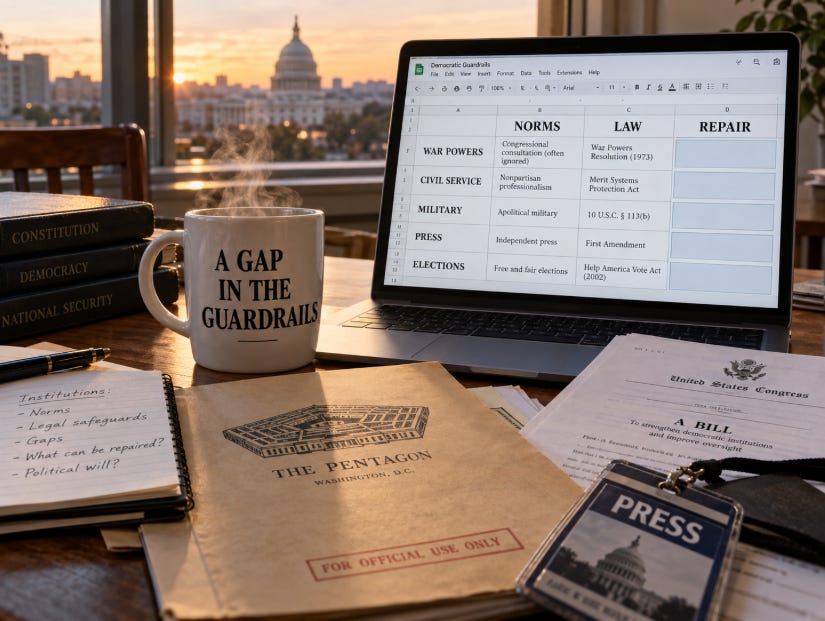
Senator Elissa Slotkin of Michigan named the pattern in a conversation with The Bulwark this week. What Americans thought were laws, she said, have turned out to be norms, and this president has blown right through them. A guardrail that depends on the good faith of the person it restrains was never a guardrail. It was a custom.
Slotkin traveled to Poland and Hungary in September, studying how countries climb out of authoritarian rule. When she came home and looked for a venue to talk about what she’d learned, several Washington universities and think tanks declined to host her. A sitting United States senator wanted to discuss recovery from authoritarianism, and institutions decided the attention wasn’t worth the risk. Carnegie said yes.
What she brought back from Budapest was practical. Hungary’s new government was 120 days old when she visited and still discovering what 16 years of Orbán had left behind: which contracts were binding, how deep the corruption ran, who in the ministries should stay. But the prime minister’s advisers had prepared before the votes were counted. They kept a spreadsheet of what they would do with power, broken out by the size of the win: a thin majority, a medium one, a supermajority. They won the supermajority and went to work on the largest version of the plan.
Then she turned the lesson inward. After Trump’s first term, there were concrete proposals for a task force to Trump-proof the federal government. The response, she said, was that he was gone and the legislative agenda came first. She now calls that a mistake. Fool me once, shame on you. Fool me twice, shame on me.
Her framework is a three-legged stool. The first leg is delivering change people can feel in their own lives. The second is accountability for those who abused public money and weaponized government. The third is converting the norms that failed into law, so no future president of either party can repeat the abuse.
I’ve argued in the Carpe Momentum series that this work can’t wait. Slotkin agrees. She says groups are already building their own versions of “Project 2029,” but the work remains scattered, with presidential candidates likely to begin pulling that brainpower together once the midterms are over and the primaries begin. Hungary suggests the danger of leaving consolidation too late. The point isn’t fantasizing about 2029. The opportunity to repair things can arrive before the repair plan does.
All of this institutional engineering is happening while Americans pay for the failures in more ordinary currency: fuel prices driven up by the war, and a Pentagon pressing Congress for a $1.5 trillion budget.
Slotkin, whose national-security career included the CIA and the Pentagon, ended her interview somewhere unexpected for a national-security hawk. The existential threat to the United States, she said, isn’t coming from abroad. It is the erosion of the middle class and the American dream, and whether people in places like Michigan still believe, in their bones, that hard work lets them get ahead.
You can repair the machinery without repairing the conditions that made it vulnerable. Laws can strengthen inspectors general, congressional war powers, civil-service protections and guarantees of press access. None of it holds for long if the people those institutions serve have stopped believing the system works for them.
There is evidence the system still responds. Mike Rogers, the Republican running for Senate in Michigan, has reversed himself on the Iran war, Slotkin says, just weeks after advocating for it. Tennessee’s governor halted executions after the state’s second botched lethal injection this year.
The machinery is battered, not immovable. Pressure still produces movement.
A moment of leverage is only useful if somebody knows what to do with it. That is our work now, to plan and implement that plan.
So what belongs on the spreadsheet?
Start with the powers and assumptions that turned out to depend on presidential restraint rather than enforceable limits. Give Congress a meaningful role when the country goes to war and the ability to conduct real oversight once it does. Protect the civil service, military, courts and election machinery from abuses that once seemed unthinkable precisely because custom said they weren’t done. Preserve what works. Repair what doesn’t.
And alongside all of it sits Slotkin’s harder question: whether working people can believe again that the system works for them.
Then comes the question Hungary understood had to be answered before the opportunity arrived.
Who is writing the spreadsheet now?
Before I go, thank you all for the kind wishes for my youngest grandchild, Ezra. He woke from his MRI a little teary-eyed, but before long he was back to his usual cheerful self. Now we wait for the results.
For the moment, I’m very grateful to have that smile back.
So glad things went well with Ezra. Sending you all the best of energy for a good result (whatever that means for all of you).
Thank you for what you do. It matters and is appreciated.
Thank you for your valuable insights! All the best to Ezra.