


Good morning! Some days the news arrives as a stack of separate absurdities, and other days the absurdities start wearing matching uniforms.
Today’s uniform is the toll booth. A toll booth on the South Lawn, in the public markets, on the Albanian coast. A toll booth in the Gulf, where billions in access payments, diplomatic gifts, sovereign wealth, and Trump-adjacent investment still somehow do not buy the one thing everyone claims to be purchasing: security.
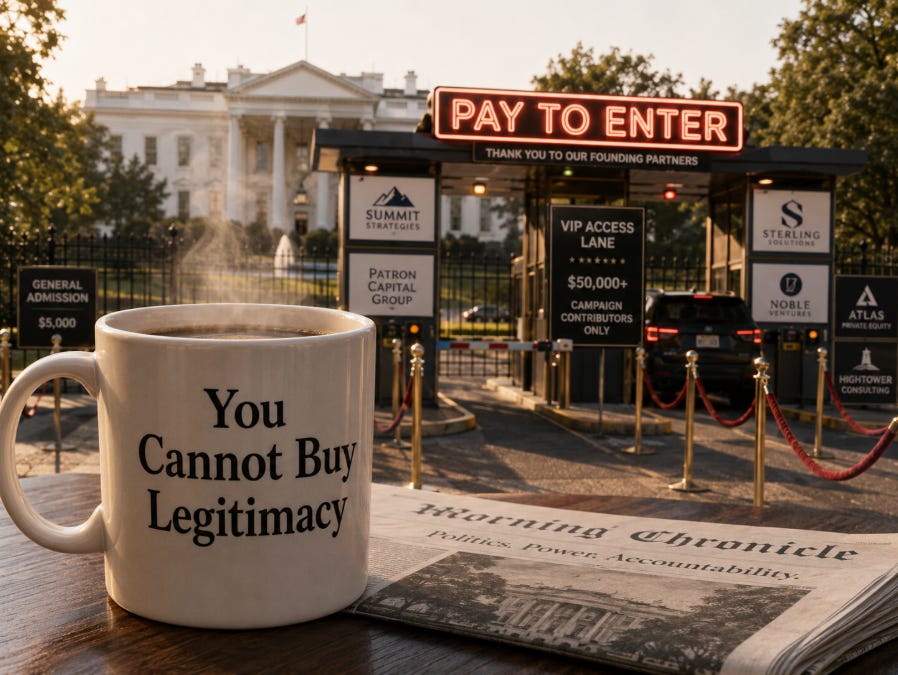
So, who pays the toll? Who gets waved through? And what does the toll fail to buy? It does not buy legitimacy or consent. It does not buy peace. And, as the administration is once again discovering, it does not even necessarily buy control over Benjamin Netanyahu, which is apparently a problem if your whole Iran deal depends on Israel not detonating it five minutes after the signing ceremony.
Let’s begin, naturally, with the cage match. Donald Trump’s birthday UFC spectacle at the White House is now before Judge Amit Mehta, after plaintiffs filed an emergency lawsuit seeking to stop the event before the South Lawn is fully converted into the kind of place where one expects to see either a mixed martial arts promotion or a late-stage Roman emperor trying to improve his numbers with men aged 18 to 34.
The plaintiffs, represented by Brendan Ballou of the Public Integrity Project, are not arguing that MMA is illegal, or that sport is bad, or that Americans must be protected from the sight of two consenting adults punching one another under regulated conditions. Their argument is much simpler and much more damning: it is a lawsuit about corruption.
That is the cleanest sentence in the whole thing, and also the reason the case has teeth even if standing remains the dragon at the cave mouth. According to the lawsuit and the Deadline White House discussion, UFC and its parent company TKO are selling sponsorship packages reportedly running from $1 million to $1.5 million per person. The event involves exclusive licensing for Paramount, brand placement on the White House lawn, and potentially promotional activity around the Lincoln Memorial, with Monster Energy already visible and Crypto.com expected in the mix. Trump, meanwhile, is invested in TKO. The public property is the stage. The private sponsors are the guests. The president is not merely the host. He is part of the business model.
The toll booth in its purest form: build it fast, monetize it immediately, then tell the court that dismantling it would be too disruptive. The cage is already there. The fighters are already cutting weight. The sponsors are already in. The title card is already sold. The Trumpian legal theory is not so much “we are allowed to do this” as “look how much we have already done.”
It is the same playbook as the East Wing demolition, the Kennedy Center branding circus, and every other gold-leaf bulldozer project in Washington: create the spectacle, alter the public space, then argue that anyone trying to stop it lacks standing, lacks timing, lacks remedy, lacks the necessary emotional dullness to understand that the president’s birthday pageant is now infrastructure.
Harry Litman does not oversell the case. On the merits, he sees real legal force. There are rules, approvals, filters, and public-property constraints that exist precisely to prevent the White House from becoming a privately monetized combat-sports venue with a Lincoln Memorial walkout. But standing is the hard part. The plaintiffs’ injuries may sound to a court like disgust, aesthetic harm, inconvenience, rerouting, pain, real to them, but often not the kind of injury federal courts will bless as a ticket through the courthouse door.
That is the darker point. If no one has standing to stop public property from being turned into a private presidential revenue platform before the thing happens, and no one has a remedy after it happens because the damage is done, then the law becomes a velvet rope. It exists. It looks impressive. Someone paid a lot for it. But the important people walk right around it.
The administration’s irreparable-harm argument is almost comic in this context. What happens if the fight is postponed? Dana White gets annoyed. Trump has to celebrate turning 80 without a cage match on the South Lawn. Some oligarchs may have to reschedule their luxury democracy-demolition weekend. This is not exactly the storming of Normandy.
The plaintiffs’ harm, by contrast, is the public harm: the transformation of the White House into a pay-per-view asset, with federal space repurposed as a branded arena for private profit and presidential self-celebration. Even a Reuters poll cited on MSNBC found only 16 percent of respondents thought holding the UFC match at the White House was appropriate. Well below Trump’s usual floor. That is basement-under-the-basement territory. Even some voters who can tolerate a great deal of institutional vandalism draw the line at turning the South Lawn into Crypto.com presents: The Decline and Fall of the American Republic, Sponsored by Monster Energy.
The lawsuit may still fail. Judge Mehta may decide the plaintiffs do not have standing, or that the event is too far advanced, or that the court lacks the proper hook to stop it. But even that outcome would prove the point. The toll booth works best when it is erected quickly, priced aggressively, and defended procedurally. By the time anyone asks whether public property may be sold this way, the answer is already: who has standing to complain?
From the South Lawn, the toll booth moves to Nasdaq.
SpaceX is set to begin trading after the largest IPO in history, a $75 billion offering that priced 555.6 million shares at $135 apiece and could rise to $86 billion with the greenshoe option, implying a valuation around $1.78 trillion. That number is so large it practically needs its own launch license.
The story is being sold as the next great American frontier: rockets, satellites, Starlink, defense, Mars, artificial intelligence, and now Musk’s proposed AI data centers in space. We used to put flags on the moon. Now we put the market multiple there and ask retail investors to salute.
The FT reports that demand was more than three times the shares on offer, with huge orders from asset managers, Gulf sovereign wealth funds, hedge funds, family offices, and retail investors. Individual investors reportedly placed more than $100 billion of orders and may receive 20 to 25 percent of the shares sold. BlackRock requested more than $5 billion. Gulf funds including Saudi Arabia’s Public Investment Fund, Qatar, and Kuwait were set to receive major allocations. Nasdaq and FTSE Russell have moved to fast-track SpaceX into major indexes, meaning many ordinary investors may soon own the company indirectly whether they intended to buy into Musk’s orbital AI cathedral or not.
This is the toll booth as market structure. The public is not just invited to invest. It is positioned to absorb the valuation. Once the stock enters major indexes, the passive-money machine starts doing what passive-money machines do: buying because the index says buy, not because the underlying story has suddenly become less hallucinatory.
And the story is hallucinatory. SpaceX is lossmaking, valued at roughly 92 times its trailing $19 billion in revenue, and pitching a claimed $28.5 trillion addressable market in part through the idea of AI data centers in space. Musk has unveiled a sketch of an AI satellite with a 70-meter wingspan, because apparently the only thing missing from the artificial intelligence bubble was a solar-powered server farm in orbit, governed by the same man who brought us X verification discourse.
A $20 billion slice of the IPO proceeds is also set to repay bridge debt tied to Musk’s merger of debt-laden AI and social-media businesses into SpaceX. That matters. This is not just capital for rockets. It is capital for the Musk stack: AI, satellites, social media, debt, defense, retail mania, Gulf money, and public-market validation fused into one corporate mythos.
There is a transparency note worth keeping in view. Some of the most structurally important questions around the valuation involve relationships and dependencies that require careful sourcing: competitor-adjacent compute contracts, underwriting banks that are also producing the growth story, and the gap between private marks and public pricing. Those receipts matter because they determine whether this is merely a historic IPO or something more circular: a market event in which the institutions selling the dream also help define the dream’s addressable universe.
The larger point is clear enough. SpaceX is the AI bubble with a launchpad. Investors are not merely buying a company. They are buying proximity to Musk’s ability to turn state contracts, retail enthusiasm, index mechanics, Gulf capital, and science-fiction infrastructure into market capitalization.
The UFC panel complained that sport is being financialized beyond recognition: World Cup tickets priced out of reach, NBA Finals seats becoming luxury assets, ordinary fans priced into television-only citizenship. SpaceX is the same logic applied to the future itself. The frontier is no longer a place. It is an asset class. You do not get to participate in the future; you get allocated shares in it, maybe, after the big accounts are done being cut back.
The toll does not buy reality. But it does buy a ticker.
From there, the toll booth shifts to the Adriatic.
Jared Kushner’s Affinity Partners is facing growing protests in Albania over plans for luxury resort developments tied to Sazan Island and protected coastal land near Zvërnec. This is not the full Sazan story, that deserves its own treatment, but it belongs here as a pointed preview, because the pattern is too obvious to leave unmarked.
Affinity announced a $1.6 billion luxury resort project on Sazan Island, an uninhabited island off Albania’s Adriatic coast, and a much larger development tied to protected coastal landscape. Environmentalists warn the projects threaten dunes, migratory-bird habitat, wildlife, and fragile natural areas. Albania’s government approved the plans, prompting scrutiny from the country’s anti-corruption prosecutors. Protests intensified after bulldozers were seen clearing sand dunes, fencing went up near a beach, and video circulated of private security violently dragging and threatening a protester.
There is also the Ivanka detail, because history retains a sense of humor even when everything else has given up. Ivanka Trump described encountering the island while swimming from a friend’s boat, as though Sazan were a lifestyle-discovery anecdote waiting for a luxury brochure. Locals were not charmed. Sazan is not some untouched fantasy island conjured out of turquoise water and brand opportunity. It is a former strategic military site used during World War II and the Cold War, with reports of thousands of Soviet-style shelters and potential unexploded ordnance. “We found it while swimming” hits differently when the place you found may contain mines.
But the important thing for today is not the travel-magazine absurdity. It is the model. Protected or militarized land is reimagined as luxury real estate. Foreign capital flows through a Trump-family orbit. Local communities are asked to accept the conversion of public or ecologically sensitive space into elite destination property. The people most affected are treated as obstacles, scenery, or future service workers in a place they will not be able to afford.
That is why the Albania fight rhymes with Gaza. Kushner’s role in promoting luxury-style reconstruction visions for Gaza, with Palestinians not exactly centered in the pitch, belongs to the same moral architecture. The land is traumatized, militarized, politically contested, or ecologically sensitive; the development class sees a blank canvas. Everyone else sees a home, a coastline, a history, a graveyard, a habitat, a military ruin, a place where people have claims that do not fit neatly into the renderings.
The slogan from Albanian protesters practically writes the transition: Albania is not for sale.
Neither, one might add, is Gaza. Or at least it should not be. But the toll booth model depends on treating places as if sale is their natural destiny and public consent is just a permitting issue.
Which brings us to the Gulf, where the toll booth becomes geopolitical.
Trump says a peace deal with Iran is close. Iran says not so fast. Markets, being markets, decided to trade the press release before reading the footnotes. The Financial Times reported that Brent crude fell as much as 5 percent to $85.80 a barrel, a three-month low, before retracing to $87.64, while WTI dropped 3.1 percent to $84.98. Stocks rallied too: the Stoxx 600 rose 1.5 percent, the FTSE 100 gained 1.1 percent, and the Nasdaq had closed up 2.5 percent on Thursday, with U.S. futures pointing higher still. Bonds joined the party, and traders pushed back expected rate hikes in both the U.S. and U.K. The market bought the headline even as Tehran disputed the premise.
When geopolitics becomes a Bloomberg terminal event, Trump says “deal,” oil falls. Iran says the Americans are still making new demands, and that the main text was only almost finalized, but the market has already moved on to the next candle. Peace, in this model, merely has to be tradable.
Al Jazeera’s live updates complicate the fantasy. Iran’s Foreign Ministry says the main part of the text was nearly finalized but the Americans became greedy and raised new requests. Iranian reporting suggests the proposed memorandum may defer the hardest questions into a 60-day negotiation period: Iran’s peaceful nuclear program, sanctions relief, compensation, frozen funds, oil sanctions, and the future administration of the Strait of Hormuz. Some frozen Iranian funds could be released after signing, with later negotiations contingent on the release of more funds and suspension of oil sanctions.
That is not a final peace. That is a promissory note written during a fire.
India has summoned a senior U.S. diplomat after U.S. attacks on commercial vessels carrying Indian sailors in the Strait of Hormuz or Gulf of Oman reportedly killed three Indian mariners. Israel has issued new displacement threats for villages in southern Lebanon. Israeli attacks continue around Tyre. Hezbollah says it has struck Israeli soldiers and vehicles in southern Lebanon. Al Jazeera puts the toll in Lebanon at 3,711 killed and 11,483 wounded.
So yes, by all means, let us celebrate the imminent peace deal, provided we define “peace” as a condition in which civilian shipping is being hit, Lebanon is still burning, Iran says no final agreement exists, and Netanyahu announces that he and Trump are in full agreement that Iran will not have nuclear weapons.
Vali Nasr, an Iranian-American academic, explains that any deal Iran signs with the United States has to be contingent on the U.S. being able to control Israel. That is the test. Not whether Trump can coax Iran into a memorandum, or whether markets can squeeze a relief rally out of a Truth Social mood swing. Not whether everyone can pretend the ceasefire is real long enough for the SpaceX IPO to price well.
The test is whether Washington can stop Netanyahu from blowing up the deal afterward.
For Iran, Nasr argues, Israel’s ongoing attacks on Lebanon are not simply a side issue. Lebanon may not be the formal dealbreaker, but it is the stress test. If Israel can keep bombing Lebanon, attacking Beirut, or maintaining a military occupation in the south while the United States claims to be brokering a regional settlement, then what exactly is Iran signing? A deal with Washington? Or a deal that survives only until Netanyahu decides he has a better use for the news cycle?
That is why the leaked Trump-Netanyahu call remains relevant. Trump reportedly berated Netanyahu, saying in substance that Netanyahu would be in prison if not for him, and Trump later confirmed the tone of the exchange on camera while Israel denied the reporting. The point is not the profanity; Biden leaked angry calls too, and Netanyahu survived those just fine. The point is whether the anger comes with discipline. Does Trump actually impose costs? Does Israel actually stop? Or is this just another performance of control, staged for Tehran, while Netanyahu keeps the operational veto?
Nasr’s broader diagnosis is even more devastating for the Gulf. Gulf states spent years buying the old American security model. They bought weapons, hosted bases, and cultivated Washington. They made the investments. Qatar gave Trump a plane. Saudi money flowed into Kushner’s investment firm. Emirati money went into Trump-family crypto ventures. When the war came, when Israel escalated, when Iran hit back, when Gulf infrastructure and shipping came under threat, the model broke.
In Nasr’s formulation, the United States brought war to their cities and vital infrastructure and failed to protect them. The Gulf states paid the toll and discovered the road was still mined.
That is the hinge between Sazan and Iran. Gulf capital flowing toward the Trump orbit may buy access, influence, invitations, and proximity. It may buy a seat at the table, a project on the coast, a stake in the IPO book, a place in the reconstruction conversation, a smile in the photo. But it did not buy protection from Iranian retaliation. It did not buy U.S. restraint of Israel. It did not buy a regional security architecture that works.
The House vote on the Iran War Powers Resolution adds a domestic coda. The House passed a resolution directing Trump to remove U.S. forces from hostilities with Iran, 215 to 208, with four Republicans joining Democrats. It is meaningful as a signal of distrust and exhaustion. It is less clear that it will mean anything operationally. Nasr’s view was blunt: absent a real break in Trump’s hold over Republicans, the administration can probably ignore Congress. Rubio can say the war is over. Trump can kick the can. Everyone can pretend there is an agreement until there is not.
But Iran may not accept indefinite pretending, because Iran’s leverage is precisely what makes the market so jumpy: Hormuz, enriched uranium, Gulf vulnerability, and the fact that U.S. and Israeli bombing did not produce collapse. Iran has learned that the Strait of Hormuz is not merely an open sea lane backed by an American guarantee. It is leverage. It is pressure. It is the place where the old model of U.S.-secured Gulf capitalism now looks less like a shield and more like a very expensive illusion.
So the day ends where it began: at the toll booth.
On the South Lawn, the toll buys access to a spectacle but not legitimacy. In the public markets, the toll buys exposure to Musk’s future but not proof that orbital AI data centers can justify one of the largest valuations on Earth. On the Albanian coast, the toll buys plans, approvals, fencing, and bulldozers, but not consent from the people who live with the consequences. In the Gulf, the toll buys proximity to Trump-world, but not security from Iran, not discipline over Israel, and not peace.
So, the toll booth is open, prices are rising, and the important people are still being waved through. But the toll does not buy the fight’s legitimacy, or the Albania’s coast. It does not buy the Gulf’s security. If Netanyahu can still shred the deal whenever he chooses, it does not buy peace.
Re that UFC debacle: Trump persists in making the White House trashy(-er) but I have to draw the line at the Lincoln Memorial.
If the US has a sacred space in Washington, it's the Lincoln Memorial. If it didn't have sanctity after Lincoln's son presided at the dedication, it certainly did after Martin Luther King's speech.
How can Trump get away with this? Have Republicans no pride in our country? Have they no shame in allowing Trump to debase one of the finest tributes to a president ever built?
I just feel sick.
And you know that godDAMNED arch is going to be shoved down our throats.
This mockery of a presidency is heartbreaking and disrespectful to all.