


There is something strange about watching a miracle become paperwork.
This week, the sale of our home was recorded, which means the public record now officially shows us as the owners of this little square of earth we have loved so hard, feared losing so deeply, and fought like absolute raccoons in a trench coat to keep. I know public records are not usually considered sacred texts, and I do understand that most people don’t burst into tears over county documents unless they have recently tried to understand escrow, but I have decided this one counts. Somewhere in the official machinery of the world, there is now a line that says this home belongs to us, and after everything, that feels less like bureaucracy and more like mercy with a file number.
Yesterday was also my husband’s and my fifth wedding anniversary, which we celebrated in the deeply glamorous manner of two people who have been parenting, packing, signing, repairing, planting, worrying, praying, and reading amortized loan schedules against their will. We also celebrated my husband’s grandpa’s birthday, and everyone calls him Pa, which already tells you something about him, I think. Some people earn a title by being larger than themselves in the lives of others, and Pa is one of those people.
He is one of the true gems of this world, the kind of man whose goodness seems to have been installed at the factory and never once recalled. He has ALS now, which makes every birthday feel tender in a way I don’t quite have words for, because joy and grief sometimes sit at the same table and pass the potatoes like they have known each other forever. It makes you notice the weight of a hand, the sound of a laugh, the miracle of another year, the ache of wanting time to be more generous than it tends to be.
And because life has a way of handing us stories when we are finally ready to understand them, I kept thinking this week about something that happened when my husband was very small, only about a year and a half old. He walked right off a dock and into the river, because toddlers are basically tiny drunk philosophers with no regard for physics, and before fear had time to become tragedy, Pa jumped in after him. That‘s the story. A little boy went into the water, and Pa went in too.
There are family stories that become almost like furniture over time, always there, always known, part of the shape of everyone’s memory. You hear them in pieces over the years, at holidays, in kitchens, in the casual way people mention the moments that could have changed everything but didn’t because someone moved fast enough. I have thought about that story many times, but this week, standing inside all this tenderness, with Pa’s birthday and our anniversary and the house finally recorded in our names, it landed differently.
Before my husband was old enough to understand what had happened, before he had the words to thank him, before he could know that a life can split open in a second and be saved by another person’s instinct to go, Pa had already taught him something sacred. When someone you love goes under, you go in.
And honestly, Ezra seems determined to keep us all grounded in the living, breathing, snack-seeking present, because he has started crawling not only on his hands and knees, but also on his hands and feet like a tiny bear foraging in the understory. He is fast now, genuinely and alarmingly fast, a barrel-racing baby bear with a new tooth and the determined expression of a man who has business in another room. Meanwhile, our plants are thriving, which feels almost suspiciously hopeful, and last night we planted cucumbers while my oldest practically vibrated with excitement over the garden. We also planted cucamelons, which I had to look up and can now confirm are perhaps the most adorable vegetable-adjacent thing humanity has ever had the nerve to grow, because they look like tiny watermelons made for a fairy picnic and taste like a cucumber got dressed up for summer.
So yes, this week has been full of small proofs. I think that is why this week’s story found me the way it did. Because there is something so wildly, wonderfully human about a person whose job is to drive a shuttle along the Louisiana coast suddenly becoming the thin bright line between three strangers and the sea.
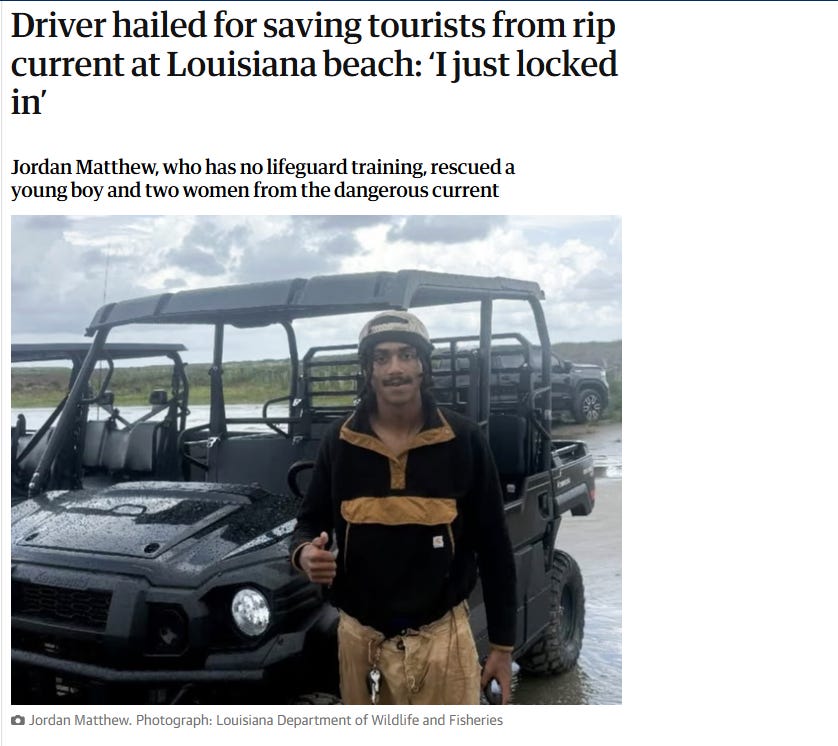
Not because he woke up that morning intending to be a hero, obviously, because most of us don’t begin our workdays by stretching our hamstrings and whispering, “Today I shall wrestle the Gulf of Mexico,” into the mirror. Jordan Matthew was just doing his job, driving tourists around Elmer’s Island Wildlife Refuge near Grand Isle, carrying people from one beautiful place to another, which is already a small and underrated form of service in this world. Then the day turned.
A group of tourists from Oklahoma had been dropped off at a remote stretch of beach, the kind of place where the water can look almost gentle from a distance, where the shoreline can seem like an invitation instead of a warning, where danger doesn’t always announce itself with dramatic music and a sensible number of signs. A young boy got caught in a rip current, and then two women went in after him, because this is what people do when someone they love is in trouble. They go in, even when they don’t know how, even when the water is stronger than they are, even when love is brave but not always equipped. By the time Matthew saw the group flagging him down, all three were in trouble.
He had no formal lifeguard training, which feels important to say, because sometimes hope for humanity doesn’t arrive wearing the uniform we expected. Sometimes it arrives in work clothes, behind the wheel of a shuttle, with no certification beyond a working heart and the sudden, terrible knowledge that if he didn’t move, someone else might not make it home. So, he moved, instinctively, just like Pa did.
He went into the water and got the boy first, then helped one of the women toward safety, and then went back for the second woman, who had drifted farther out and was exhausted by the time he reached her. He kept himself calm enough to help her stay calm, which may be one of the most underrated miracles in any emergency, because panic is contagious, but so is steadiness. When they finally reached the shore, she was so tired that he had to lift her over his shoulder and carry her the rest of the way out.
I keep thinking about that part. A stranger carried another stranger out of the water, not as an idea, a metaphor, or as one of those glossy inspirational posters with a sunset and a suspiciously perfect font, but in the actual world, with saltwater, actual fear, muscles burning, and actual people watching the line between tragedy and mercy get redrawn in real time. All three survived.
They were shaken, of course, because anyone would be, and I imagine their bones remembered that water long after their bodies were dry. Emergency responders came, the danger passed, and later the tourists reportedly took Matthew to dinner to thank him, which is one of those small, almost comically human endings that makes me want to sit down for a minute. The sea had nearly taken them, a shuttle driver had carried them back, and then somehow the day ended at a table, with food and gratitude and the impossible ordinary sweetness of being alive.
That’s the part I can’t stop holding. Maybe because our family has its own story about water. Maybe because this week we celebrated a man who once jumped into a river after a tiny boy who would grow up to become my husband, the father of my children, the person who has stood beside me through every impossible turn of this strange and beautiful life. Maybe because it’s impossible to measure the full meaning of a rescue when it happens, because you are only thinking about the body in the water, the breath that must be saved, the child who must be lifted back into the world.
But a rescue keeps going. It goes into the years after, into the marriage that child grows up to build, into the grandchildren who climb into his lap, into the fifth wedding anniversary his future wife will one day write about, into the house they fight to keep, the garden they plant, the cucamelons their children are disproportionately excited about, and the baby bear crawling across the floor with a new tooth and no respect for household order.
A person jumps into the river, and generations later, the ripples are still moving. That, to me, is hope. The muscular kind of hope. The kind that kicks off its shoes and runs toward the water. The kind that knows fear, danger, and exhaustion are real, and still insists that another person’s life is worth the risk.
The world is very loud right now, and so much of that noise is made by people trying to convince us that cruelty is power, that indifference is maturity, that the smartest thing a person can do is harden themselves against the suffering of everyone else. We are told, again and again, to look away, to protect our own, to keep moving, to let the drowning drown if saving them might inconvenience our schedule.
Then a shuttle driver sees three people in the water, and he goes in. Then I think about Pa seeing his tiny grandson disappear off a dock, and he went in too.
Neither story feels small to me, because neither story ends at the shoreline. These are the moments that reveal what a person is made of before the world has time to applaud or analyze. They don’t pause to ask whether the danger is convenient, whether the timing is fair, whether the person in the water has done enough to deserve being saved. They see a human being being swallowed by something stronger than they are, and something inside them answers before fear can finish its sentence.
And maybe that is what I needed to remember this week. The water can look calm and still be dangerous, which is true of the Gulf and also true of rivers, grief, illness, parenthood, money, fear, and whatever fresh nonsense is currently circling the drain of public life. There are currents we can’t see from the shore, and sometimes people are caught in them long before anyone notices they are going under. Sometimes the strongest thing a person can say is not a speech, or a slogan, or even a prayer, but simply, stay calm, I’m coming.
Maybe that is the lesson. Maybe humanity is not saved by grand declarations so much as ordinary people who refuse to let each other disappear. A neighbor with a casserole, a nurse with gentle hands, a teacher who keeps snacks in a drawer, and a man named Pa whose birthday becomes a gathering place for tenderness, memory, gratitude, and the ache of loving someone whose life has helped hold up everyone else’s. A shuttle driver who runs into the Gulf of Mexico because three people need him, and a grandfather who jumps into a river because his grandson does. Someone is in trouble. Go.
So yes, there may still be hope for humanity after all. It’s in the public record, somehow, because this home is finally ours, it’s in the garden, where cucumbers and cucamelons are putting down their tiny ridiculous promises. It is in a baby’s new tooth, an anniversary, a birthday, and a family story about a river that still makes my heart stop for a second.
It’s in Pa, and in all the people like him, the ones who don’t wait for permission to love bravely, and it’s standing on a Louisiana beach, soaking wet and exhausted, carrying a stranger out of the sea.
There is wholeness in your telling that is warm and loving, the best of human nature…memorializing the better angels of our nature.
Another fabulous essay. Your writing, your insights, are a joy to read. Thank you again.