

When the Emperor Has No Clothes and the Cabinet Has No Conscience
On May 7, 2026, Brazilian President Luiz Inácio Lula da Silva walked out of the White House and gave a twenty-minute press conference. He discussed Iran, Cuba, nuclear nonproliferation, rare earths, trade negotiations, the procedural history of a 2010 Brazil-Turkey nuclear agreement he had personally handed to Donald Trump across the table that afternoon, and his mild amusement that Trump had promised to read it that evening. He was specific, self-aware, occasionally funny, and completely coherent in his second language.
Donald Trump posted four sentences on Truth Social.
The bilateral meeting between the two presidents had been listed as open to credentialed press. Fox News spent the better part of the afternoon telling its audience the joint appearance was imminent, “we promise, any moment now,” before the Brazilian delegation quietly departed and the press conference that had been repeatedly promised simply ceased to exist. No explanation was offered.
It was the latest and most visible data point in a pattern that a growing cohort of credentialed medical professionals have been documenting for years, warning about with increasing urgency, and watching confirm itself in real time, often faster than anyone can write it down.
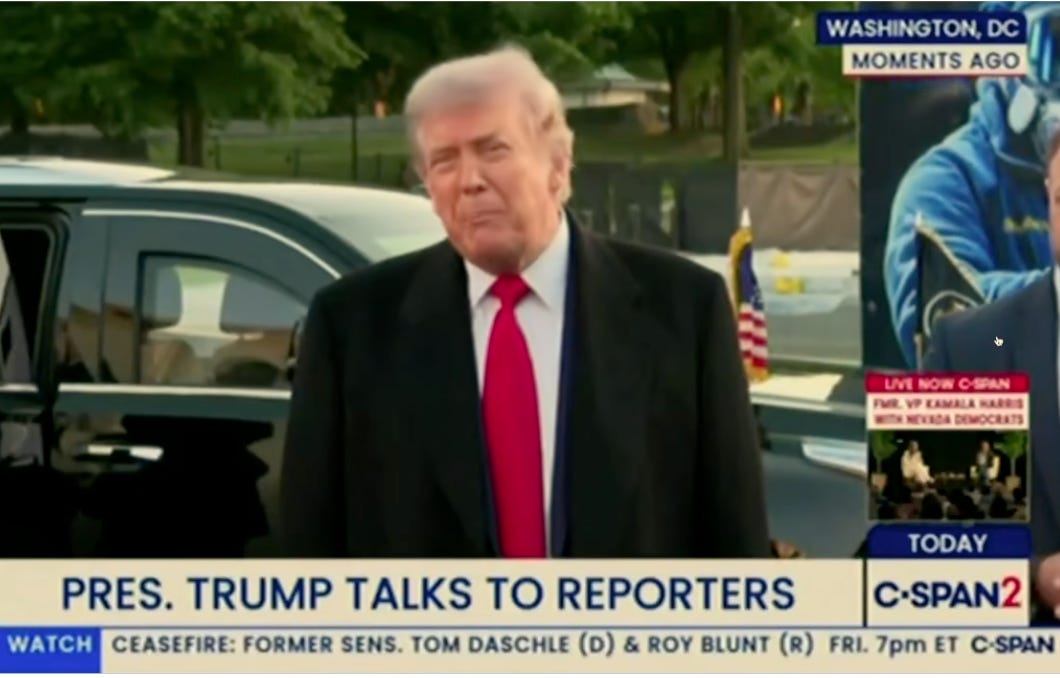
That same day, Trump took a presidential motorcade to the National Mall to inspect renovation work at the reflecting pool. When ABC reporter Rachel Scott asked why, with the Iran war at a critical juncture, he was spending significant time on decorating projects, Trump called it “such a stupid question,” told Scott she “probably understands dirt better than I do,” and described her to the assembled crowd as “one of the worst reporters” and “a horror show.” As the press was being thanked and ushered out, Trump turned to an aide and, according to multiple accounts and lip reading of available video, called her a bitch.
It was not a calculated political attack of the kind Trump has always deployed strategically. It was an unguarded, reflexive response to having an inconvenient truth named out loud, the kind of disinhibition that is clinically distinct from deliberate cruelty, and that those tracking his condition have been flagging with increasing alarm.
One day earlier, at a Mother’s Day event in the Rose Garden, Trump had delivered what was nominally a tribute to angel moms and Gold Star mothers. What it actually was, for anyone listening carefully, was a clinical document. The speech looped. It perseverated. It moved without transition from border statistics to shoe-ruining mud to drug interdiction percentages to the reflective properties of white stone to Lee Greenwood. He asked grieving mothers on camera whether time had healed their wounds. He answered his own question. He mentioned his own mother twice.
The audience was friendly, the setting controlled, the format designed to minimize the unscripted. This has become a template.
This pattern has not gone unnoticed by the medical community, and saying so is no longer the province of fringe commentators or partisan operatives. On November 4, 2024, the day before the presidential election, fifty nationally renowned geriatric, neurological, and forensic psychiatric experts published an open letter to the American people. They were careful about what they were and were not claiming. They were warning, not issuing a diagnosis. The distinction matters.
The behaviors they documented were observable and repeated: deterioration in language skills including paraphasias, (substituting invented sounds for real words), impaired memory filled in with confabulation, tangential thinking, perseveration, disinhibition in speech and behavior, and the amplification of maladaptive personality traits. They noted these signs comprised critical information for voters. They submitted their informed opinion, they said, in the interest of public trust and safety.
Alas, the electorate did not act on it. Eighteen months later, the same cohort of professionals, this time thirty-six of them, their names and institutional affiliations now publicly attached, escalated. On April 30, 2026, their statement was entered into the Congressional Record at pages S2162-S2163 by Senators Sheldon Whitehouse and Jack Reed of Rhode Island. The signatories included two Nobel Peace Prize recipients, former faculty from Harvard, Yale, Vanderbilt, Columbia, and George Washington University, a past president of the American Psychoanalytic Association, and a consultant profiler to the executive branch of the federal government. Not fringe, they were the establishment sounding an alarm the establishment would ordinarily prefer not to sound.
Their 2026 assessment was unambiguous: Trump’s mental state had deteriorated further since their 2024 warning. The observable signs now included grandiose and delusional beliefs, among them imagery of himself as Pope, as a mythical warrior hero, as a combat pilot dropping feces on civilians. Severely impaired judgment and impulse control. Significant disinhibition and perseveration, including what they described as seemingly compulsive manic-like late-night communications, one hundred and fifty social media posts in a single night. And escalating threats of violence that they characterized as endangering national and global stability.
They invoked the Declaration of Geneva, the successor to the Hippocratic Oath binding physicians to humanitarian principles since the Nuremberg trials, as the ethical foundation for speaking publicly. This, they were saying, is what the duty to warn looks like when the patient is the most powerful person on earth.
The letter closed with a Nixon parallel that was not rhetorical. In August 1974, as impeachment loomed, Defense Secretary James Schlesinger was so alarmed by Nixon’s condition that he directed the Chairman of the Joint Chiefs that any military orders from the president, especially nuclear ones, first be cleared through him or Secretary of State Kissinger. The nuclear football was quietly removed from Nixon’s control.
The thirty-six physicians asked, directly and on the congressional record, whether we could trust Pete Hegseth and Marco Rubio to do the same.
It is a question that answers itself. Schlesinger acted as a check on Nixon because he was alarmed by what he saw. He was an institutionalist who understood that his responsibility to the republic superseded his loyalty to the man who had appointed him. Whatever one thought of the Nixon administration, it contained people capable of that distinction.
The current cabinet does not make that distinction. Pete Hegseth is not a reluctant instrument of this administration’s worst impulses. He is a committed one, and has actively worked to dismantle oversight structures within the Department of Defense, purge perceived ideological enemies from the military’s senior ranks, and reshape the armed forces around a nationalist-Christian warrior identity that is his own as much as it is his patron’s. Still, he is coherent where Trump is not, ideologically driven where Trump is impulsively reactive, and fully capable of the kind of operational planning that advanced cognitive decline tends to disrupt. He does not share Trump’s pathology. He shares Trump’s conclusions, and he is more dangerous for the difference.
The thirty-six physicians asked whether Hegseth would do what Schlesinger did. The more unsettling question is what Hegseth would want in return if he did. A man who has used the Pentagon as an instrument of ideological consolidation does not invoke the Twenty-Fifth Amendment out of civic duty. He does it when it serves a larger project. The question of who benefits and how is never far from any move he makes.
This is the closed loop that the physicians’ letter, for all its courage and precision, does not fully reckon with. The constitutional remedies it invokes, the Twenty-Fifth Amendment, cabinet action, removal, were designed for a political culture in which the people empowered to act shared basic commitments to the republic’s continuity. That assumption is load-bearing, and today it may no longer hold.
Impeachment remains the safer theoretical course, precisely because it routes around the cabinet entirely and places the decision with the legislature. Legal scholars have noted that impeachment proceedings, if constructed around conduct in which the next several figures in the line of succession were complicit, and the list of qualifying offenses is not short, running from war powers violations to the concealment of the Epstein files to systematic due process abrogation, could create the predicate for challenging their fitness to assume the presidency as well.
But impeachment requires a House majority that does not currently exist, and recent redistricting has made the arithmetic of flipping it considerably more difficult than the raw polling would suggest. There is no realistic path before January at the earliest, and only then if Democrats take both chambers, a substantial if.
The kakistocracy is doing a creditable job of undermining itself. The tariff regime has rattled business constituencies that were prepared to be accommodating. The Epstein file concealment is a slow burn with too many people holding too much exposure for it to stay managed indefinitely. The DOJ’s weaponization is generating a legal record that will outlast the administration. And the cognitive deterioration that the White House has worked so hard to manage, the controlled settings, the friendly audiences, the bilaterals that go dark, has a horizon.
That horizon may be only six days away. On May 14th and 15th, Donald Trump travels to Beijing to meet Xi Jinping, the first visit to China by an American president since Trump’s own first term in 2017. This will not be a carefully curated audience, or a charming Rose Garden ceremony. It is Xi Jinping on his own turf, holding most of the high cards, fully aware that he holds them, and in no particular hurry to pretend otherwise. Five days before the summit, China’s Ministry of Commerce issued a directive instructing every Chinese citizen, company, and organization not to recognize, enforce, or comply with American sanctions. Xi did not send that signal by accident.
The agenda is genuinely consequential. Iran dominates; China hosted Iran’s foreign minister this week for the first time since the war began, and Beijing’s leverage over any ceasefire pathway is considerable. Trade, rare earths, Taiwan, nuclear security, artificial intelligence, each of these issues carries the weight of civilizational stakes, and none of them admits of the vague four-sentence readout that served as the official American account of the Lula meeting. Xi’s government has its own communications apparatus, its own interests in characterizing what happens in that room, and no particular incentive to protect the White House’s narrative management operation.
The summit was originally scheduled for March. It was postponed when the Iran war erupted. There is every possibility it gets postponed again, Trump’s schedule has shown a pattern of contracting around manageable environments, and Beijing is the least manageable environment imaginable. If it is cancelled or delayed once more, that will itself be a story, and not a difficult one to read.
If it proceeds, the concealment strategy that has defined this administration’s handling of Trump’s public appearances will face its most demanding test. Lula walked out and held his own press conference because he had a coherent account to give and a domestic audience to give it to. Xi will not hold a press conference on Trump’s behalf. What comes out of Beijing will come out on China’s terms, in China’s time, filtered through Beijing’s assessment of what serves Beijing’s interests. The White House will not control that narrative. It has never been less equipped to try.
Thirty-six physicians put their names and reputations on the congressional record last month and said, with the precision their training affords them, that what we are watching is not theater and not politics. It is, in their expert opinion, a rapidly worsening, reality-untethered, increasingly dangerous decline. They said steps toward removal must be undertaken with the greatest urgency.
Dr. John Gartner, among the most vocal of the professionals tracking this deterioration, offers a formulation that is worth sitting with. The Donald Trump you see today, he says, is the best you will ever see him. It will only get worse from here.
Read that again in the context of what this week produced. The controlled settings. The bilateral that went dark. The motorcade to the reflecting pool. The reporter called a bitch under his breath while the cameras were being thanked and ushered out. The four-sentence Truth Social post standing in for American diplomacy while Lula gave twenty minutes of coherent testimony about the same meeting. If this is the best, the trajectory in the other direction is not abstract. It is a matter of when, not whether.
The urgency has not decreased since they wrote that. It has a departure date now. Beijing. Six days.
we are sliding so quickly to some major points of crisis... i have little confidence that those surrounding trump would have the spine to step in and prevent something catastrophic from happening, or even recognize the potential... every citizen of this country should be so embarrassed at how he treats women in general, women reporters in particular. his approach to tough questions and challenges has set a standard for the far right... challenge something, ask a question, and in return rather than a debate about policy or facts you get threats or insults... if you are a male you get insults, if you are a woman, you get threats to your person or family... we are exuding from every pore the worst of humanity... the country faces the risk of trump doing something catastrophic, the country risks a foreign entity taking advantage of no one of competence or honesty at the helm, and the country is at risk of permanent irreversible damage to our position in the world.
Timely and well put. Thank you, Mary