

On January 20, 2025, Donald Trump returned to the Capitol rotunda, raised his right hand, and began a second, nonconsecutive term as president. The ceremony, another American ritual of continuity, was meant to draw a clean line between campaign chaos and the sober obligations of governing. But for much of the country, the unease wasn’t about the oath.
It was about the overlap: the feeling that the presidency and the Trump business universe were not two separate worlds, but one system with two entrances. If you want to understand why so many Americans, across parties, across regions, have started reaching again for words like grift and corruption, you don’t begin with an indictment or a single “smoking gun.” You begin with a trail, a sequence of payments, and a slow loosening of guardrails. A set of choices that, taken one by one, can always be explained… and taken together, start to feel like something else.
This is not a courtroom, nor a verdict. It’s an attempt to do what investigative reporting does at its best:
assemble the public record into a coherent picture, and let readers sit with what it implies. Here’s the map of the drift: money flows toward the president’s orbit, ethics distance narrows instead of widening, a policy-sensitive industry becomes a family engine, foreign gifts become plausible, and when scrutiny arrives, lawsuits don’t just seek damages, they seek control of the story.
There is a sound money makes when it moves in large quantities, not a literal sound, but a social one. Phone calls get returned faster, problems get solved more gently, and awkward relationships suddenly become smooth. In Trump’s second term, some of the most consequential money didn’t arrive as hotel bookings or licensing deals. It arrived as settlement payments: corporate agreements designed to make litigation disappear.
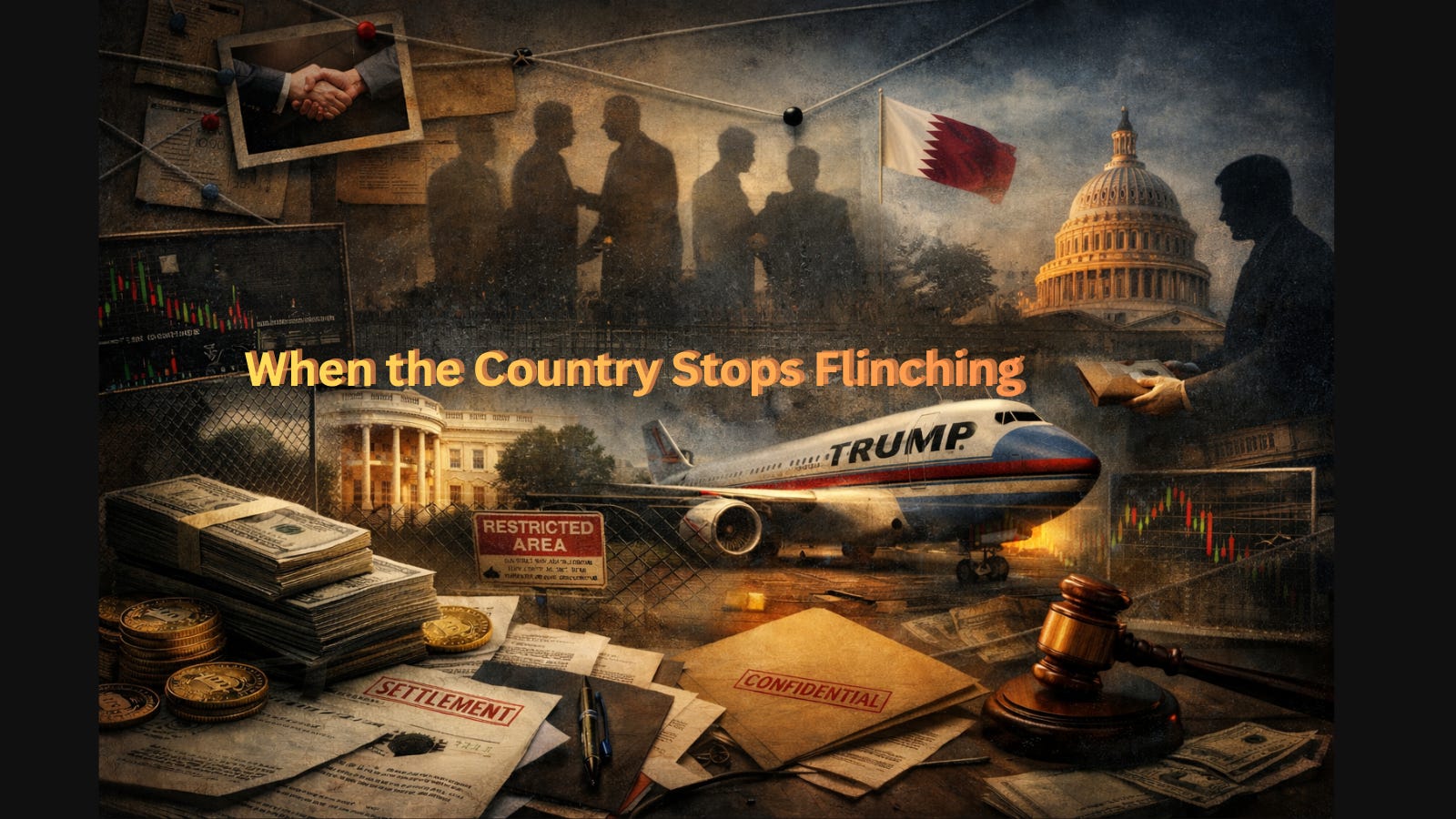
Meta confirmed it would pay $25 million to settle Trump’s lawsuit over his suspension after Jan. 6, structured as a $22 million donation to Trump’s future presidential library and $3 million in legal fees. Then came X: a roughly $10 million settlement, with part expected to go toward legal fees and the balance directed to a future presidential library. Then YouTube: a court filing described a $24.5 million settlement, with $22 million earmarked for a White House State Ballroom project held through the Trust for the National Mall, and $2.5 million going to other plaintiffs. Then Paramount/CBS: it agreed to pay $16 million including plaintiff’s fees, with the remainder going to a future presidential library and no money paid directly to Trump.
Even before Trump was sworn in, there was the ABC News settlement: ABC agreed to contribute $15 million to Trump’s presidential foundation and museum and to pay $1 million in legal fees. Read each line on paper and you can feel two forces forming in your mind at the same time: the argument, and the resistance to it.
Because there’s always an answer. Settlements happen, companies settle to avoid risk, and some of the money goes to “libraries,” not personal accounts. The Trump team frames it as accountability; the companies frame it as closure. All of that can be true, but still, the pattern persists.
The U.S. presidency is not just a job. It is a pressure system, that can bless or punish. It can steer regulators, shape markets, influence mergers, and change enforcement priorities. When large corporations start routing money into a sitting president’s orbit, whether to legal fees, library funds, or quasi-public projects, the question becomes unavoidable: “what are they buying: peace… or favor?”
A Washington Post analysis of Trump’s expanding legal campaign against media organizations noted that some settlements landed amid corporate moments where federal approvals and regulatory sensitivities were in play, timing that raises questions even when no explicit deal can be proven from the outside. In corruption stories, the first visible thing is rarely the bribe. It’s the behavioral change: the way powerful institutions start acting as if the safest path is to pay.
American ethics rules are strongest when they’re boring. When presidents divest, or create distance, not because they must, but because they understand the office is a public trust. When watchdog agencies exist with enough independence to be annoying. Trump has never been comfortable with that version of the presidency. And in the early stretch of his second term, the distance between the Oval Office and private interest did not expand. It narrowed.
Ahead of the second term, the Trump Organization released a voluntary ethics agreement that bars deals with foreign governments but allows deals with private foreign companies, a notable break from a stricter first-term policy. The Associated Press warned that this structure could create channels for outside actors to try to buy influence with the new administration. Then came the oversight signals from Washington itself. On February 10, 2025, Trump removed David Huitema, the director of the Office of Government Ethics, the independent agency responsible for executive-branch ethics guidance.
Again: each move can be defended. Voluntary ethics agreements are not laws, presidents sit in a special category in certain statutes, and personnel changes happen. But the question doesn’t ask only, “Is this legal?” It asks, “What kind of environment is being built?” Because corruption is often less about a single transaction and more about a governing climate: one in which conflicts of interest stop being treated as an emergency and start being treated as background scenery.
If the settlements are the headline money, crypto is the deeper structural story, the one that changes how Trump-world wealth can expand while staying hard for ordinary citizens to fully track. In March 2025, Trump signed an executive order establishing a Strategic Bitcoin Reserve and a U.S. Digital Asset Stockpile, a major federal signal about crypto’s legitimacy and centrality. At the same time, Trump-linked business activity in crypto accelerated. Trump Media and Technology Group announced that institutional investors would inject $2.5 billion through share purchases and convertible notes, with proceeds intended to create a “bitcoin treasury.”
Then the Trump Media/Crypto.com partnership: the Associated Press reported the formation of a Trump Media CRO Strategy entity designed to build a substantial CRO treasury, alongside plans to integrate Crypto.com’s wallet infrastructure into Truth Social, tying a policy-sensitive, enforcement-sensitive sector directly into a Trump-branded platform and family ecosystem. This is the core tension, and you don’t have to be partisan to feel it.
Crypto is not like owning hotels where profit comes from guests. Crypto is a sector where government posture can move markets, through regulation, enforcement discretion, and the sheer force of public legitimacy. When a president’s family deepens its financial exposure to crypto while the White House elevates crypto’s status, it becomes difficult to draw a clean line between “public policy” and “private benefit.” Even if no one ever writes the words quid pro quo, the incentives begin doing the talking.
And then the wealth numbers hit. A Bloomberg analysis reported that digital assets added about $1.4 billion to the first family’s wealth over the prior year, making crypto about one-fifth of an estimated $6.8 billion fortune. If that figure is even close, it isn’t a footnote. It’s a reshaping of what the Trump financial empire is, less grounded in tangible property, more tethered to a volatile sector unusually sensitive to political signals.
At this point in the story, readers usually ask the question that keeps writers like Mary and me digging: So, what changed? Not Trump’s appetite, not his style. Those have been consistent for years. What changed is the setting: a second-term presidency with the muscle memory of the first, and a network of institutions that have learned, sometimes the hard way, that this is a president who uses power publicly and personally, and rarely separates the two cleanly.
In May 2025, the Defense Department accepted a luxury Boeing 747 from Qatar for Trump’s use as Air Force One. The story quickly took on a life beyond aviation. A foreign gift so large it felt less like diplomacy and more like tribute. Supporters argued it was a gift to the U.S. government, not Trump personally. Critics raised constitutional and ethical questions, and the Emoluments Clause entered the conversation for a reason. ABC News later reported that the U.S. accepted an “unconditional donation,” with no stipulation about what happens to the aircraft after Trump leaves office, and sources described a plan to transfer ownership to the Trump presidential library foundation afterward.
The deeper truth is that the controversy itself illustrates the problem: the lines are so blurred that people can’t agree on what they’re even looking at. And when a system becomes hard to see, it becomes easier to live with. That’s how normalization happens. The plane matters, even if it never generates a criminal case, because it demonstrates how foreign governments and powerful actors may behave when they believe a president’s favor is unusually available to purchase.
Now we arrive at the question that sounds technical but is emotionally explosive: Trump’s tax records. In late January 2026, Trump sued the IRS and the Treasury Department for $10 billion, alleging the agencies failed to prevent the leak of his tax information to news outlets, and that the breach caused reputational and financial harm and public embarrassment.
The leak itself is not a gray-area ethics dispute. It was, unfortunately, criminal. The Justice Department has said former IRS contractor Charles Littlejohn was sentenced to five years in prison for disclosing thousands of tax returns without authorization to news organizations. And the law around confidentiality is strong: 26 U.S.C. § 6103 makes tax returns and “return information” confidential, with disclosure allowed only under specific statutory exceptions.
This matters for a separate reason: many Americans assume presidential candidates’ taxes are “supposed” to be public. In reality, that’s a norm, not a legal requirement. Candidates do have public disclosure obligations, presidential candidates file public financial disclosure reports through the Office of Government Ethics, but tax returns are not automatically public simply because someone seeks office. Efforts to force disclosure through ballot access have also hit legal walls; for example, in Patterson v. Padilla, the California Supreme Court blocked enforcement of key parts of California’s presidential tax disclosure law.
So yes: Trump’s tax records are legally protected. And yes: Americans can still reasonably argue that a presidential candidate should disclose them voluntarily. Both can be true, but the lawsuit raises a different question: what does Trump stand to gain from it besides money? Money is the obvious answer. But lawsuits by powerful figures often seek other results too. They can redirect attention from the content of the leaked records to the injustice of the leak itself. They can brand the press as a conspirator rather than a messenger. They can chill future disclosures, legal or illegal, by raising the perceived cost of crossing Trump-world. And they can create a storyline in which Trump is not the subject of scrutiny, but the victim of it, an inversion that has served him politically for years.
The government’s response to the breach underscores the scale. The Treasury Department said it canceled contracts with Booz Allen Hamilton, citing failures to safeguard data, and stated the breach affected approximately 406,000 taxpayers. That number matters, it reminds us this wasn’t only about Trump. It was a system failure that touched hundreds of thousands of people. But in Trump’s hands, it also becomes another stage: another fight, another headline, another lever for reshaping perception while extracting value.
In American life, we often imagine corruption as a moment: a man in a dark suit sliding an envelope across a table. In reality, corruption in modern democracies often looks like influence laundering, money that travels through respectable channels and arrives wearing clean gloves. A corporate settlement becomes a “donation” to a future museum, a legal payout becomes “support” for a White House construction project held by a tax-exempt entity, and a foreign gift becomes a government asset that may later end up displayed in a Trump-branded legacy space.
Meanwhile, the administration’s actions shift the landscape in ways that can predictably benefit Trump-linked ventures, especially in crypto, without anyone needing to leave fingerprints on a literal bag of cash. No single piece proves corruption in the way a prosecutor needs. Not “beyond a reasonable doubt.” And as of now, the public record on these second-term examples is largely about payments, policies, and weakened guardrails, not a criminal finding a district attorney can hold up and declare case closed. But the job of citizenship, and the job of journalism, is to recognize patterns before they harden into permanence.
When people say “this feels corrupt,” what they’re often sensing is not just anger, it’s recognition. Democracies don’t usually fall because one man is accused of corruption. They falter when people decide corruption is too complicated to track, too exhausting to confront, too normal to fight. And history shows how these systems form: money drifting toward the leader’s orbit, guardrails weakening, institutions adapting.
In South Korea, the Park Geun-hye scandal became a national trauma: political power braided together with behind-the-scenes influence and corporate interest. In 2021, South Korea’s Supreme Court upheld a 20-year prison sentence for Park over bribery and other crimes, closing a historic corruption case. The lesson isn’t “that could happen here” in a simplistic way. The lesson is that the structure often becomes visible only after the damage is done.
Under Ben Ali, Tunisia’s economy became, in part, a family enterprise. A World Bank paper examined how entry regulation aligned with the business interests of Ben Ali’s family using firm-level data, an empirical look at how regulation can quietly serve insiders’ profit. This is the end-stage version of what Americans fear: not a corrupt act, but a captured system.
And the United States is not immune to its own history. In the 1920s, corrupt deals involving oil leases in naval reserves spiraled into one of the defining scandals of the Harding era. The Federal Judicial Center describes how those drilling-rights deals sparked a national scandal and a web of civil and criminal trials. The lesson isn’t that every contract is corrupt. It’s that corruption can live inside paperwork until investigators force it into daylight.
These are not perfect matches, nothing is. But the rhyme is recognizable: money moves toward power; oversight weakens; the system learns what it can get away with. Here is the hardest part to write, and the hardest part to read: The real danger is not that corruption happens. The real danger is that it teaches everyone watching a lesson. “This is how you do business with America now.” Once that lesson spreads, corruption stops being a scandal. It becomes a system. A prosecutor has to ask: Can you prove intent? Can you prove an exchange? Can you prove criminality beyond a reasonable doubt?
A citizen has to ask a different question: What kind of presidency are we willing to normalize? If the presidency becomes a place where corporations pay to settle with the sitting president, where foreign gifts of staggering scale become plausible, where family ventures expand into a policy-sensitive industry while the government formalizes that industry’s legitimacy, then the country doesn’t need a conviction to suffer the damage. Because the damage is the drift, it’s the moment when people stop flinching. And the moment we stop flinching is the moment the system stops fearing us.
So, we do the unglamorous thing. We follow the paper, name patterns, and refuse to let the blur become the background. We keep the public record in public view, loudly, relentlessly, until the people in power remember that this country does not belong to the donors, the lobbyists, the executives, or the family brand. It belongs to the public. And the public can still decide, together, that this is not what we will accept.
So, in this moment we have to ask, what are we supposed to do about this? How do we fight for a better future for our kids, our grandkids, our families and friends? The answer is simple at its core, and it takes me back to a story I read as a child: “Hogfather,” by Terry Pratchett. It’s a book full of wild prose and extravagant turns, but it carries a message that is almost stubbornly childlike in its clarity.
To save the Hogfather from the Auditors of Reality, who seek to eliminate him, and in doing so keep the sun over the Discworld from rising, Death’s granddaughter, Susan, doesn’t need a weapon, she doesn’t need a throne, she needs something far more fragile and far more powerful: she must make sure the children keep believing. That’s what this moment is asking of us. We have to keep believing, believing that a better future is still possible, that we still have agency, that ordinary people can stand up to corruption, violence, and dishonesty and win. We have to keep believing long enough to act like it’s true.
Call Congress, every day, not once, not when it’s convenient, every day. Stay educated and informed. Name what’s happening out loud, spread the word to your family and friends, and ask them to call too. Share this essay, this newsletter, and others like it, far and wide. Give people the tools they need to believe. Because if we let the Hogfather vanish, if we let cynicism swallow us whole, then corruption doesn’t just continue. It becomes permanent. And one day we’ll look up and realize we stopped expecting the sun to rise at all.
It is dark, this battle is long term and as they say, 'It's always darkest before the dawn', but with the dawn, there is HOPE! I cling to that hope and will stay vigil ever after...
The corruption and sleaze of this administration and its hangers on oozes out, contaminating the whole country. We the people have to stand up and say "Enough is enough. This is not who we are, what we stand for, what we will allow to become the legacy of future generations." It has to end now.