

If you’re trying to figure out what actually matters this afternoon, start with the thing that has a habit of steamrolling every other political narrative the minute it gets ugly: price anxiety.
The Strait of Hormuz is still effectively blocked by the Iran war, and the International Energy Agency says member countries will release a record 400 million barrels from emergency reserves to try to calm markets. That is a big move. It is also not exactly reassuring. When governments start cracking open the emergency stash at this scale, the message is less “everything’s fine” than “we are now in the part of the movie where everyone starts talking too calmly.”
Which is why Trump is in Ohio and Kentucky today trying to project economic confidence while also taking time out to go after Rep. Thomas Massie, because apparently even in a geopolitical crisis there is always time for a side quest. The White House would very much like voters to absorb the message that everything is under control. Unfortunately for them, gas prices have a way of turning every grand political narrative back into a very personal act of financial violence.
This is the part of the day’s story that matters most. The market story and the political story are now the same story in different clothes. Hormuz disruptions have triggered the largest emergency oil release in IEA history, because an absurd share of the world’s oil and gas passes through that chokepoint. You can hold as many press events as you want. If people start to feel like filling the tank now requires a co-signer, the rest of the script is basically dead.
The louder political fight, at least in Washington, is over Trump’s SAVE America Act. Senate Majority Leader John Thune says the Senate will take it up, but he is resisting demands to change filibuster rules to shove it through. With Democrats opposed and no obvious Republican appetite to detonate Senate procedure for this particular exercise, the whole thing looks less like imminent lawmaking than a loyalty pageant with a C-SPAN budget. That does not make it meaningless, it makes it diagnostic.
The real story is the split inside the GOP. Trump wants the party talking about voting rules, mail ballots, and trans issues. House Republicans would much rather talk about taxes, energy, and the cost of living, because some of them have apparently noticed that voters can, in fact, buy groceries. One side wants a culture-war midterm. The other wants a grocery-bill midterm. Right now, the grocery bill has the stronger polling operation.
Meanwhile, a more consequential election story may be unfolding below the level of today’s loudest manufactured drama. New Mexico just enacted a law barring armed federal agents from polling places, and other states are considering similar moves. That suggests Democratic-led states are no longer just warning abstractly about federal overreach. They are legislating like they expect it to show up in tactical gear.
That is worth watching because it sits right at the intersection of voting rights, federal power, intimidation, and pre-election legal trench warfare. It is quieter than the Senate bill fight, which is exactly why it may matter longer. Screaming gets the segment, infrastructure gets the consequence.
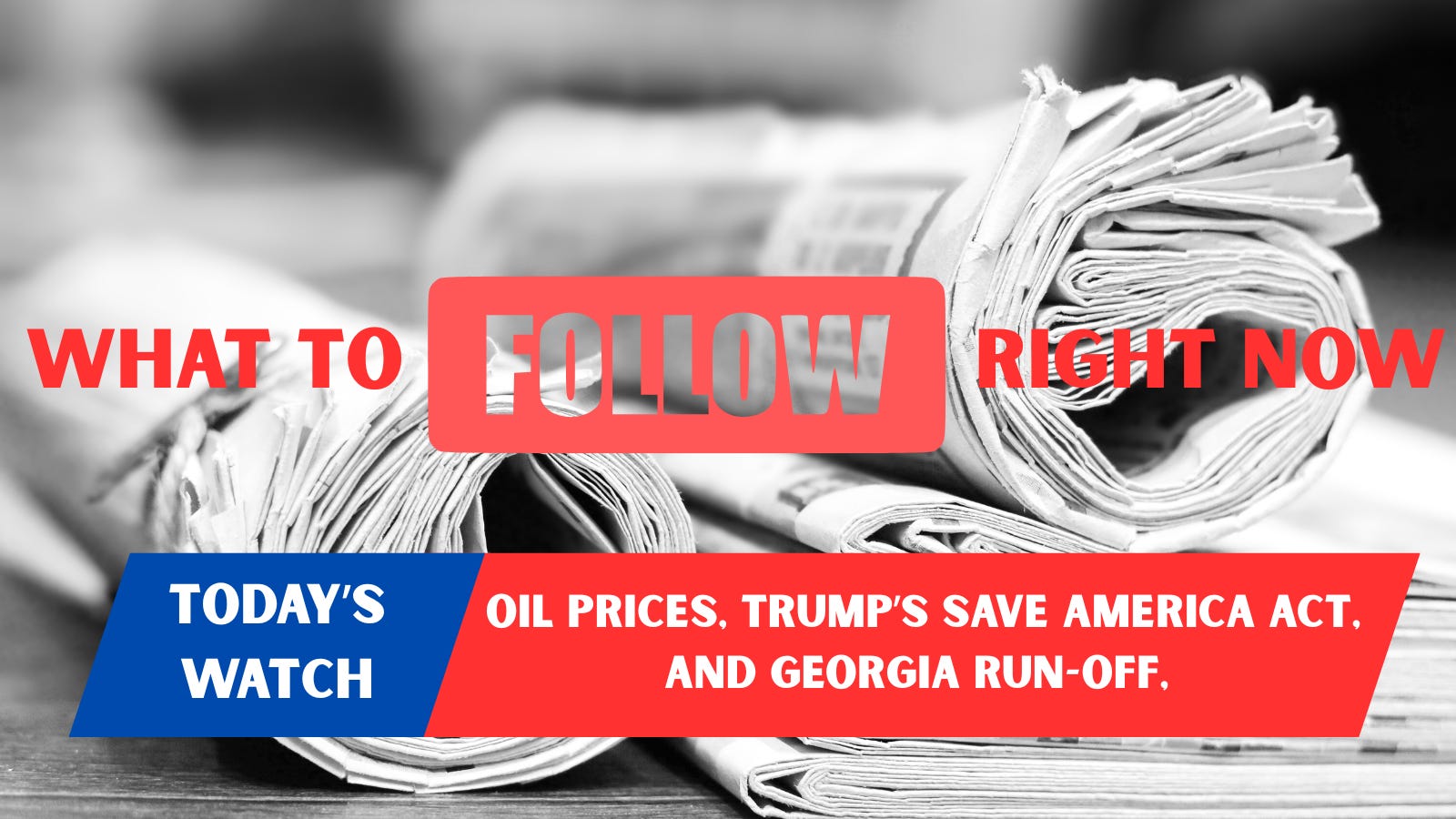
And then there’s Georgia, where no one won outright in the special election to replace Marjorie Taylor Greene, so Trump-backed Republican Clay Fuller and Democrat Shawn Harris are headed to an April 7 runoff. On paper, this is still a Republican-leaning seat. In practice, every special election in a narrowly divided House instantly becomes a national mood ring for people who learned the district existed about twelve minutes ago.
That is the board right now. Watch whether the oil story stabilizes or gets worse, whether Trump spends more of this trip talking about affordability or indulging his favorite pastime of grievance aerobics, and whether Republicans can keep the conversation centered on election rules when the economic story is louder, meaner, and much easier for voters to feel in their actual lives.
Valid U.S. passports are among the few accepted forms of ID under the Save (Trump from losing the midterms) Act. Studies show most passports are held by Democrats and independents not likely to be MAGA.
If I were to present my passport to register to vote under the Act, what’s to stop Palantir’s systems from cross checking my name to other data (Act Blue donations as one source) and revoking my passport and enough others in key swing districts to sabotage the elections?
Even assuming the revocations would eventually be overturned, or judges would stay revocations pending further proceedings, this government doesn’t care. All election officials would see is passport invalid. At the very least, election chaos would ensue.
Admittedly, this is a bit of spiralling. However, I don’t think it’s wise to give power over the validity of a voter ID to the same people who orchestrated an attempted coup in 2021 and are still committed to its fruition.
As Putin reminded Trump in Alaska he can’t cheat or intimidate voters if voting by mail continues. Never mind that he often voted by mail himself. He’s against it now and in 2028.