

There are weeks when the news doesn’t arrive as one great explosion, but as a slow poisoning, a series of decisions written in the flat language of policy that still manage to say something intimate and brutal about the people in power. This week, our leaders told us what they think we are worth. They told us in the water we drink, in the warnings we may not receive before the next storm, and in the public lands they are preparing to hand over to the same industries that have already taken so much from us.
They didn’t say it plainly, because they rarely do. They said it through proposed rules, budget lines, confirmation votes, and polished statements about efficiency, balance, and legal process. They said it in the careful vocabulary of government, where harm is softened until it sounds almost reasonable. They said that if our children drink chemicals linked to cancer, if our towns lose the weather data that could help save lives, if our mountains and deserts are carved into profit, then so be it. There is money to be made, and apparently there are still pockets waiting to be filled.
The first story is about water, which means it’s about everything.
On Monday, the Environmental Protection Agency announced two proposed rules related to PFAS, the “forever chemicals” that don’t naturally break down in the environment and have been linked to serious health risks. One proposal would keep federal drinking-water limits for PFOA and PFOS, but allow eligible water systems to request two additional years, until 2031, to comply. The other would rescind drinking-water regulations for PFHxS, PFNA, GenX chemicals, and certain mixtures involving those chemicals and PFBS. The EPA says this is about correcting what it calls an unlawful process under the Safe Drinking Water Act, but for families living with contaminated water, process isn’t the same thing as protection.
That is the cruelty of it. The agency isn’t saying, “Your water is safe.” It’s saying, in effect, that the paper trail matters more urgently than the poison trail. It’s saying that the rule needs to be reconsidered while the chemicals continue their invisible work in the bloodstream, in the body of a pregnant woman, in the body of a child, in the body of a community that has already been asked to absorb too much.
When the Biden administration finalized the original PFAS drinking-water standards in 2024, the EPA said the rule would reduce exposure for approximately 100 million people, prevent thousands of deaths, and reduce tens of thousands of serious illnesses. The agency’s own 2024 announcement said PFAS exposure has been linked to deadly cancers, liver and heart impacts, and immune and developmental damage to infants and children.
So, when those protections are delayed or weakened, we should not pretend the stakes are abstract. This isn’t a fight over bureaucratic neatness. This is a fight over whether a mother should have to wonder if the water coming from her kitchen faucet is quietly endangering her child. This is a fight over whether a rural family, a working-class neighborhood, or a community downstream from a chemical plant gets clean water now, or waits while lawyers and lobbyists argue over timelines.
EPA Administrator Lee Zeldin said the Trump EPA is committed to taking on PFAS “the right way,” but that phrase carries a terrible weight when the “right way” means more time for contamination and less certainty for the people drinking it. Public health advocates heard the announcement very differently. Dr. Anna Reade of the Natural Resources Defense Council accused Zeldin and Robert F. Kennedy Jr. of “trying to sell potions out of the back of a covered wagon,” a line that lands because the promise is so familiar. Trust us, they say. Wait longer, they say. We are protecting you by not protecting you yet.
The second story is about weather, which means it’s about whether we will be warned before the next disaster comes.
As the United States prepares for hurricane season and another summer of dangerous heat, experts are warning that cuts to climate and weather-data programs could make federal forecasts less reliable when people need them most. The Guardian reported that the Trump administration has proposed a modest budget increase for the National Weather Service, while cutting NOAA overall by 40 percent. Weather forecasts don’t come from nowhere. They come from satellites, balloons, buoys, land sensors, ocean observations, climate research, and the scientists who know how to interpret a planet that is changing faster than our politics can admit.
This is one of those stories that should terrify us precisely because it sounds technical. A buoy lost here, a balloon launch skipped there, a research program cut, a data stream narrowed, a forecast degraded by degrees until the warning arrives too late or not clearly enough. People don’t usually die because a budget document looks cruel. They die because the warning was not accurate, because the heat index was underestimated, because the flood came faster than expected, because the storm track shifted and the system meant to see it had been hollowed out.
Monica Medina, a former NOAA official, put it plainly: “we’re going in the wrong direction.” Craig McLean, NOAA’s former acting chief scientist, offered the equation that should be written above every climate budget hearing in America: “Weather times time equals climate.” When you cut climate research, you aren’t just cutting some distant academic inquiry. You are cutting the memory and foresight of the nation. You are dimming the instrument panel while the plane flies into rougher air.
The administration and its defenders point to artificial intelligence as part of the future of forecasting, and AI may well be useful when it’s fed enough accurate data and used with humility. But there is something almost obscene about starving the systems that collect the data, then praising the machine that depends on it. AI cannot conjure truth from absence. It cannot make a vanished weather balloon report what it never measured, and it cannot teach itself the shape of a changed climate if we refuse to keep looking at the world as it is.
Meteorologist Chris Gloninger warned that AI weather models were trained on “a climate that no longer exists.” That is the sentence that should stop us cold. We aren’t living in the old atmosphere. We are living in the one we made by burning coal, oil, and gas for generations while the people who profited told us not to worry. The roads, drainage systems, power grids, crops, and emergency plans around us were built for a steadier world, and now the people in power are cutting the tools that help us survive the unsteady one.
The third story is about land, which means it’s about inheritance.
On Monday, the Senate confirmed Steve Pearce to lead the Bureau of Land Management in a 46 to 43 vote. BLM manages roughly 10 percent of land in the United States and oversees about 700 million acres of underground minerals, including major reserves of oil, gas, and coal. This isn’t a minor appointment. This is the person now charged with helping decide the fate of enormous stretches of the American West, places of sagebrush and canyon, migration and memory, places where ecosystems still breathe because generations before us had not yet managed to sell every last acre.
Pearce told senators, “We can and must balance the different uses of public land.” That sounds reasonable, because it’s designed to sound reasonable. Balance is one of the great laundering words of politics. It asks us to imagine a scale in which extraction and preservation sit in equal moral weight, as though a coal lease and a living watershed are simply two competing preferences, as though a drilling rig and a desert bighorn sheep are just different stakeholders at the same table.
But the context matters, AP reports that Pearce is known for supporting public land leasing and industry, and that the Trump administration has been opening millions of acres of public lands for mining and drilling while reversing Biden-era conservation plans. Senator Martin Heinrich’s office said Pearce previously pushed to sell off public lands, opposed the Organ Mountains-Desert Peaks National Monument designation in New Mexico, advocated downsizing national monuments, and pushed privatization for corporate interests instead of public use and recreation.
The Center for Biological Diversity was blunter, saying the Senate had handed control of “our mountains, deserts, rivers and grasslands” to a man it accused of trying to sell them off. Its public lands advocate Ryan Beam said Pearce has “oil in his veins and dollar signs in his eyes.” That is advocacy language, yes, but it captures the emotional truth of what millions of people feel when they watch public lands treated like a liquidation sale.
Public lands aren’t just scenery. They are habitat, carbon storage, clean water, Indigenous history, recreation, refuge, and the last quiet places many Americans will ever know. They are where pronghorn move across old migration routes, where old forests hold water in their roots, where families camp under stars they cannot see from the city, where children learn that the world is larger than commerce. When these lands are leased, drilled, mined, fragmented, and reduced to what can be extracted from them, something is taken that cannot simply be bought back later.
Taken together, these three stories form a kind of confession.
They tell us that our leaders know the water is contaminated, but they are willing to slow the response. They know the weather is becoming more dangerous, but they are willing to weaken the systems that warn us. They know public lands belong to all of us, including future generations, but they are willing to put them in the hands of people who see them first as inventory. These aren’t separate failures. They are one governing philosophy, repeated in different rooms with different letterhead.
What our leaders are saying is that health can wait, safety can wait, the future can wait, but profit must not wait. The oil must move. The mines must open. The chemical companies must be accommodated. The utilities must be given more time. The agencies must be thinned. The land must be made available. But what is being built to last isn’t protection. It’s permission.
We should name that clearly, because clarity is one of the few antidotes to the fog they keep producing. This isn’t normal, this isn’t inevitable, this isn’t balance. This is a choice, made by people with names and titles and votes, to place industry closer to power than the public, and to ask the rest of us to live with the consequences.
The water remembers what we put into it, the atmosphere remembers what we burn, the land remembers every cut, every road, every lease, every promise broken and every promise kept. One day, our children will ask what our leaders did when the evidence was already everywhere, and what we did when those leaders showed us so plainly what they thought we were worth.
I hope we can say that we refused to let them define our worth for us. And I hope we remember that refusal is not only resistance. It is care: calling, voting, organizing, showing up, telling the truth, protecting what can still be protected, and refusing to confuse despair with wisdom.
“This is a choice, made by people with names and titles and votes, to place industry closer to power than the public, and to ask the rest of us to live with the consequences.” Sadly, the public has not been “asked” to live with the consequences and impact on future generations. The dictator’s minions sold their souls as well as the public lands and resources to the highest bidder. It’s a comprehensive strategy to plunder and squeeze every asset for gain written by the Heritage Foundation et aliaa.
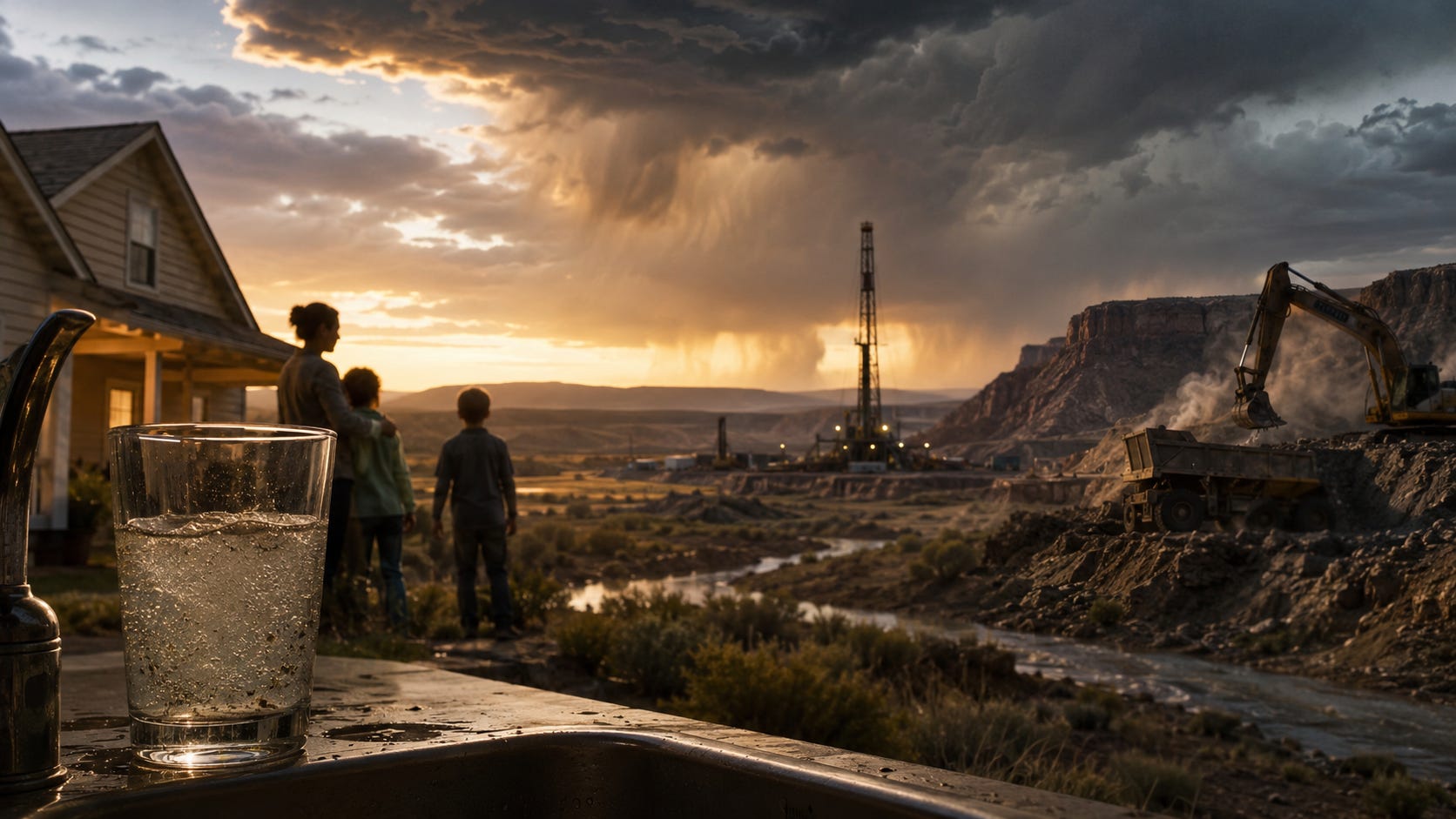
Thank you for this piece. Also, I am curious about the image used for this post. Is there an artist or is that an AI generated image?