


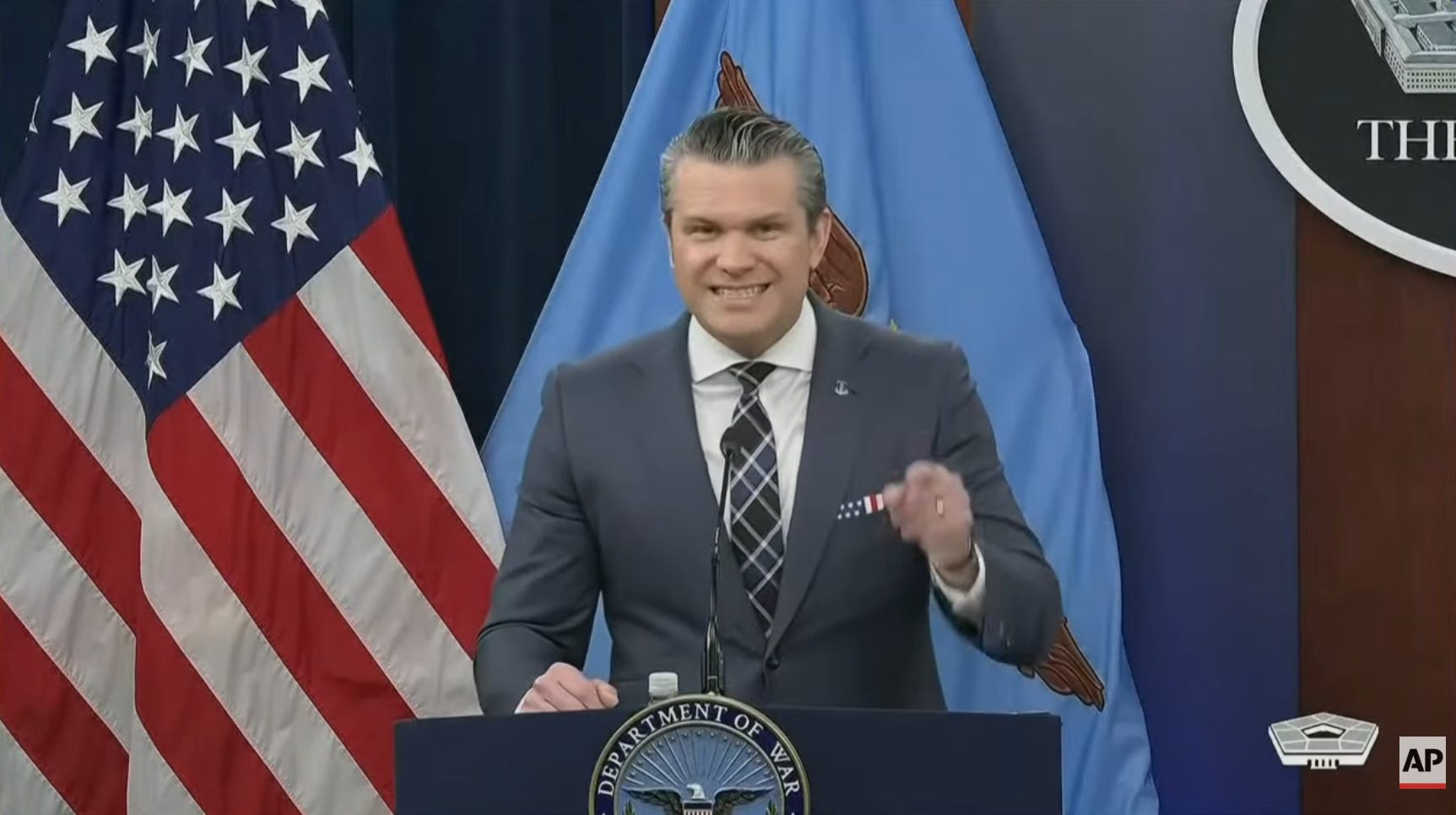
Yesterday, Pete Hegseth stood before the American public and spoke of honoring the fallen as they returned home in coffins. He spoke about attending the Dignified Transfer Ceremony and about speaking to the families, and then he offered the country a version of grief that sounded less like mourning and more like a recruitment slogan. He said, “What I heard through tears, through hugs, through strength, and through unbreakable resolve, was the same from family after family. They said, ‘Finish this. Honor their sacrifice. Do not waver. Do not stop until the job is done.’ My response along with that of the president was simple. Of course we will finish this.”
I cannot say with certainty what every family said in that room, because I was not there to hear it for myself, but I can say now that at least one grieving father has publicly contradicted Hegseth’s version of events. Charles Simmons, whose son Tech. Sgt. Tyler H. Simmons was among the dead, said he did not tell Hegseth or Trump to keep fighting and did not say anything along those lines. That matters because it reveals exactly how this kind of war rhetoric works. Powerful men take the most private language of grief and try to convert it into public consent for more violence.
Whether those exact words were spoken by anyone else or not, what Hegseth offered at that podium was not reverence, honesty, or care. It was an old trick in a fresh suit, the dead held up as proof that more death is necessary, mourning repackaged as resolve, and shattered families made to stand in for a nation that never seems to run out of other people’s children to spend.
What I cannot bring myself to believe, not for a single second, is that in the first raw moments of loss, with hearts broken open and futures collapsed, family after family approached the Secretary of War to ask for more bombing, more escalation, and more blood. I do not believe that mothers looking at flag draped coffins were thinking about military momentum or national resolve. I do not believe that brothers and sisters were standing there in the wreckage of their lives hoping that what had just been done to them should now be done to someone else. Grief does not speak the language of empire that fluently unless someone has taught it to, shaped it, staged it, and handed it a script.
You can hear the strain of that script in the way he speaks, in the lowered eyes, in the deliberate certainty, in the effort to make brutality sound like duty and cruelty sound like courage. It is all presentation, all muscle flexing dressed up as moral clarity, all the familiar theater of a small man trying to make power look like principle. What he offers is not strength, because strength does not need to hide behind dead servicemembers in order to justify itself. What he offers is the oldest performance in American war making, which is the insistence that if we have already sacrificed so much, then we must sacrifice more, because to stop now would somehow dishonor what has already been lost.
I spent my childhood with my brother away fighting one of these wars, one of these lies about protection and duty and safety. My family was lucky enough that he came home, but even that sentence is more complicated than it appears, because he returned to us alive and still we lost him in ways that took years to name. The warm boy who once protected other children from bullies did not simply come back and resume his life where it had paused. He came home altered by horror, burdened by memory, carrying things that never should have been placed inside any young person and certainly not under the banner of patriotic service to a safer world.
That is what men like Hegseth never say when they talk about sacrifice. They never say that war does not end when a soldier boards a plane home. They do not say that war keeps living in the body long after the uniforms are folded away, that it settles into the nervous system, that it follows families into kitchens and holidays and ordinary afternoons, that it steals tenderness and sleep and ease, that it can leave a person standing in front of the people who love him most while still being unbearably far away. They speak as though war is an event, a mission, a task to complete, while families know it as an inheritance that can be handed down in silence, fear, and grief for years.
My brother walks through the world now with the conscience that war failed to beat out of him. He carries the picture of a young girl who suffered because of his actions, and instead of burying that pain beneath slogans or self congratulation, he allowed it to change him. He got an education so he could help others living with trauma like his own. He did not give up his conscience in order to survive what he had done and seen. He let that conscience become the thing that guided him afterward, and to me that is what honor actually looks like. Honor is not standing at a podium describing death and destruction from above like it is a show of force to be admired. Honor is not speaking with swagger about the machinery that tears children apart. Honor is not treating war as a stage on which to perform masculinity for the cameras. Honor is what remains when a person refuses to become numb, refuses to call cruelty victory, and refuses to let power erase the human cost of what was done in his name.
That is why one of the most chilling things Hegseth said in that briefing was, “We’re hunting and striking, death and destruction from above.” He offered the line with the confidence of someone who wants the public to feel awe instead of revulsion, and I felt the opposite. I felt the cold of hearing a man speak about massive violence with the polished assurance of someone who has convinced himself that distance makes it cleaner. He invoked his own experience in earlier wars and referred to Bush as a foolish politician, and while I do not disagree that there was foolishness there, what seems different now is not wisdom but a terrifying absence of restraint. At least earlier administrations understood they needed to pretend, however imperfectly, that the loss of civilian life mattered. What stands before us now is a version of war rhetoric so stripped of shame that it barely bothers to hide its contempt for the dead on the other end.
And it is not only the dead abroad who are being treated as expendable. Standing there beside him, Caine spoke with pride about how young these servicemembers are, and that pride turned my stomach because youth should call forth protection, not appetite. It should make us pause, not posture. The fact that they are young is not evidence of national greatness. It is evidence of how early this country learns to place its children on the altar and call the smoke patriotism.
I think about the mothers on every side of this violence, the mothers here who are handed folded flags and speeches about resolve, and the mothers there who gather what remains of their children after our officials have finished explaining why the blast radius was regrettable but necessary. I think about the obscene distance between the language of the briefing room and the reality of a mother trying to survive the unendurable fact that her child will never come home from school, never laugh from the next room, never leave a pair of shoes by the door again. Men like Pete Hegseth speak in abstractions because abstractions allow them to keep moving. Mothers live in particulars, and particulars are what make war impossible to sanitize.
This is why I cannot accept the theft of grief that happened in that briefing. The dead do not belong to the state once they are buried. Their families do not owe the government a continued supply of resolve. Their mothers do not owe men like Hegseth composure, endorsement, or silence. Their loss does not become military property simply because a politician or a television soldier decides to wrap himself in it.
I also cannot accept the lie that the only honorable path available to a servicemember is obedience. My brother’s life taught me otherwise. A true soldier is not one who abandons conscience in service of command, but one who keeps enough of it intact to recognize when something is wrong, when the mission is rotten, when the justification is hollow, when the order being carried out is less about defense than domination. We ask some of our youngest citizens to shoulder unbearable moral weight, and then we tell them that duty means silence, compliance, and endurance. It does not have to mean that. There remains, even in uniform, the possibility of refusal. There remains the possibility of saying no. There remains the possibility of recognizing that what is being demanded is not courage but surrender of the soul.
That possibility matters because it is one of the only things standing between a nation and total moral collapse. If soldiers are taught that honor means obeying every lie, then we have not built a military, we have built a machine. If, on the other hand, they understand that honor includes restraint, conscience, and the refusal to carry out what they know to be wrong, then perhaps there is still some human ground left beneath all this ash.
My family spent years in the aftermath of Iraq wrestling with trauma, broken hearts, fear, and the grief of losing someone who was still alive. We know what war does after the speech ends. We know what it costs after the headlines move on. We know that some of the most honorable people who serve are the ones who come back determined not to glorify what they survived, but to tell the truth about it, to help others carry what they can, and to resist becoming mouthpieces for the same machinery that harmed them.
So when Pete Hegseth stands before the country and asks us, explicitly or implicitly, to see more war as the proper tribute to the dead, I reject him. I reject the theft of mourning in service of power. I reject the use of young servicemembers as props in a fantasy of dominance. I reject the idea that devastated families are naturally asking for more devastation. Most of all, I reject the cruel and ancient lie that the only way to honor sacrifice is to multiply it.
Honor does not live in the briefing room. Honor lives in the mother who refuses to let her child be turned into a slogan. Honor lives in the soldier who keeps his conscience. Honor lives in the person who has seen what war does and still chooses not to worship it. And if there is any hope left for us, it will not come from men like Pete Hegseth promising to finish the job. It will come from the people, including soldiers themselves, who finally decide that this job should never have been theirs to finish in the first place.
In other words, Pete, I’m not falling for your bull shit, and I hope others will join me.
I was once assigned on a roster for the graves registration point duty. Actually twice. This involved inspecting identification papers of dead soldiers and the body itself just before it was shipped home. The army was very worried about shipping bodies to the wrong address, or with the wrong name. I had to go to the morgue, aka the graves registration refrigerated trailers, look at the ID papers and take a look inside the body bag to make sure it was the right person. As I said I only had this duty twice, which was enough. Somehow they should make Hegseth do this every time there's a casualty. What a rotten human being.
Hegseth, and Trump, are caricatures of men. Empty, hollow, men who deal in falsehoods and stolen valor. I wonder if, in their heart of hearts, they actually realize this - but, even so, they would never consciously acknowledge this.
The fact that they hold sway over honorable men and women sickens me.