


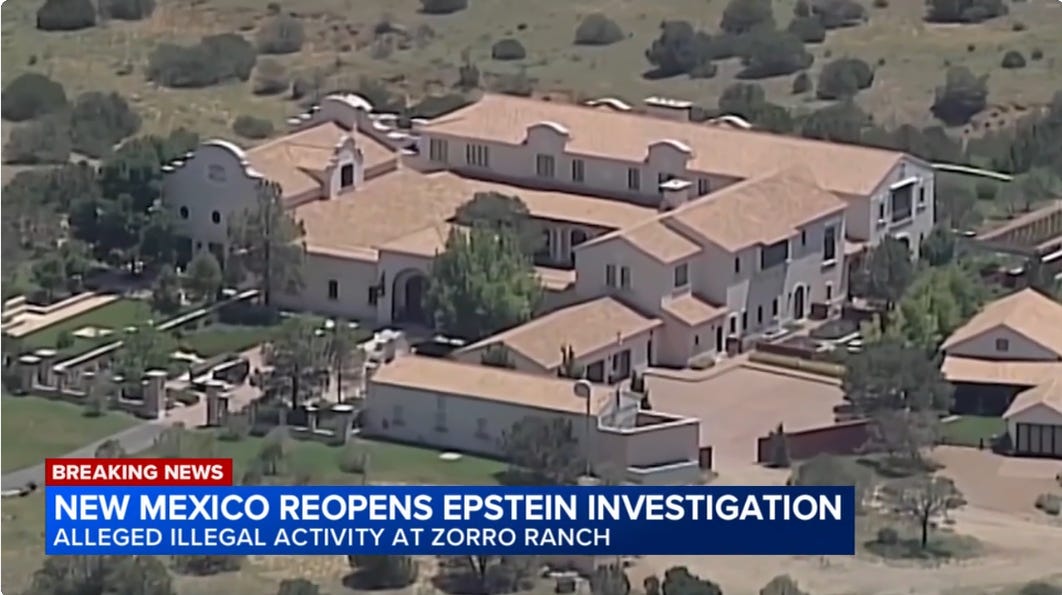
For years, Jeffrey Epstein’s Zorro Ranch hovered at the edge of the public story, a place so remote, grotesque, and freighted with suggestion that it seemed to absorb rumor, survivor testimony, and scraps of public knowledge without ever becoming the center of the reckoning it appeared to demand.
Women said it mattered. New Mexico officials were quietly examining it in 2019. Federal authorities plainly knew about it. And yet it never received the scrutiny its role in this story should have triggered. Now New Mexico investigators are back at the ranch, years later, trying to understand what happened there and what was lost when the trail was still warm.
The state has reopened its criminal investigation into alleged illegal activity at Epstein’s former property, and in March investigators searched the ranch with help from state police and a K-9 team. That search comes after New Mexico disclosed that its earlier investigation was closed in 2019 at the request of federal prosecutors in New York, which means the state had an active line of inquiry into allegations tied to the ranch and then was told to stop pursuing it. That is the part of the story that deserves the closest attention.
The easiest version of this story is the one the internet always wants, a story built from horror, mystery, innuendo, and a fresh excuse to turn Epstein into content once again. The harder and more consequential version is that a state was investigating allegations tied to one of Epstein’s most infamous properties, federal prosecutors asked that state to stand down, and now, after the property changed hands and years of potential evidentiary decay have passed, investigators are back trying to reconstruct a path that should never have gone cold in the first place.
What makes that so disturbing is not simply that Zorro Ranch was associated with Epstein, because almost everything in his world now carries that stain. What makes it disturbing is that this property had long been identified as one of the places where abuse allegedly occurred.
At Ghislaine Maxwell’s trial, Annie Farmer testified that when she was 16, Maxwell gave her a nude massage at the ranch and that Epstein climbed into bed with her the next morning and pressed against her without permission. Virginia Giuffre said Epstein trafficked her there to powerful men. Other women described the broader pattern that appeared again and again across Epstein’s world, which was isolation, coercion, grooming, and abuse carried out in environments designed to make resistance feel futile and disclosure feel impossible. Zorro Ranch was part of the geography of the abuse itself.
New Mexico did, in fact, begin moving on it. Reporting from 2019 shows that state authorities were interviewing possible victims and gathering records related to the ranch, while public lands officials were turning over documents they believed might help identify alleged co-conspirators and clarify how the property was used. One New Mexico official said at the time that there was “a story to be told in New Mexico,” and that phrase lands differently now because it suggests the state understood, even then, that this was not some decorative side plot to the broader Epstein scandal.
What we know now is that New Mexico’s earlier inquiry was closed at the request of the U.S. Attorney’s Office for the Southern District of New York. Recent reporting indicates that federal prosecutors asked the state to cease any investigation into sex trafficking and send over the material it had gathered. New Mexico complied, turning over police reports, recorded witness interviews, correspondence, and other investigative records.
That fact is alarming, but it is worth being precise about why. On its own, a federal request that a state step back is not proof of a cover-up. It is a standard feature of major cases, particularly when federal prosecutors are worried about parallel investigations muddying witness statements or complicating future charges. Former New Mexico officials have said that was the rationale they were given, and as a matter of ordinary prosecutorial practice that explanation is entirely plausible. What is much harder to explain is what appears to have happened after the handoff.
A December 2019 email cited in recent reporting said, “We have not searched the New Mexico property.” That sentence is devastating because it transforms the question from one about jurisdiction into one about institutional failure. If this place mattered enough for New Mexico to investigate, if survivors had already pointed to it, and if serious allegations were already attached to it, why was the ranch apparently left unsearched when the case was still fresh enough for evidence, witness recollections, and supporting records to be more intact than they are now?
That is the question hanging over this property, and it should remain at the center of any serious account of Zorro Ranch. The newest burst of attention has been driven in part by a deeply disturbing anonymous email from 2019 alleging that two foreign girls were buried near the property on the orders of Epstein and Ghislaine Maxwell. The claim is horrifying, and it is obviously the kind of allegation that captures attention because it sounds like the darkest imaginable extension of an already monstrous story. But it is also, at least on the public record we have right now, unverified.
That distinction matters because the existence of the allegation is itself newsworthy, particularly if it was shared with authorities and not meaningfully pursued. The allegation, however, is not established fact, and any credible piece should resist the temptation to write as though it has already been proven. The more durable significance of that email is that it underscores how many serious leads connected to Zorro Ranch appear to have been left unresolved for years.
The delay is not some technicality. Time degrades evidence, properties change ownership, workers leave, memories blur, and documents disappear into boxes, hard drives, sealed files, redactions, and bureaucratic limbo. Even if investigators find something meaningful now, they are doing it in the shadow of years that cannot be restored. And if they find nothing, that result will not erase the underlying question, because a ranch that might have yielded a clearer picture in 2019 may not be able to tell the same story in 2026.
That is why the reopening matters, and why it matters for reasons deeper than the tabloid thrill that always follows Epstein coverage. New Mexico is finally treating Zorro Ranch as more than a creepy footnote in the mythology that has accumulated around this case.
State lawmakers appear to understand as much. The New Mexico House has created a special committee to investigate the ranch and related allegations, with the authority to gather evidence and issue findings later this year. The attorney general has reopened the criminal side. The current owners have cooperated with the search. The state says it will follow the facts wherever they lead. Taken together, those moves amount to a belated acknowledgment that this part of the Epstein story was never adequately resolved.
That is what makes Zorro Ranch more than an artifact of a monstrous man’s private empire. It is a case study in how powerful cases can fail in ways that look much less dramatic than people imagine. Sometimes failure does not arrive as one giant decision or one unmistakable act of corruption. Sometimes it arrives through deference, handoffs, ordinary caution, and the bureaucratic logic that tells one office to stop because another office has it from here.
Hector Balderas, the former New Mexico attorney general, has said the cooperation that followed was “one-way.” That may be the most revealing phrase in the story because it captures the quiet pathology of institutional failure, which is not always open sabotage and is often something more familiar and more maddening than that. A state yields to federal authority, material is handed over, assurances are made, and then the momentum drains out of the case until what remains is not resolution but vacancy.
The temptation with Epstein is always to chase the most sensational detail because there is never a shortage of them, and because sensational details create the feeling of revelation even when they mostly generate noise. But the more enduring scandal here may be simpler and darker than that. A place survivors said mattered did not receive the scrutiny it deserved when it mattered most.
Now the state is back, years late, asking the question it should have been allowed to keep asking all along. What happened at Zorro Ranch, why was that question interrupted the first time, and what was lost in the years when no one was looking hard enough?
While I appreciate your caution in leaping to conclusions just on suspicious, I admit I just want to go to New Mexico and digdigdig... boxcar@sonic.net
"... what the internet always wants, a story built from horror, mystery, innuendo, and a fresh excuse to turn Epstein into content once again." Brilliant turn of phrase, Shanley!