

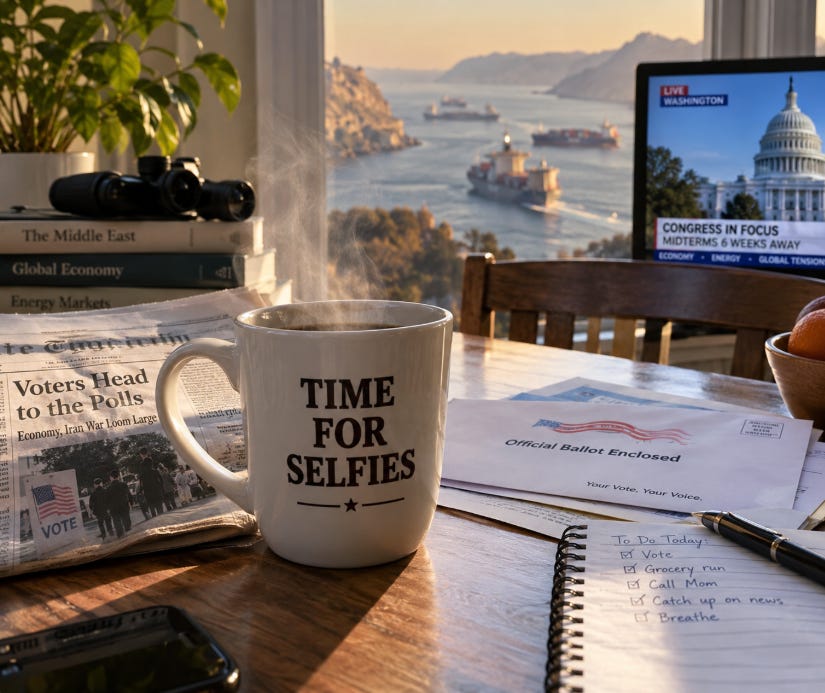
Good morning! Early and absentee voting opened this morning in Virginia, Minnesota, Idaho, and South Dakota. Six weeks of campaign rhetoric just became six weeks of actual ballots being cast, a useful reminder that “the midterms” are happening right now, in a strip mall parking lot near you, regardless of what cable news decides to lead with tonight.
The Guardian frames the moment around two issues in particular: the cost of living and the continuing war in Iran. That seems about right, because if you wanted to design an election environment in which foreign policy, monetary policy and the price displayed on the gas station sign all became part of the same conversation, congratulations: here we are.
From 30,000 feet the economy is looking pretty good while sending the bill directly to your house. The unemployment rate is 4.1%. Consumer spending remains strong. The stock market has helped push household net worth to $186 trillion, up $26 trillion since the end of 2024. Investment has been robust, helped by enormous spending on artificial intelligence and data centers. Reassuring, provided Safeway accepts aggregate household net worth at checkout.
Down here on Earth, consumer prices were 3.4% higher in August than a year earlier. For five consecutive months, wage gains have failed to keep pace with inflation. Mortgage rates have climbed to 6.95%, performing the brave public-relations service of technically remaining below 7%. Gasoline is up. Diesel, which works its way into the cost of almost everything that spends time on a truck, reached $6.40 a gallon Thursday in the Wall Street Journal’s reporting, compared with $3.71 a year ago.
Welcome to Schrödinger’s economy: robust until you open the credit-card statement.
The Journal found Stacy Hislop, a 64-year-old Michigan retiree receiving about $1,900 a month from Social Security. Rising prices have already pushed her to withdraw $2,000 from savings, leaving roughly $13,000. She canceled a road trip because of gas prices and has been selling things on eBay to bring in extra money. She owns her home outright, which ought to be the definition of retirement security, except now she worries higher rates could make the house harder to sell if she eventually needs the equity.
Consumer sentiment is how economists refer to this. We grandmothers call it arithmetic.
The “misery index,” inflation plus unemployment, another economics term, now sits at 7.5, higher than it was the month before Trump won the last election on the promise of fixing exactly this.
Dollar General CEO Todd Vasos offered another revealing measure. He said the company is increasingly seeing even middle- and upper-middle-income consumers behave more like lower-income shoppers, and hearing people earning around $100,000 say they no longer feel like high-income households.
The pressure becomes still more obvious as winter approaches. In the Northeast, nonprofit groups that help people afford heating oil are warning that even their assistance isn’t stretching as far as it used to. One Connecticut organization offers grants of up to $500. This year, for the first time, that may not buy the minimum 100-gallon delivery required by some suppliers.
And this is the difficulty with talking about “the economy” as though it were one organism with one pulse.
The Fed raised rates Wednesday for the first time in three years, new Chair Kevin Warsh’s first hike, made explicitly over the president’s objections. And the Fed isn’t an outlier: the European Central Bank raised rates last week, and overnight the Bank of Japan followed, lifting its benchmark to a 31-year high, as central banks worldwide contend with inflation pressure from the Iran war’s energy shock and the AI investment boom. This isn’t an American mood. It’s a global bill, and everyone’s getting handed their share.
The Middle East connection has become increasingly difficult to separate from the domestic affordability story. Aaron David Miller, who’s advised both parties on Middle East policy, put it plainly to Reuters: this is what happens when a president launches a war of choice without weighing the unintended consequences. The consequence, in this case, is currently arriving at the pump.
Trump is scheduled to address the United Nations on Tuesday, where the Iran conflict will inevitably loom over his appearance. The administration has repeatedly emphasized American military successes in the conflict. But seven months in, the war is no longer neatly contained within Iran’s borders, or within the Strait of Hormuz.
Iran-backed Houthi forces have seized the Yemeni port of Mokha and the strategic island of Mayun at the mouth of the Bab el-Mandeb, putting renewed pressure on the narrow passage connecting the Red Sea with the Gulf of Aden. The strait had become particularly important as Saudi Arabia diverted oil around the heavily disrupted Strait of Hormuz; now that alternative is under pressure as well. Maritime monitors continue to rate the threat in the southern Red Sea as substantial, and northbound and southbound ship transits through Bab el-Mandeb have fallen amid the instability.
That is the larger story now. A conflict that began with attacks on Iran has spread into the shipping lanes around Yemen, added pressure to Saudi energy infrastructure and squeezed two of the world’s critical maritime chokepoints at once. The economic consequences have therefore continued well beyond the initial projections for a short campaign, and well beyond the countries actually doing the shooting.
So when voters see a gasoline sign today, they aren’t necessarily separating “foreign policy” from “economic policy” into neat little cable-news boxes.
Rep. Robert Garcia, the ranking Democrat on the House Oversight Committee, took control of Congress out of the abstract to explain what control actually buys.
Garcia told the Financial Times that if Democrats win control of the House, he intends to make investigations into Trump-family business dealings and associates a major focus of the committee. Garcia repeatedly used the phrase “Trump crime family,” which is his characterization, not an established legal finding, and said he believes congressional investigators should build evidence concerning possible crimes and impeachable offenses.
Committee gavels come with something considerably more useful than rhetorical outrage: Subpoenas. It determines who gets to issue the subpoenas and what they decide to subpoena.
Garcia said investigators would pursue information involving Donald Trump Jr., Jared Kushner, Trump-connected cryptocurrency ventures, corporate donors, Elon Musk’s government activity, and other subjects. He acknowledged that compelling members of the Trump family themselves to testify could prove difficult, but suggested congressional investigators could instead obtain records and testimony from business associates.
Some of those questions already exist.
Oversight Democrats have asked the Pentagon inspector general to examine billions of dollars in federal awards involving companies connected to investment firms associated with Donald Trump Jr. and Eric Trump. The Pentagon has said companies receive no preferential treatment based on political connections, and Trump Jr.’s representatives have said he does not participate in government-contract negotiations on behalf of portfolio companies.
One company backed by Trump Jr.’s 1789 Capital, rare-earths startup Vulcan Elements, received a $620 million Pentagon loan. Another, drone manufacturer Unusual Machines, received a military contract.
Garcia also told the FT there are Democrats who worry another impeachment-centered Congress could swallow the party’s legislative agenda. His response was essentially that healthcare and economic legislation belong to other committees; Oversight’s job is oversight.
Control of the House doesn’t merely determine which party gets the nicer offices and possession of the ceremonial wooden hammer.
Which brings us to our little corner of schadenfreude. Trays upright, meme coins fastened.
Forbes’ latest accounting has Trump’s net worth sliding from $7.3 billion to roughly $7 billion this year; a $300 million haircut that costs him 44 spots on the Forbes 400. Trump Media shares are down about 50%, his memecoin down 70%, World Liberty tokens down 75%, together erasing nearly $1.8 billion on paper.
Only $7 billion. Someone start the casserole train.
Except: while the paper value was falling, Trump was busy converting enthusiasm into cash. World Liberty sold nearly $2 billion in tokens and equity, with an estimated $800 million landing in Trump’s pocket; the memecoin kicked in another $600 million-plus in fees and sale proceeds. Net effect: his liquid assets nearly doubled, from $1.1 billion to $1.9 billion, after taxes. The retail believers took the markdown. Trump took the money and ran the numbers.
Some of those believers noticed. Chad Nedohin, once an unofficial leader of Trump Media’s retail-investor faithful, has soured on the business, the Iran war, and Epstein, per Forbes. Faith created value. Value created liquidity. Liquidity went somewhere. Faith got expensive.
And lest populism feel insufficiently tiered: Trump Media is now charging high-frequency trading firms $60,000–$100,000 a month for faster access to the president’s own posts. Even direct access to the populist-in-chief comes with a premium tier.
The old-money side of the ledger is thriving; golf and clubs now worth an estimated $1.8 billion, with Mar-a-Lago alone clearing $50 million in operating profit last year on revenue up 55%. The meme-coin faithful may wobble. The country-club crowd remains reassuringly upholstered.
The Secretary of Defense has his priorities in order. Pentagon emails this week specified that troops attending Hegseth’s “State of the Force” address need “impeccable grooming” and the right waist-to-height ratio, with some earning a workout session with the boss himself. Somewhere, a war that’s costing $246 million a day continues without him, while he stage manages government selfies.
Which brings us nicely back to the governing style on display at the White House last night.
Trump hosted hunters, anglers and outdoor-industry representatives for a Rose Garden dinner Thursday evening and signed two substantive executive orders, one expanding hunting access and related programs on federal lands and another directing changes in saltwater recreational-fishing regulation.
The speech explaining these policies was somewhat less linear.
Trump began by discussing his newly paved Rose Garden and the old grass, which he said had turned to mud and caused women’s high heels to sink into the ground.
Then came the new granite helipad, followed by the White House moldings followed by Joe Biden’s insufficient interest in White House moldings.
Then Trump announced that the building is now in better condition than when it was constructed in 1792.
Three minutes in, the hunters were surely delighted to discover they had accidentally attended This Old House: Executive Mansion Edition.
Eventually he reached the executive orders.
While reading the hunting order, Trump arrived at its protections for traditional lead ammunition and openly acknowledged that he didn’t really understand why the provision was necessary. He asked Interior Secretary Doug Burgum about it, wondered aloud whether lead ammunition was better than other ammunition and finally settled on the more politically useful explanation: the audience wanted it, and he was giving it to them.
The administration’s order itself is much more specific. It directs agencies to review federal-land access restrictions, expand hunting opportunities where appropriate, support youth and veteran hunting programs, and allow traditional lead ammunition and tackle under specified circumstances.
From there he moved to boating. Trump described a Biden-era vessel-speed rule as though recreational fishermen had been forced to crawl across the ocean at ten miles an hour to protect sharks.
The actual federal rule concerns seasonal vessel speeds in designated areas intended to reduce collisions with endangered North Atlantic right whales. The Biden administration had proposed extending those protections to additional smaller vessels but withdrew that proposal in January 2025.
Right whales somehow became sharks during the presidential retelling.
Once sharks entered the chat, destiny took over. The electric boat story returned. Trump once again recalled asking a boat manufacturer whether a sinking electric vessel would electrocute him and presented the famous binary choice between remaining with the electrical system or entering shark-infested water.
Again, he selected electrocution.
Before finishing, Trump joked to Bass Pro Shops founder Johnny Morris that presidential power was so enormous he could ban fishing and put Morris out of business until Morris called begging for relief. Then he praised duck hunters, compared his record favorably with Theodore Roosevelt’s, returned to discussing the beautiful stone surface beneath everyone’s feet and once more invited guests to inspect the new helipad.
“If you don’t like it,” he said, “let me know.”
Then he added that he wouldn’t do anything about it.
Which is probably as good a place as any to end this morning.
Beneath all the weirdness, something serious is happening.
Americans have begun voting while the economy posts excellent statistics and painful receipts at once, while central banks on three continents raise rates to restrain inflation, and while a seven-month war reaches into American households through gas prices and borrowing costs. They’re deciding who controls the committees with subpoena power. They’re watching fortunes rise and fall around a political brand. And they’re watching an administration more invested in how it looks governing than in being governed well, the curated troops, the renovated garden, the granite helipad waiting just beyond dinner.
The midterms are no longer coming. The first ballots are already being cast. Everything we’ve been watching just entered the voting booth with them.
I don’t care who you are; if you don’t show up for court, a warrant is issued.
I am so tired of people being able to short circuit justice by simply not showing up.
Congress issues a warrant, ignore it, and send out the Federal Marshalls
LOL. Donboy does the UN, pass the popcorn. I want an inside view of the translation room where the "speech" is rendered in the home language of the attendees. Oh, and the reverse translation back to English of what actually came across in their headphones.