


There is a moment in Donald Trump’s bilateral meeting with Iraqi Prime Minister Ali al-Zaidi, buried between the trade talk and the oil deals, when Trump describes his guest as “young and handsome, which I don’t like.”
It gets a laugh as it was meant to. It is also, unintentionally, among the most honest sentences in the transcript because it reveals exactly how the president sorts the world in front of him. Not into allies or adversaries. Not into interests and threats. Into people he likes and people he does not, contestants he is rooting for and contestants he wants eliminated.
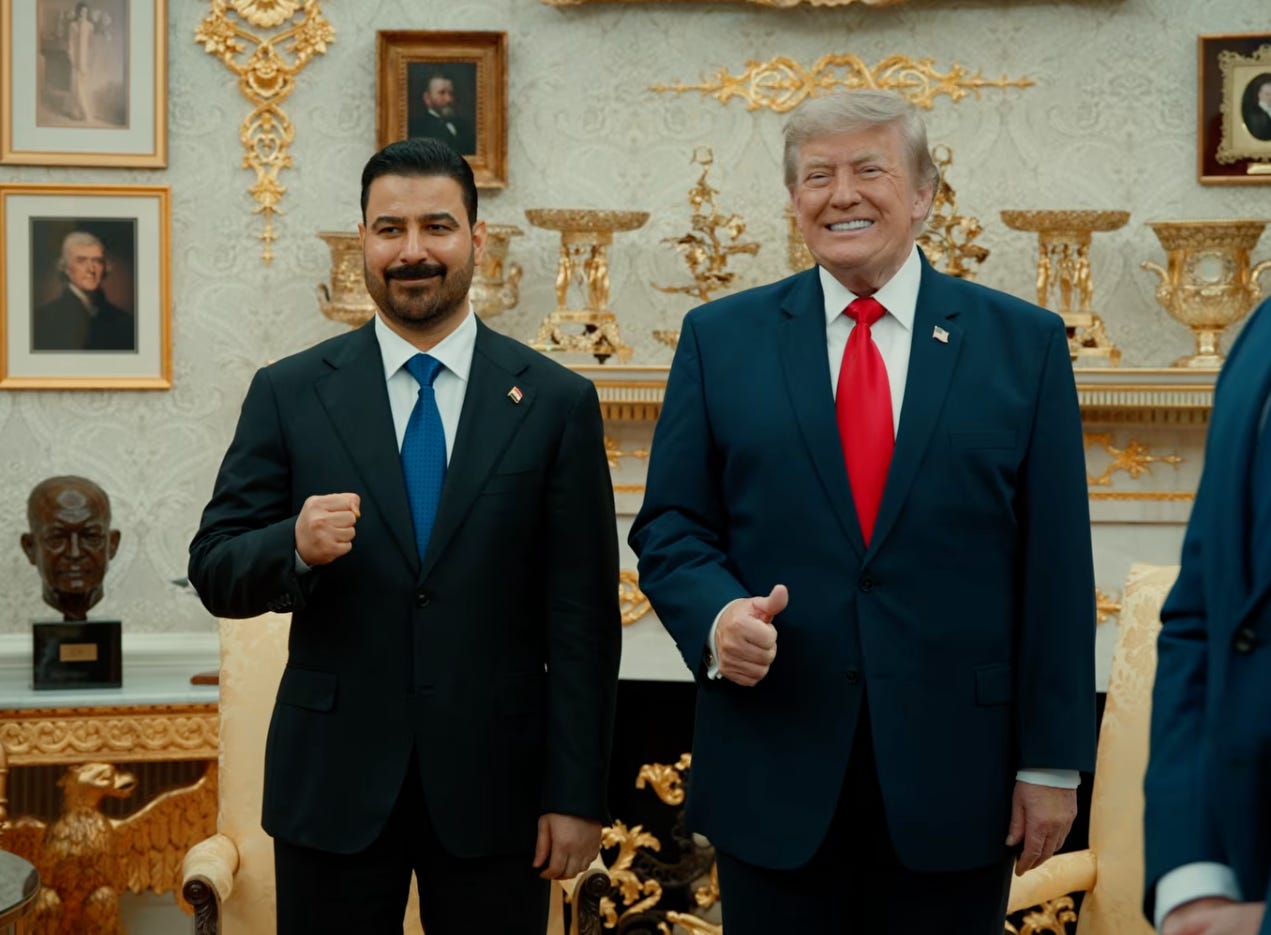
He says as much elsewhere in the meeting, almost as an aside. Lunch with the Iraqi delegation had not been on the schedule. Trump ordered it anyway.
“I like them,” he explained.
That was the whole rationale. A White House can improvise lunch for an afternoon. It cannot safely improvise an international order unless the object is not order at all, but a succession of transactions in which access, protection, and survival depend upon pleasing one man.
The Iraq bilateral meeting offered a lighter version of that system. Trump praised the prime minister’s appearance, claimed his electoral victory as one of his own successful endorsements, predicted that he would remain in power for a long time and repeatedly advertised Iraq’s oil reserves. American forces would leave by September 30, the prime minister said, while American companies would remain. Trump enthusiastically agreed. The soldiers could go home. The oil companies were just arriving.
The performance felt unprepared because the administration increasingly regards the people who prepare American diplomacy as part of the problem.
The Department That Wasn’t in the Room
The Financial Times recently published what amounts to an obituary for the United States Department of State.
More than half of American ambassadorships were vacant as of late June, including major posts in Germany and Saudi Arabia. Nearly 80 percent of US embassies in Africa had no ambassador. Of Trump’s 101 second-term ambassadorial nominations, only nine had gone to career diplomats.
The department’s workforce had fallen by more than 3,000 people, over 20 percent, since Trump returned to office.
The losses extend beyond head count. Career officers describe an institution in which experienced diplomats are frightened to report candidly, policy papers disappear into internal voids, and foreign governments increasingly bypass Foggy Bottom because State Department officials may know no more about Trump’s intentions than their overseas counterparts.
One administration official reduced the modern embassy’s role to that of a “logistical hub.”
The Iraq bilateral could have been produced as an instructional video. Trump spoke about Iraq’s election as though the prime minister had won a Republican primary with his endorsement. He said he had “fought” for him, contrasted him with another candidate Trump considered bad for America and predicted that the man’s influence would spread throughout the Middle East.
The Foreign Service was created a century ago to replace precisely this kind of patronage system with professional expertise. Trump is reversing the arrangement. Foreign leaders once cultivated the United States government. Now they cultivate the ruler’s household.
Flattery becomes a form of access. Foreign leaders praise Trump’s instincts, describe him as a miracle maker, and arrive bearing commercial opportunities. A well-placed compliment may produce lunch, a call to the right person may erase a policy, and a promise of investment may replace a fee scheduled to take effect in five hours.
The lunch was improvised. So, increasingly, is American foreign policy.
The Toll That Wasn’t a Toll
The Strait of Hormuz provides the cleanest demonstration of the method because the full sequence, lined up hour by hour, lasted less than two days.
On Monday, July 13, in the Oval Office, CNN’s Kaitlan Collins asked Trump whether months of bombing Iran had simply become “the new normal for the American people.”
His answer measured the war against Vietnam.
“We were in Vietnam for 19 years,” Trump said. “We’re here for four months.”
Pressed on who would pay for continued American protection of the strait, he named the beneficiaries, Israel, Qatar, Saudi Arabia, Kuwait, Bahrain and the United Arab Emirates, and made the demand explicit.
“I wanna be reimbursed,” he said, “because we’re protecting a very rich portion of the world.”
The same day, a Truth Social post made the arrangement formal. The United States would become “THE GUARDIAN OF THE HORMUZ STRAIT” and collect a 20 percent fee on cargo passing through it.
Less than two days later, the fee was gone.
By Trump’s account, Gulf monarchs began calling him once the proposal landed. Five hours before it was due to take effect, he scrapped it, citing “highly productive conversations with Middle East leadership” and promising enormous new investments in the United States instead.
He told Fox News why he preferred the replacement.
“I don’t like the idea of a fee,” Trump said.
He then explained that the strait “has to remain free” while affirming that the American blockade of Iranian ports would continue.
The fee disappeared. The blockade did not.
Tehran did not mistake the change for de-escalation. Iran’s deputy foreign minister said the renewed blockade had effectively dismantled the Islamabad memorandum that was supposed to provide a path toward a lasting settlement.
What happened was not that America stopped charging for control of the chokepoint. One form of payment was exchanged for another. A maritime toll became investment pledges. Direct reimbursement became commercial access. The instrument changed. The chokepoint did not move.
Trump had attempted to turn military protection into a billable service. When the invoice produced resistance, he accepted a different form of compensation and declared the negotiation a triumph.
That may be the purest expression of Trumpian diplomacy: nothing is free, not even the freedom of navigation he insists must remain free.
Next Week, Again
If the toll reversal demonstrates the method’s flexibility, Trump’s threats against Iran’s civilian infrastructure demonstrate its stagnation.
This is the fourth performance of essentially the same script.
On March 21 and 22, Trump issued a 48-hour ultimatum to reopen the Strait of Hormuz or face the “obliteration” of Iran’s power plants, beginning with the largest.
On March 23, the deadline was quietly postponed for five days while talks continued.
On March 30, the threat returned, now expanded to include desalination plants if Iran failed to agree to peace terms “shortly.”
On April 7, Trump announced another hard deadline and threatened in a national address to bomb Iran “back to the Stone Age.”
Then, on July 14, the same ultimatum returned. The power stations were back on the target list. Bridges had been added. The deadline was once again “next week.”
In his Fox News interview, Trump narrated the planned escalation without apparent irony.
American strikes would intensify night after night. Then, he said, “next week comes the power plants. Next week comes the bridges.”
“We’re going to knock out all of their power plants,” Trump said. “We’ll knock out all of their bridges unless they get to the table and negotiate.”
Three previous versions of the ultimatum expired without the threatened nationwide infrastructure campaign materializing. The fourth arrived with the same theatrical intensity as the first, as though the earlier deadlines had never existed.
This is a script being rerun because it generates headlines without requiring the administration to explain what happens after the final deadline, the next deadline or the deadline after that.
Pickaxe Mountain follows the same rhythm in miniature. Trump has repeatedly threatened to give the suspected underground nuclear facility “a nice, big, fat shot right in the front door.” Yet American forces did not strike it during either the Twelve-Day War or Operation Epic Fury.
Outside experts have questioned whether even America’s largest conventional bunker-busting bombs could reliably destroy a facility believed to be buried so deeply. The repeated threat may therefore conceal a capability problem. Trump keeps promising an attack whose success the military may not be able to guarantee.
But the most revealing line in the interview was broader than any particular target.
“The only way you can negotiate with these people is through strength,” Trump said. “And the only strength is military strength.”
That is the operating doctrine behind the dismantling of professional diplomacy.
Expertise is not strength. Alliances are not strength. Credibility, international law, regional knowledge, economic leverage and negotiated safeguards are not strength. Only the ability to destroy something counts.
Trump said America’s objectives had already been achieved. Iran’s military capability had been reduced to a fraction of what it had been, he claimed, and would require 20 years to rebuild.
Yet the bombing would continue until he personally said it had been enough.
If the military objectives are complete, the remaining objective is punishment.
He said Iran must negotiate. Minutes later, he said, “I don’t want to negotiate now.”
His representatives were still communicating with Tehran, but the message was not an offer, a framework or even an exchange of positions.
“You better make a deal,” Trump summarized, “or you’re not going to have anybody left.”
Diplomacy had become the paperwork accompanying surrender.
Save the Oil, Bomb the Grid
Trump insisted that American forces were being careful with Iranian civilians.
He made that claim while threatening the electrical systems that keep hospitals functioning, pump drinking water, operate sewage treatment plants, refrigerate food and medicine and sustain civilian communications.
No particular power plants were identified as serving a defined military operation; Trump threatened all of them. Nor did he specify individual bridges whose destruction might offer a concrete military advantage. Instead, the country’s bridges were treated collectively as leverage to compel political submission.
Attacking a particular bridge or power facility is not automatically a war crime. Civilian infrastructure can lose its protected status if it is being used in a manner that makes an effective contribution to military action and if destroying it offers a concrete and direct military advantage.
Even then, the attacker must distinguish between civilian and military objects, take feasible precautions and refrain from an attack when the expected civilian damage would be excessive in relation to the anticipated military advantage.
A blanket campaign against an entire electrical grid is something else.
Amnesty International concluded that Trump’s earlier threats against Iran’s power infrastructure raised grave concerns under international humanitarian law and could amount to war crimes if carried out. The International Criminal Court has issued arrest warrants for Russian commanders accused of directing attacks on Ukrainian power infrastructure, alleging war crimes involving attacks on civilian objects.
The precise facts and jurisdictions are not identical, but the underlying legal concern is.
Trump is not describing civilian suffering as an unfortunate consequence of striking a particular military target. He is describing civilian deprivation as the instrument intended to force Iran’s government to yield.
The contrast with Iran’s oil infrastructure is extremely revealing. In the same interview, Trump explained that he had instructed the military to spare the oil facilities on Kharg Island.
“I said hit everything but the oil,” he recalled. “Don’t touch that, because I don’t want that in terms of the world economy.”
The oil was too valuable to destroy. The electrical grid was being saved for last. Trump’s distinction was not between civilian and military necessity. It was between assets whose destruction might disrupt markets and infrastructure whose destruction might terrorize a population into submission.
Protect the commodity, but hold the society hostage.
That same distinction connects Iran to Iraq and Venezuela.
We Have Venezuela
The clearest window into how Trump thinks about energy and sovereignty came not from a threat but from a boast.
At a May 27 cabinet meeting, Trump described the United States as having so much oil that it barely needed to think about imports. Then he expanded the national ledger beyond America’s borders.
“Now when you add Venezuela to it,” Trump said, “we have, I think, 64 percent of the world’s oil.”
The number is nowhere close to accurate. No plausible combination of proven American and Venezuelan reserves approaches 64 percent of the global total. But the falseness of the figure matters less than its grammar. Trump did not say Venezuela had become an important trading partner. He did not describe a commercial agreement or strategic alliance. He incorporated the country’s reserves directly into the American column.
“We have Venezuela.”
It was the language of acquisition: the way a conglomerate describes a newly absorbed subsidiary when adding its assets to a consolidated balance sheet.
That might be dismissed as another Trumpian shortcut if American policy did not mirror the possessive construction so precisely.
The US Treasury receives most of the revenue from Venezuela’s exports and releases money back through the Venezuelan banking system under conditions established by Marco Rubio’s team. Washington determines who may spend the money and for what purposes.
The United States drafts the sanctions licenses that decide which companies may operate in Venezuela and under what terms. American officials have prioritized the entry of US firms over European producers already established in the country.
Rubio weighs in on major government appointments. Venezuela’s interim president, Delcy Rodríguez, maintains a direct relationship with him through Spanish-language WhatsApp messages that reportedly include policy discussions, gossip, birthday greetings and selfies.
When Venezuela’s foreign minister issued a mild condemnation of the American attack on Iran, Washington instructed Rodríguez’s government to remove the post and warned against supporting US adversaries publicly. The statement disappeared.
When Fox News approached Rodríguez for an interview, she reportedly said Trump would first have to approve it. Trump loved the story and repeated it to others as evidence of her deference.
Control over revenue. Control over commercial access. Influence over appointments. Authority over foreign policy. Preferential treatment for American companies. An unelected local government dependent upon Washington’s continued approval.
That is what “have” is carrying in “we have Venezuela.”
It was not merely a slip. It was a fairly accurate one-word summary of the arrangement.
American officials themselves reportedly refer to Rubio as Venezuela’s “viceroy,” a title without a close American analogue since L. Paul Bremer governed occupied Iraq in 2003.
Rubio does not need to relocate to Caracas. He effectively directs key parts of the country from Washington. He helps control Venezuela’s finances, sanctions regime and access to its most valuable natural resource. Rodríguez submits major decisions for American review while the timetable for democratic elections remains indefinite.
Rubio once presented himself as a champion of Venezuelan democracy. He has now bypassed María Corina Machado, the country’s most prominent opposition leader, in favor of Maduro’s former vice-president because Rodríguez controls the existing machinery and has obeyed American instructions.
The regime’s leader was removed, while much of the regime remained and Washington acquired the keys.
It is managed dependency more than any promotion of democracy.
Trump’s energy arithmetic makes the purpose plain. Venezuela has become an overseas reserve entered on America’s strategic balance sheet. The country’s debts remain Venezuelan. Its instability remains Venezuelan. Its sovereignty has become negotiable, and its oil appears under “our assets.”
Ownership, Extraction, Preservation
Set Venezuela beside Iraq and Iran, and the pattern comes into focus.
Venezuela’s oil is something America already possesses.
Iraqi oil is something American companies are going in to “take out,” in Trump’s words during the bilateral.
Iranian oil is something to preserve even in the middle of a war, while the country’s power plants, bridges and water systems become bargaining chips.
Ownership. Extraction. Preservation.
Three different postures toward sovereignty, each determined less by the independence of the country than by the status of its resources and the compliance of its government.
Venezuela has submitted to American management, so its oil can be counted as ours.
Iraq has accepted American commercial partnership, so its leader receives praise, lunch, and predictions of regional greatness.
Iran has resisted, so its population is presented with a countdown to darkness.
The formula is remarkably consistent.
Friends receive grants. Clients receive protection. Compliant governments receive controlled access to their own money. American companies receive resources. Resistant populations receive ultimatums.
A State Department Repurposed
The State Department is not simply being dismantled. It is being converted. The professional functions capable of complicating presidential action are the ones being hollowed out: regional expertise, institutional memory, candid analysis, dissent channels and experienced diplomats able to warn that a threat is illegal, an objective is unattainable or an adversary understands the negotiating file better than Washington does.
The coercive and administrative machinery remains in excellent condition.
The department is now offering grants of up to $3 million to European civil-society groups, educational institutions, nonprofits and even for-profit organizations willing to advance the administration’s preferred ideas about migration, censorship, national sovereignty and “Western civilizational heritage.”
Nearly $5 million is available to cultivate what the administration calls resistance to Europe’s current political trajectory.
The State Department insists it will not finance European political parties. It merely proposes to fund the ideological infrastructure surrounding movements it favors, which is apparently considered entirely different because the checks will not have campaign logos printed on them.
A department built around a formally nonpartisan professional service is being emptied while its money is redirected toward political alignment abroad.
The administration rails against foreign interference when another country comments on American democracy. Yet it is openly using American public funds to influence Europe’s internal debates over migration, speech regulation and national identity.
Sovereignty is sacred until a sovereign country adopts policies Trump dislikes.
The institution has not been replaced by nothing. It is being divided into useful and inconvenient components. The inconvenient components are the experts who might disagree.
The useful ones can distribute grants, enforce sanctions, control revenues, arrange commercial access and administer punishment.
Trump is not withdrawing America from the world. He is removing the institutions that once interpreted the world, converted power into policy and occasionally restrained presidential impulse. The machinery of knowledge and restraint is being dismantled. The machinery of extraction and coercion remains fully operational.
The Countries Are Beside the Point
None of this is really about any single country. It is one operating model expressed at different levels of coercion: a lunch invitation extended because a foreign leader is likable, a naval blockade converted into an investment solicitation, a cabinet appointment cleared over WhatsApp, an electrical grid held hostage while the oil fields are carefully spared.
Whether the setting is a Gulf monarch’s phone call, a Caracas text thread, an Iraqi bilateral or a Fox News interview, American foreign policy is now conducted as a series of personal transactions performed for an audience.
Foreign leaders become endorsees. Embassies become logistical hubs. Sovereign revenues become allowances. National resources become deal flow. War becomes a sequence of theatrical deadlines followed by another round of bombing until Trump decides the punishment has been sufficient.
Diplomacy assumes an interlocutor whose interests, history and sovereignty cannot simply be wished away.
Trump’s foreign policy begins somewhere else entirely.
We produce our own oil.
We have Venezuela.
Iraq’s oil is coming out.
Iran’s oil must be protected for the world economy.
The countries themselves are almost beside the point.
This info makes me truly sick. The U.S. has become the thug of the world. Who will ever trust us again?
‘The devil is in the details’……in this case literally. The details of these lesser reported issues, such as Venezuela and the staffing of African consulates, reveal Trump and his regime for what they truly are - racist white supremacist dictators who will take by force and then plunder by coercion.
I had no knowledge of the inner workings of the Venezuela file. And now that I do, I find it exceptionally disturbing. But why am I surprised? After all….kings colonize. And my country is on his wish list. 🇨🇦