


Good morning! Two unarmed men were killed by immigration agents within six days. Neither was the person ICE had gone looking for. Neither encounter was recorded by an agent’s body camera. In both cases, the government reached for some version of the same explanation: the vehicle moved, the officer felt threatened, and the dead man had therefore transformed an automobile into a weapon.
For approximately one day, even the Department of Homeland Security seemed to recognize that this might be a problem.
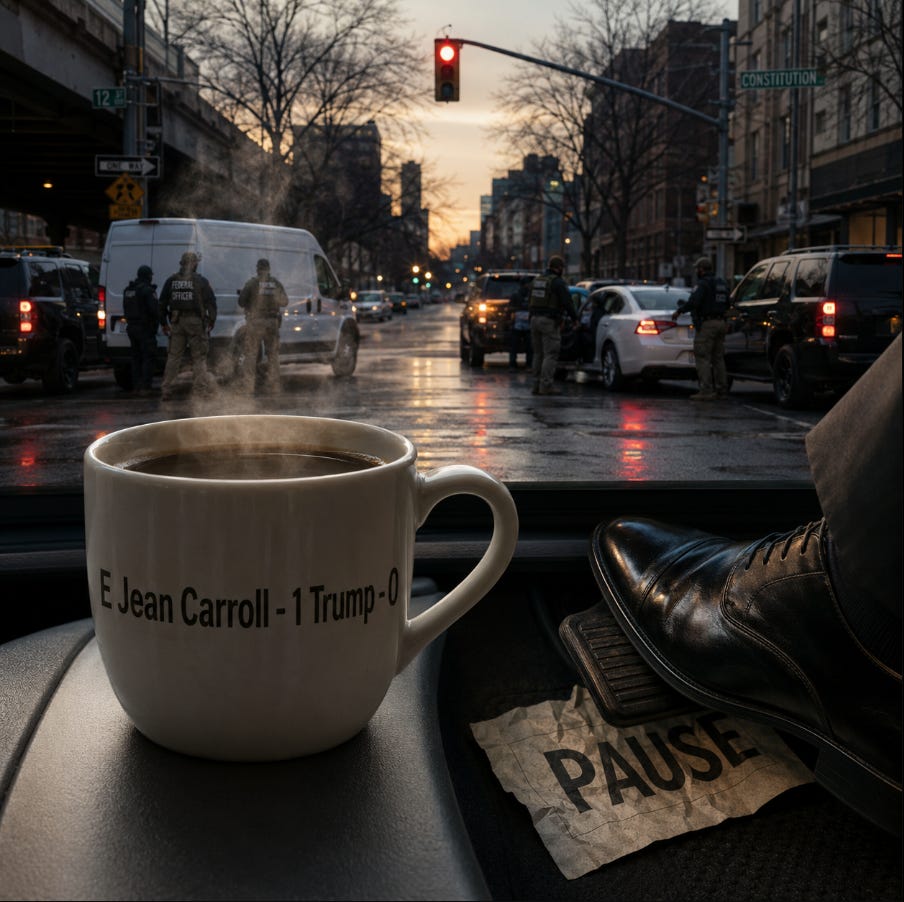
On Tuesday, federal immigration officers were instructed to suspend most traffic stops while DHS reviewed its procedures and considered additional training. The pause was not absolute. It reportedly included an exception for people the government classified as especially dangerous. It was the smallest imaginable application of the brakes after two men had been killed in nearly identical encounters, witness testimony contradicted the government’s accounts, and the agents responsible had failed to wear the body cameras DHS previously promised would become standard equipment.
Then Donald Trump noticed that somebody in his administration had attempted restraint.
By Wednesday morning, the White House had overturned the order. Trump declared on Truth Social that ICE could not surrender what he called one of its most important “Crime Fighting tools, THE TRAFFIC STOP!” Once again, capitalization was deployed where judgment might otherwise have gone. He accused Democrats of playing into criminals’ hands, repeated an inflated claim about 25 million people entering the country under Joe Biden, demanded that ICE keep producing favorable crime statistics and assured the officers that they were “loved and respected in America.”
He did not mention either of the men they had killed.
He offered no condolences to their wives or children. He did not ask why ICE agents were conducting high-risk vehicle stops in unmarked vehicles without body cameras. He did not wait for the investigations to determine whether the officers had followed policy or whether the policy itself had manufactured the danger. DHS had spent one day trying to contain the fallout. Trump saw the pause, diagnosed weakness and ordered everyone back into traffic.
The first man was Lorenzo Salgado Araujo, a 52-year-old Houston builder who had lived in the United States for decades. On the morning of July 7, he drank his coffee, took the meal his wife had prepared, said goodbye to his dog and left the house he had built. He picked up three members of his construction crew in his white van and headed toward a job site.
ICE was not looking for him. Agents were conducting what they described as a targeted operation, but Salgado was not the target. The government later acknowledged that agents apparently focused on the van because one of its passengers resembled the person they wanted. Unmarked SUVs began pursuing it. According to Representative Sylvia Garcia, they used no sirens and carried no cameras recording the encounter.
ICE says Salgado rammed an agency vehicle and tried to run down an officer. The three men inside the van tell a radically different story. They say no agent was ever directly in its path. They say officers stood along the passenger side and fired through the open window after the van had stopped. Victor Salgado, Lorenzo’s younger brother, was sitting in the passenger seat. His attorney says an agent held a gun directly in front of Victor’s face and fired past him at Lorenzo.
Then ICE handcuffed the surviving witnesses and took them away.
Daniel Tirado Pantoja, Jose Trinidad Rojas and Victor Salgado were confined at the Montgomery Processing Center in Conroe. Tirado has reportedly lived in this country for 30 years, is married and has a teenage son who is a United States citizen. Rojas is a 51-year-old construction worker who has also lived here for decades. Victor watched his older brother die from the passenger seat.
The agency implicated in the shooting became the agency issuing the justification, preserving much of the evidence, imprisoning the witnesses who contradicted it and possessing the power to remove those witnesses from the country.
ICE is investigating itself, controlling the shooter, the official narrative, the physical evidence, the surviving witnesses and the witnesses’ ability to remain available for an investigation.
The Harris County district attorney has now certified all three men as material witnesses, an important step toward obtaining U visas that could prevent their deportation while the killing is investigated. Houston’s mayor and police chief have also asked the Texas Rangers to conduct an independent inquiry. The requests are necessary precisely because ICE has demonstrated that it cannot be both a party to the shooting and the sole author of its history.
Six days later, the vocabulary traveled north.
On Monday morning, immigration officers were surveilling a residence in Biddeford, Maine, connected to someone with a final removal order. They attempted to stop a vehicle leaving the property. The driver was not the person named in the operation.
An officer shot him dead.
The Colombian Embassy identified him as 26-year-old Johan Sebastián Durán Guerrero. Friends and advocates say he lived nearby with his wife and young daughter and was authorized to work in the United States. According to reporting from Maine, his wife and daughter witnessed the aftermath; the little girl was still wearing her pajamas.
The Maine attorney general’s initial statement said the driver attempted to flee “in the direction of the officer.” DHS first offered the more dramatic claim that he had tried to use the vehicle as a weapon, then shifted to saying the officer fired because the fleeing car threatened “public safety.” Those are not identical accounts.
A car moving in someone’s direction describes geography. Trying to run over someone alleges intent. “Weaponizing” a car converts disputed motion into an attack and places the dead man on trial before investigators have finished marking the scene.
No ICE body camera recorded the crucial moment.
Security footage from a nearby business apparently captured at least part of the encounter, and Maine Attorney General Aaron Frey’s office is leading a state investigation with assistance from Maine State Police, local departments and federal authorities. The officer has been placed on leave. That is standard procedure, not a finding of wrongdoing, but the state-led investigation at least provides the possibility of scrutiny beyond the department whose personnel pulled the trigger.
The government’s recurring “weaponized vehicle” explanation would be more persuasive if video and witnesses did not keep interfering with it.
Renee Good was killed in Minneapolis after DHS said she had used her car as a weapon. Bystander footage challenged the administration’s description. Ruben Ray Martinez, a 23-year-old American citizen, was shot during a Texas traffic encounter in March 2025; ICE’s involvement was not disclosed publicly until nearly a year later, and video complicated the government’s claim that he intentionally ran over an agent.
Last week, Salgado became the tenth person fatally shot by ICE or Customs and Border Protection personnel since Trump returned to office, according to a Guardian review. Durán Guerrero appears to bring that broader count to eleven, although different news organizations use narrower categories when counting only deaths during immigration operations. Five of the eleven were reportedly inside vehicles.
This is not a statistical curiosity. It is a tactical pattern.
Responsible police departments have spent decades discouraging officers from firing into moving vehicles except in the most extraordinary circumstances. Killing or incapacitating the driver can leave the vehicle moving without control, creating precisely the public danger the officer supposedly intended to prevent. Former ICE officials have asked why agents are initiating these confrontations at all when people can often be arrested at homes, workplaces or other locations where a vehicle cannot become part of the encounter.
ICE has apparently found a more efficient solution: create the hazardous stop, place the agent near the car and then cite the hazard as justification for shooting the driver.
The deaths do not end on the street. Human Rights Watch and Physicians for Human Rights counted 52 deaths in ICE custody during the first 500 days of Trump’s second administration. Their analysis found that the mortality rate was rising alongside the rapidly expanding detention system, while public information about medical treatment and the circumstances surrounding many deaths remained limited. Congress nevertheless approved roughly $70 billion for immigration enforcement in legislation signed last month, including approximately $38 billion for ICE and $26 billion for Customs and Border Protection.
The result is an agency swimming in money but somehow unable to provide its officers with equipment that small municipal police departments have used for years. Biddeford’s mayor noted that his city’s officers have worn body cameras for nearly a decade. ICE can apparently finance detention centers, tactical deployments, unmarked vehicles and publicity operations with names like “Catch of the Day,” but recording an officer before he kills the wrong man remains administratively elusive.
The missing cameras are not a technological failure. They are an accountability choice.
So are the traffic stops.
For a few hours, DHS appeared to understand that the tactic needed review. Two unarmed men were dead. Neither was the target. The surviving witnesses in Houston said the government’s account was false. The Maine account shifted within hours. No agent had recorded either shooting.
Trump personally reversed the pause.
That intervention eliminates the convenient “bad apple” defense. Two deaths prompted the department to suspend the tactic; the president personally ordered it restored. What happened can no longer be dismissed as the conduct of individual officers operating at street level. It is now a policy maintained after its lethal risks became impossible to deny.
Trump has been warned in blood. His response was to demand better statistics. The next death will not be an unforeseeable accident. It will be the foreseeable cost of a tactic the president was specifically invited to reconsider and chose to preserve. The administration noticed the bodies, paused for a day and decided the bodies were acceptable.
That is the important distinction between negligence and doctrine.
Elsewhere in domestic news, however, the American legal system located two small electrical outlets still connected to reality and administered Donald Trump a pair of badly needed jolts.
E. Jean Carroll has received the $5.625 million Trump owed her after a unanimous federal jury found him liable for sexually abusing her and defaming her when she spoke publicly about it.
The original award was $5 million. Trump placed the money in escrow while pursuing appeals, apparently reasoning that time is free when every legal bill is somebody else’s problem. The Supreme Court declined to review the verdict, and Judge Lewis Kaplan ordered the funds released after concluding that Trump had been stalling for years.
The delay added more than $600,000 in interest, making litigation one of the few Trump business strategies that has reliably increased another person’s wealth.
Carroll’s lawyer confirmed that the payment arrived Monday. Carroll announced on Substack that “the eagle has landed.” Trump’s lawyers, unable to prevent the transfer, responded with their traditional legal formulation: witch hunt, Democrats, hoax and several tablespoons of aggrieved punctuation.
Actual Americans serving on the jury unanimously found against him. Appellate judges left the verdict intact, and the Supreme Court declined to intervene. At last, the money cleared escrow.For once, Trump’s version of events bounced.
This was only the smaller Carroll judgment. Trump is still fighting the separate $83.3 million award another federal jury imposed for his earlier defamation of her. That second verdict is the much larger invoice generated by his inability to stop attacking a woman after the legal system repeatedly advised him that shutting up was available at no cost.
Trump’s week of involuntary wealth redistribution did not end there.
A federal judge in Florida also dismantled the judicial legitimacy behind his extraordinary attempt to sue the government he controls, negotiate a settlement with officials who work for him, protect himself and his family from tax audits and create a $1.776 billion taxpayer-financed fund for allies who believe the government has treated them unfairly.
Trump, his sons and the Trump Organization filed a $10 billion lawsuit against the IRS and Treasury Department over the illegal disclosure of his tax information. That underlying leak was real and unlawful. The contractor responsible was prosecuted and imprisoned.
The solution, however, was not supposed to involve the president sitting on both sides of the negotiating table, reaching across to shake his own hand and asking a federal court to admire the settlement.
Judge Kathleen Williams observed the small constitutional difficulty that Trump was the plaintiff while also serving as the president responsible for the agencies named as defendants. The parties displayed no meaningful disagreement. Acting Attorney General Todd Blanche, Trump’s former personal lawyer, felt able to speak for both the people suing the government and the government being sued.
This is generally discouraged in an adversarial legal system, although it remains popular in professional wrestling.
Williams found that the lawsuit had been filed for an improper purpose and that Trump and his lawyers had acted in bad faith to manipulate the courts. She concluded that the case was an effort to place a judicial “patina of legitimacy” over an agreement that would confer immunity on people and entities affiliated with the president and earmark billions in public money for grievances Congress had never defined in law.
The judge stopped short of formally declaring every provision of the private agreement void. She did, however, bar Trump and the government from invoking the supposed settlement in official proceedings as the product of legitimate litigation. The distinction matters. The parties may still wave their piece of paper at one another in private, but they cannot use the court as a decorative notary stamp for the president’s arrangement with himself.
The anti-weaponization fund had already been shelved after provoking the rare bipartisan congressional response of, “Wait, you want how much?” But the audit-immunity provision remained a live concern. Williams’s ruling prevents the administration from claiming that a genuine judicial dispute produced that shield.
She also referred Trump lawyer Alejandro Brito to the Florida Bar for discipline, temporarily blocked another attorney from filing in her district and directed that her order be sent to professional authorities considering complaints involving Blanche and Associate Attorney General Stanley Woodward.
Trump had hoped to establish that nobody wins a lawsuit against Donald Trump quite like Donald Trump. Judge Williams concluded that there had never been a real contest.
It is encouraging to learn that somewhere inside the federal judiciary, at least one official can still count the players and notice that both teams are wearing the same uniform.
The contrast with the ICE story is difficult to miss.
When federal agents kill people, Trump insists that accountability would weaken the government. When federal courts order Trump to pay a judgment or refuse to bless his self-dealing, he insists that accountability is persecution.
The doctrine is entirely consistent. Force directed outward is strength. Law directed inward is a witch hunt. An immigrant’s moving vehicle becomes a weapon. A unanimous jury becomes a hoax. A collusive settlement becomes justice. The only illegitimate exercise of government power is the one that produces consequences for Donald Trump.
Still, E. Jean Carroll has her money, the IRS arrangement has lost its judicial disguise, and federal and state investigators in Texas and Maine now have an obligation to determine why two men who were not ICE’s targets ended up dead. That is not remotely enough.
On mornings like this, we take our accountability wherever we can find it, even if it arrives in escrow, wrapped in sanctions and accruing interest.
Before I close, I want to thank everyone who sent well wishes about my stiff neck. Marz and I did not succeed in seeing a medical professional. That was partly a consequence of living in a rural area where availability is limited, and partly because my options have been narrowed by the health-care system that people like the late Lindsey Graham and Mitch McConnell spent their careers protecting, one that has helped price supplemental coverage beyond my budget.
We did manage to acquire what now resembles the entire over-the-counter aisle of a small pharmacy: lidocaine patches, CBD creams, assorted pain remedies, hot treatments, cold treatments and enough topical products to make me detectable from low Earth orbit.
Marz has been attentive, although his medical qualifications remain largely ceremonial. His treatment philosophy consists primarily of staring at me, following me from room to room and occupying whichever piece of furniture would be most useful at the time.
We are powering through somehow.
Thank you for the kindness, the concern and the good wishes. They have meant more than you know.
I still have a feeling that so many of these newer ICE "officers" are from among the ranks of pardoned J6 rioters.
Somewhere there's a secret betting pool: which "team" can collect the most notches on their guns?
Minnesota was fastest out of the gate but faded early. Texas thought they were a shoo-in, but don't place yours bets just yet - the surprise dark horse Maine is moving up on the outside.
I would not be at all surprised if that's what these goons are doing..
[On a different topic: my sympathies about your neck. Would you be willing to post a brief note as to how well CBD ointments are working for you?]
What We the People must do to secure the blessings of liberty to ourselves and our posterity after reelecting this mob boss and surviving his mafia regime feels more and more like a special RICO case followed by a slate of constitutional amendments to make sure this kind of thing doesn't happen again followed by a administration dedicated of Truth and Reconciliation.