


Good morning! Four months ago, Defense Secretary Pete Hegseth announced that the United States had “achieved every single objective” in Iran. Yesterday, Senator Jon Ossoff offered him repeated opportunities to say whether that declaration had been accurate.
Hegseth, perhaps testosterone-deficient by his own new standards, did not muster the gumption to answer yes or no.
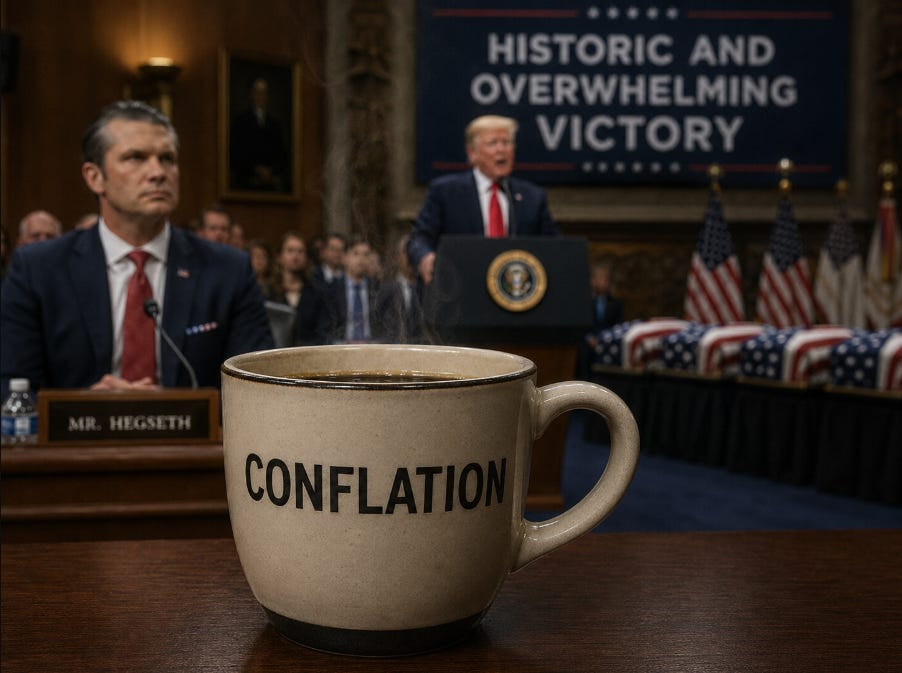
Ossoff reminded him that, on the fourteenth day of the war, he had declared Iran’s military “destroyed” and “combat ineffective.” Three weeks later, Hegseth called Operation Epic Fury a “historic and overwhelming victory,” said Iran would remain combat ineffective for years and announced that every objective had been achieved. Was that true?
Hegseth spoke about Iran’s vanished navy, buried missiles, damaged industrial capacity and the incomparable power of the American military. Ossoff tried again. Was the statement accurate? Yes or no?
Still no answer.
Hegseth did manage to answer a simpler question. Ossoff asked whether the Pentagon was requesting roughly $68 billion through the new supplemental.
“Sixty-seven,” Hegseth corrected him.
“Yes.”
The administration has therefore reached an awkward stage in its historic and overwhelming victory. Every objective has been achieved, the enemy has been destroyed, its navy is resting comfortably at the bottom of the sea. Sustaining all this success, sadly, will require another $67 billion immediately.
The United States has now bombed the country for an eleventh consecutive night. Jordan reported that Iran launched six missiles toward the kingdom on Wednesday. Four were intercepted; two fell in remote, uninhabited areas. Iran claimed it struck Jordanian air bases, drone facilities and helicopter storage sites, although those damage claims have not been independently established in the information available here.
The missile program Hegseth called “functionally destroyed” continues to function. Senator Patty Murray reminded him of his April 8 declaration: “Their missile program is functionally destroyed, launchers, production facilities and existing stockpiles depleted and decimated and almost completely ineffective.” She then asked how Iran could still be firing at American bases and ships three months later. Hegseth finally conceded, “I acknowledge they still have capabilities, no doubt,” explaining that some missiles had survived inside underground facilities even as he insisted Iran remained weaker than at any point in decades.
This is the administration’s new working definition of “functionally destroyed”: damaged enough to support the previous victory speech, but functional enough to support the next appropriation request.
Hegseth also said Iran’s conventional navy had been completely sunk. Yet the maritime war is growing rather than disappearing. Traffic through the Strait of Hormuz remains badly disrupted. Secretary of State Marco Rubio appeared at the ASEAN summit warning that Iran’s effort to control the strait and collect tolls represented “a very dangerous precedent.” That is a perfectly reasonable principle, although it would be more convincing had President Trump not recently proposed that the United States charge ships a 20 percent toll for passing through the same international waterway.
Senators raised that small philosophical wrinkle with Hegseth. He had previously insisted that international waters belonged to all nations and that Iran had no right to “tax, toll or control” them. Had he talked Trump out of imposing America’s own toll? Hegseth could not bring himself to answer that either.
Hegseth has called the blockade “effectively impenetrable.” Rubio is now traveling overseas warning that Iran still has enough control over Hormuz to threaten the world economy. One could interpret that as evidence the blockade is not quite impenetrable. The administration prefers to interpret it as evidence that it urgently needs more money to maintain the impenetrability through which Iran continues to penetrate.
Iran has not simply escaped the boxes Trump built around it. Its allies have begun constructing another. The Iran-aligned Houthis announced a naval blockade against Saudi Arabia in the Red Sea. Two tankers carrying Saudi crude toward Asia reportedly turned around, and the EU’s naval force advised vessels linked to the US, Israel or Saudi Arabia to avoid the Red Sea and Gulf of Aden. The administration that had not yet reopened one strategic chokepoint must now worry about two. The best way to prevent a regional war was to start a bilateral one and wait for everyone else to join.
The human cost continued to arrive beneath the rhetoric. Trump plans to attend the dignified transfer at Dover of four American service members killed in the war. Al Jazeera placed the total at 18 dead and more than 450 injured. Rubio was asked about the rising casualty count. “Any time you’re in a combat zone there’s danger associated with it,” he replied. There is. There is also supposed to be a reason for placing Americans in that zone, an achievable objective for keeping them there, and a plan for bringing them home. “Combat zones are dangerous” is not an explanation. It is the sentence printed on the waiver after the administration has misplaced the strategy.
Hegseth described the supplemental as an “urgent necessary injection” while insisting it was no substitute for Trump’s full $1.5 trillion Pentagon budget. “Not funding this department at 1.5 trillion,” he declared, “I believe, is the greatest threat that our nation faces.”
The greatest threat facing the United States is Congress giving Pete Hegseth less than $1.5 trillion to manage.
Senator Patty Murray noted that the Pentagon received $150 billion through the Republican reconciliation law and a record $839 billion for fiscal 2026, roughly a trillion dollars for the year, while about half the reconciliation money remains unspent. Buried inside the new “Iran” request are $800 million to keep the National Guard in Washington, more than $1 billion for troops at the southern border, and $900 million for Caribbean boat strikes. Murray asked the obvious question: why had operations in Washington, at the Mexican border, and in the Caribbean suddenly become urgent components of the Iran war? Hegseth responded as he did to nearly everything asked of him: by blaming the Biden administration. But these bombs belong to Trump. So does the blockade. American service members are returning home during Trump’s war. At some point, a president who claims absolute credit for every sunny morning must accept partial ownership of the weather after lunch.
Hegseth disclosed that the current Pentagon estimate for the war is $37.5 billion, already higher than the previous estimate. The short, victorious war has become a financing arrangement with adjustable rates.
The nuclear justification is becoming equally difficult to follow. During Tuesday’s bilateral with Lebanese President Joseph Aoun, Trump said Iran would need “20, 25 years to rebuild,” only to add a moment later, “We’re not finished at all.” Asked whether Tehran had moved centrifuges into a mountain complex, he conceded, “We don’t have it on record. All we do is read the fake news.” Then came the threat: “We’ll be hitting that area pretty soon” and “very heavily.”
The sequence was unusually clear. Trump admitted he did not know whether the reported activity had occurred, dismissed the reporting as fake news, and threatened a major military strike based on it, in that order. Evidence is for people who have not yet ordered the bombers.
Satellite images examined in Al Jazeera’s reporting show fresh impact scars within the Bushehr nuclear complex. Iranian authorities say the country’s only working nuclear power plant continues to operate. An operating reactor is, in the most literal sense, not obliterated.
At the same time Trump is threatening to bomb Iranian sites where officials may merely be “thinking about nuclear,” his administration is reportedly preparing to sign a civilian nuclear agreement with Saudi Arabia that could eventually allow the kingdom to enrich uranium or reprocess plutonium on its own soil, under terms that may provide for less intrusive inspections than the UAE accepted under the 2009 “gold standard” arrangement. The administration’s regional doctrine can be summarized without much loss of nuance: Iran may not enrich uranium. Saudi Arabia may eventually enrich uranium. The deciding variable is not the proliferation risk but whether Westinghouse gets the reactor order.
Iran receives bombs for retaining enrichment capacity. Saudi Arabia may receive enrichment capacity without normalizing relations with Israel. Westinghouse receives prospective customers. Congress receives the arrangement after it is signed. When foreign policy is run like one of Trump’s leveraged businesses, each emergency becomes collateral for the next transaction.
The bilateral eventually wandered to Venezuela, where Trump offered his clearest vision of successful war. “We took over Venezuela,” he said. “We went to war with Venezuela and the war ended in one day.” He described removing millions of barrels of oil, and said the war had paid for itself “many times over.”
The Financial Times has since done the arithmetic Trump prefers to skip. Using shipping data and crude pricing, the paper calculated the US has collected roughly $13 billion in Venezuelan oil revenue since January. Venezuela’s own government set up a website to track its share of that money. It shows one entry: a $300 million transfer in March. A State Department official told Congress, without apparent irony, “It’s their money but... they have to get our permission.” Congressional Democrats have been requesting an accounting since January and have mostly received letters back, not answers; meaningful oversight may ultimately depend on the outcome of November’s elections.
Venezuela demonstrates the ideal Trump conflict: take over the country, seize the commodity, declare the population delighted, and keep the books closed. Iran is proving more troublesome because it remains capable of shooting back and has not yet accepted America’s preferred payment terms. “They haven’t seen anything yet,” Trump added. “We’ve been nice.” Hegseth had spent the hearing demanding money to replenish munitions. Trump was simultaneously telling the world the administration had been restraining itself. One shudders to imagine the surcharge for becoming unpleasant.
DARVO is a term coined by psychologist Jennifer Freyd to describe a predictable three-step response when someone is confronted with wrongdoing: Deny the conduct or responsibility, Attack the credibility or motives of the person confronting them, and Reverse Victim and Offender, recasting the accuser as the aggressor and the person facing scrutiny as the one under attack. Tuesday’s hearing offered the entire sequence in real time. Ossoff asked a factual question, was Hegseth’s declaration that “every single objective” had been achieved accurate?, four separate times. Hegseth answered with denial by evasion, replacing yes or no with speeches about Iran’s damaged navy, buried missiles and diminished military strength.
The attack-and-reversal stages arrived near the end of the hearing. Senator Gary Peters argued that American troops were serving honorably while their political leaders had failed to provide a winning strategy. Hegseth did not defend the strategy. Instead, he accused Peters of smearing the war fighters. Peters drew the distinction again: “You, sir, are the failure,” not the people on the front lines, but the officials who placed them there without a coherent plan. Hegseth escalated to “Trump derangement syndrome” and charged Democrats with political cowardice for refusing to fund the Pentagon.
That is DARVO adapted for government: deny the leadership failure, attack the lawmaker asking about it, then reverse the roles so the official demanding another $67 billion becomes the defender of the troops and the senator seeking accountability becomes their betrayer. Civilian leaders fuse themselves with the people in uniform, making criticism of the former sound like contempt for the latter. Accountability becomes disloyalty. Appropriations become patriotism. Strategy becomes whatever the president said most recently, and victory becomes a renewable subscription.
Iran escaped every box the administration built for it. The Houthis have begun building another in the Red Sea. And on Trump’s homemade front page, naturally, the boxes remain beautifully sealed, victory is complete, everyone is thrilled, and the bill belongs to somebody else.
If he won’t answer the question, then a senator should have the guts to put a hold on any vote on the DOW budget. Same with the other trumppets that refuse to answer questions related to their departments, nominations etc.
So the international waterways were totally functional until Trump started his war of choice. Then Iran closed the Strait of Hormuz. Now, it looks as though Iran's proxy, the Houthis, will close or have closed the Strait of Bab al-Mandab. Is this going to result in WW3 to clean up Trump's mess? I knew we would be in increased danger of WW3 with such an incompetent fumbler in power, but I didn't think he was going to start it.