


Good morning! Trump signed a surrender-shaped memorandum of understanding with a felt-tip pen in the palace of the Sun King and declared, “This was not easy. I can tell you,” while Emmanuel and Brigitte Macron looked on. The image does the work all by itself: Versailles, Sharpie, chandeliers, the ghost of empires past, and Donald Trump performing victory over a document that foreign analysts, U.S. hawks, U.S. doves, and even pro-Trump outlets are already reading as retreat with better lighting.
Versailles was built to project absolute power. Trump used it to stage the managed decline of American leverage as if it were triumph. The agreement offers a pause in hostilities, a reopened Strait of Hormuz, and a 60-day negotiating clock toward a real nuclear deal. But the central criticism is exactly what makes the palace signing so grotesque: the benefits to Iran are immediate or concrete, while the hardest concessions from Iran are deferred, diluted, or dressed up as promises Tehran had already made before the war began.
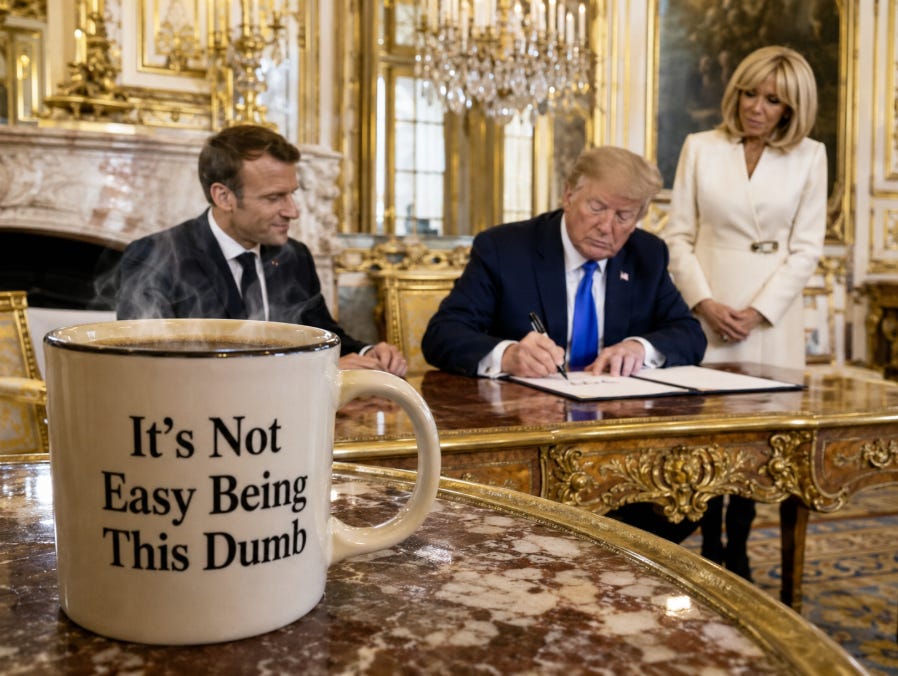
The topline this morning is simple: Trump and Iran’s President Masoud Pezeshkian have signed the U.S.-Iran memorandum of understanding electronically, and Trump then appears to have physically signed it at Versailles in the sort of made-for-television flourish that would be funny if the preceding months had not been so catastrophic. The formal Switzerland ceremony now seems beside the point; the document is in effect, the next-phase talks are headed to Geneva, and the 60-day clock has started ticking, unless it has not, because Trump has already downgraded the deadline from ultimatum to “as long as they’re behaving, I really don’t care that much.”
So much for “60 days or we bomb.” Or rather, not so much “so much” as “both things are true depending on which camera is running.” Trump says the deadline is flexible, but also says he will “bomb the hell out of” Iran if it violates the agreement. The MOU reportedly prohibits the threat or use of force, but Trump has helpfully clarified that the threat of force will remain available under the legal doctrine of “you can call it whatever you want, but it’ll probably happen.” Somewhere, a treaty lawyer is currently chewing through a chair leg.
The deal ends, or at least pauses, the U.S.-Israel war on Iran. It reopens the Strait of Hormuz. It begins the removal of the U.S. naval blockade. It allows Iranian oil to move again. It sets up a pathway to sanctions relief and asset unfreezing. It contemplates a $300 billion reconstruction and development framework for Iran, apparently funded by regional partners and licensed or approved by Washington. And in exchange, Iran reaffirms that it will not procure or develop nuclear weapons, which is the same position Iran has long publicly maintained, including under the 2015 nuclear deal that Trump spent years denouncing as the worst bargain in human history.
This is the humiliation buried under the gold leaf. The war was sold on maximalist objectives: stop the nuclear program, destroy the missile capability, end support for proxies, maybe even crack the regime open and let the Iranian people rise. But the MOU does not deliver those things. Missiles are not eliminated. Drones are not addressed. Hezbollah is not disarmed. The regime is still there. The nuclear question is largely deferred. Enrichment is still to be discussed. The stockpile issue is wrapped in the fog of “nuclear dust,” granite rubble, and Trumpian geology lessons.
Indeed, Trump has now decided that Iran having ballistic missiles is basically fair, because Saudi Arabia and Qatar have some too. This is an extraordinary reversal. For months, Americans were told the missile program was one of the reasons the war had to be fought. Now the president says missiles are not the same as nuclear weapons and Iran can have “some” in relative proportion. The goalposts have not moved; they have been packed into a shipping container and sent through Hormuz toll-free for 60 days.
The Strait of Hormuz is its own masterpiece of self-own. Iran closed or effectively disrupted the strait during the war, sending oil markets into panic and helping force the diplomatic exit Trump now calls victory. Under the MOU, Iran reopens it toll-free for 60 days. After that, Iran and Oman are expected to discuss the future management and possible fee structure. The United States fought a ruinous war and Iran may have discovered that threatening a global energy chokepoint is a viable subscription model.
U.S. doves are furious because the war was unnecessary, destructive, and predictable. Senator Chris Murphy’s floor speech was the clearest indictment so far. He said he wanted the war to end and was prepared to swallow a bad deal to stop the bleeding, but not one this humiliating. His argument is devastating because it is not anti-ceasefire; it is anti-delusion. Iran, he said, makes no new commitments. It agrees to open a strait that was open before the war. It promises not to obtain a nuclear weapon, which it had already promised. It agrees to talk about nuclear restraints, which it was already willing to do. Meanwhile, the United States gives up oil sanctions, frozen funds, and leverage before the real nuclear negotiations begin.
Murphy’s summary is the one sentence every headline writer should be stealing: the agreement is basically a multibillion-dollar payment to Iran so Iran opens the Strait of Hormuz. For 60 days. Toll-free. The “free trial” foreign policy doctrine.
U.S. hawks are furious for the mirror-image reason: they supported the war because they thought it would produce capitulation. Instead, it produced an MOU that many of them believe is weaker than Obama’s JCPOA. That is not just a policy critique; in Trumpworld, that is theological heresy. Trump built an entire political identity around the idea that Obama was laughed at by Tehran for releasing Iranian money. Now Trump is overseeing an agreement that may release more money, loosen oil restrictions, create a $300 billion reconstruction framework, and leave the hard nuclear concessions for later. This is like spending ten years screaming that your neighbor’s roof repair was a scandal, then burning down the block and calling your rebuilding contract a triumph.
Foreign analysts are not being fooled either. Oxford Analytica’s Laura James called the MOU a pragmatic exit strategy from a disastrous conflict, not a real deal. She said she has very high confidence there will not be a final agreement in 60 days, because the hard questions are too complex and the agreement lacks the sticks needed to force a final settlement. Translation: this is a pressure-release valve, not a peace architecture. It takes pressure off Iran, pressure off oil markets, and pressure off Trump’s midterm problem. The actual nuclear settlement has been deferred to a future meeting where reality will be waiting with a clipboard.
Phillips O’Brien was even blunter. He called it a magnificent deal for Iran. In his view, Iran got almost everything it wanted and gave up essentially nothing new: a possible role in controlling Hormuz shipping, a reconstruction package, sanctions relief, and language about U.S. forces withdrawing from proximity to Iran. The nuclear language, he argued, merely restates Iran’s longstanding position. The war did not weaken the regime; it strengthened it. Ordinary Iranians endured bombing and false promises of liberation, only to wake up under the same regime, now richer, tougher, and able to claim it survived the American onslaught.
James O’Brien’s reaction captured the moral rot of the thing. Iran gets the money. The regime stays in place. The people who believed Trump or Netanyahu might bring change are worse off. Trump does a victory lap. Netanyahu may still torch the whole arrangement by continuing operations in Lebanon. And everyone who predicted that this would end in disaster gets the grim privilege of being right again, which is not satisfying, because thousands are dead and the worst people are still posing for cameras.
Lebanon is now the live grenade. The MOU includes cessation of military operations on all fronts, including Lebanon. Iran treats that as central. Hezbollah calls the agreement a “big victory” and says negotiations with Israel should be limited to mutual security, not disarmament. Israel, meanwhile, is not exactly clasping hands and humming peace hymns. Israeli forces continue operations in southern Lebanon. Israeli officials are reportedly in stubborn negotiations with the United States over remaining there. Netanyahu’s allies are urging him not to back down. Former Israeli defense officials are warning the war has left Israel in a worse strategic position. Trump is publicly telling Netanyahu to be more responsible, while Netanyahu’s domestic politics reward defiance. It is a ceasefire with five arsonists and one wet napkin.
This is why the foreign reaction matters so much. European leaders may welcome de-escalation because no one wants another oil shock, but they are not mistaking the pageantry for substance. British commentators are openly describing the deal as a humiliating exit from a disastrous conflict. Foreign analysts see the Iranian leaks and the final document lining up in ways that suggest Tehran negotiated extremely well. Callers, columnists, and correspondents abroad are asking the question American officials are trying to bury under bunting: if this was victory, what would defeat look like?
Then there is the American taxpayer. The war cost money to fight, money to absorb, money to stabilize markets, and now potentially money or licensed capital to rebuild what was destroyed. Trump insists the United States is not paying Iran directly. Fine. But even if the $300 billion comes through regional partners, private investment, asset release, waivers, licenses, and reconstruction mechanisms, the broader point remains: the policy arc is bomb, destabilize, panic, concede, rebuild, declare victory. The Department of Government Efficiency has apparently opened a Middle East franchise specializing in circular demolition.
The human cost is the part that should be sourced most carefully, not least. Route it through the people who count the bodies: 165 dead at the Minab girls’ school in southern Iran, most of them children, per Iranian and regional reporting; more than 3,884 killed in Lebanon since March, per its health ministry; 13 Americans dead, by Senator Murphy’s count on the Senate floor. The aggregate across the region runs into the thousands. That is the ledger under the gold leaf, and it does not get walked back, reframed, or signed away with a Sharpie.
Satirist Andy Borowitz had the line of the morning: “Republicans owe the American people $300 billion for the reconstruction of their country.” It works because the absurdity is not confined to Iran. The same people who can conjure a $300 billion reconstruction framework for Tehran after helping produce the wreckage cannot seem to maintain the Lincoln Memorial Reflecting Pool after a $14 million renovation without begging federal workers to volunteer for 12-hour algae-scrubbing shifts before July Fourth.
There, in miniature, is the whole regime. Abroad, they bomb first, discover consequences later, and then dress the cleanup bill as statesmanship. At home, they turn maintenance into spectacle, spectacle into crisis, and crisis into unpaid labor. The Reflecting Pool was supposed to be “gorgeous, beautiful,” leak-free, algae-free, photo-ready for the nation’s birthday. Instead, it became another Trump project defined by the very problem it claimed to solve.
The Versailles signing matters because it was not an isolated grotesquerie. It was the foreign-policy version of the algae bloom. A gaudy renovation of reality, rushed for the cameras, promoted as permanent, and almost immediately overtaken by the rot underneath.
The kakistocracy always promises grandeur. It delivers emergency cleanup crews.
So yes, Iran may get reconstruction. The regime may get relief. Trump may get his palace clip, his Sharpie flourish, his “This was not easy. I can tell you.” But the American people get the bill, the allies get the migraine, the world gets another lesson in what happens when fools are handed force, and federal workers get asked to scrub the reflecting pool so the algae does not ruin the fireworks.
There is the whole story of this administration, shimmering green in the summer heat: a country that can pay to rebuild what Trump broke overseas, but has to pass the hat to clean up his vanity project at home.
Kakistrophe abroad, algae at home. Happy Fourth.
My Dear Mr. President:
Regarding the questionable US/Iranian MOU suspending the conflict in the Gulf, you half-jokingly agreed that its success would be yours, but failure would rest with Vice President Vance, essentially threatening to throw him under the bus.
I’d urge caution. Upon your resignation or removal from office and given the discretionary pardon powers afforded United States presidents, you should give some serious thought to the size of the bus under which JD can toss your sorry hindquarters.
Regards,
One appendix to the whole story of this administration: How much of the $300 billion or more will stick to the Trump, Kushner, and Witkoff families?