

This must be what vertigo feels like. That sort of dizzying feeling that comes from watching an elected official lie to the public with total confidence, unbothered by evidence, contradiction, or even the mild inconvenience of arithmetic. Not spin, or simply hyperbole, just flat, declarative falsehoods delivered as if they were weather reports. It leaves you wondering whether you are witnessing deliberate deception or a man sealed inside a reality of his own construction. Neither option is comforting.
That vertigo was on full display during Donald Trump’s marathon White House press conference today, a rambling victory lap marking his first full year back in office. Over nearly two hours, he claimed historic economic growth, “almost no inflation,” and “the strongest border this country has ever had, by far.” The economy, he said, had gone from “dead” to “the hottest in the world.” Crime was “down everywhere.” Jobs were “the best numbers in history.” Manufacturing was “roaring back.” Trade deficits were “vanishing.” Wars had been “ended” or “never started” because of him.
To help reporters keep track of this abundance of success, the White House circulated a glossy document titled “365 Wins in 365 Days,” which Trump referenced repeatedly. “Page after page after page,” he said proudly, thumping the binder. “Nobody’s ever done anything like this.” When pressed for specifics, he waved the question away. The proof, he insisted, was self-evident. “Everyone knows it,” he said. “You can feel it.”
At several points, Trump appeared genuinely baffled that anyone might doubt him. “Inflation is basically gone,” he declared, insisting prices were now “lower than anybody ever thought possible,” moments before boasting that tariffs were bringing in “so much money we don’t even know what to do with it.” The border, he said, was “perfect, the strongest it’s ever been, maybe in history,” even as he returned again and again to lurid accounts of crime waves, “invasions,” and cities supposedly overrun by violence.
He described his administration as “the most transparent government maybe ever,” then immediately pivoted to grievances about subpoenas, investigations, and what he called “total witch hunts” designed to undermine him. The performance had a looping quality, assertions stacking atop contradictions, confidence substituting for coherence. If there was a governing philosophy on display, it was this: repetition is evidence, and volume is verification.
At the same moment Trump was congratulating himself for extinguishing fires he mostly started, Mark Carney was standing in Davos doing something far less theatrical and far more dangerous to authoritarians everywhere: naming reality.
The World Economic Forum, better known simply as Davos, has always occupied an uneasy place in the public imagination. Founded in 1971 by the German economist Klaus Schwab, it began as a modest gathering of European business leaders and policymakers aimed at improving corporate governance. Over time, it evolved into an annual summit of global elites: heads of state, central bankers, CEOs, economists, academics, and civil society leaders convening each January in a Swiss ski resort to talk about the state of the world.
Critics are not wrong to note its contradictions. Davos is exclusive by design. It is expensive to attend, heavily curated, and disproportionately representative of wealth and power. It has a long history of lofty rhetoric about shared prosperity that has often failed to translate into material improvements for people far from the Alps. For many, it has become shorthand for elite insularity, a place where those least affected by global dislocation gather to discuss its management.
Yet, caricature obscures function. Davos is not a shadow government, nor is it a decision-making body. No treaties are signed nor are any laws are passed. Its influence lies elsewhere: in agenda-setting, relationship-building, and the slow convergence of ideas that later harden into policy. It is where central bankers compare notes, where trade officials float trial balloons, where alliances are tested and sometimes quietly reconfigured. It is messy, self-important, and imperfect, but it is also one of the few spaces where competing centers of power still speak to one another directly.
That duality is precisely why Davos matters in this moment. It is not a forum for bombast or unilateral declarations. It rewards fluency in systems, not dominance performances. The currency there is credibility: numbers that hold up, strategies that anticipate second-order effects, and an ability to persuade rather than coerce. It is a place built for technocrats, for people who believe that institutions, however flawed, are preferable to improvisation.
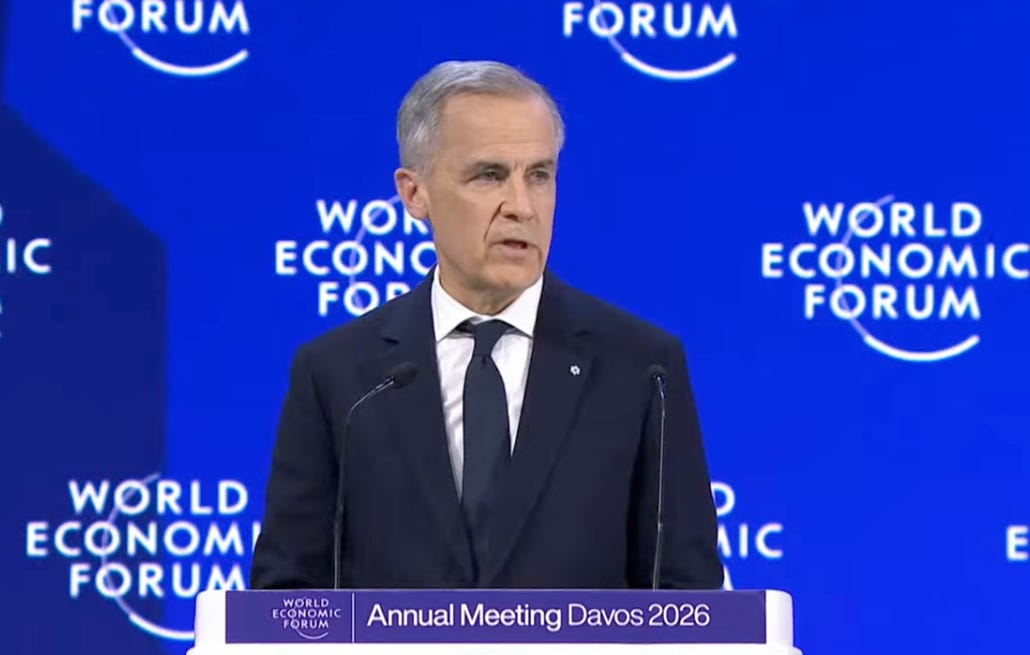
This is why Carney’s speech landed so forcefully in the room, and why Trump’s posture feels so discordant. Carney spoke the language Davos understands: risk, resilience, coordination, trade-offs. Trump arrives with grievance, spectacle, and a personalist vision of power that treats institutions as obstacles unless they amplify him. The forum did not change; the world did. And Davos, for all its flaws, has noticed.
Carney’s speech, widely praised across Canada and beyond, did not pretend the old order was intact. It did not insist that globalization was fine, that the rules-based system was quietly humming along, or that everyone should simply trust the strong to behave benevolently. “Let me be direct,” he said. “We are in the midst of a rupture, not a transition.”
He described a world in which great powers increasingly use tariffs, trade, finance, and supply chains as tools of coercion, and warned that middle powers could no longer survive by polite denial. Drawing on Václav Havel, Carney urged countries to stop “living within the lie” that the system still works as advertised. “When integration becomes the source of your subordination,” he said, “you cannot pretend it is mutual benefit.” Compliance, he warned, does not buy safety.
The answer, in Carney’s telling, was not retreat or nostalgia. “The old order is not coming back,” he said plainly. “We shouldn’t mourn it. Nostalgia is not a strategy.” What was required instead was resolve: the willingness to name reality, to build strength at home, and to act collectively with others prepared to do the same. For a room accustomed to euphemism and hedging, the effect was bracing, less a policy seminar than a declaration that pretending time could be rewound was no longer an option.
Trump will not arrive in Davos empty-handed, exactly. He arrives carrying what he now calls his “Board of Peace,” a vaguely defined personal construct that seems to exist somewhere between a vanity project, a loyalty test, and a bespoke replacement for the United Nations. It is not entirely clear whether this board is meant to govern Gaza, the broader Middle East, or the world at large. What is clear is that it bypasses existing institutions, sidesteps international law, and treats legitimacy as something conferred by Trump himself rather than by mandate, consent, or process.
World leaders, for their part, have reacted with something between polite refusal and barely concealed incredulity. Announced with great fanfare and very few details, the proposal has steadily lost altitude as leaders decline invitations to join what many view as a rival to the UN built around Trump’s personal authority. Bloomberg reports that fellow G7 leaders have largely opted out, wary of lending legitimacy to a body that would place Trump squarely at the center. The grand Davos signing ceremony he reportedly envisioned never materialized. Instead, the Board of Peace has been met with silence, side-eye, and diplomatic distancing.
It is perhaps telling that for many observers, the name itself triggered a kind of cognitive whiplash. “Board of Peace” has the vague, aspirational quality of a corporate rebrand or a focus-grouped slogan, earnest, abstract, and oddly hollow. More than one reader suggested it sounded less like an institution than the “Bored of Peace,” capturing the fatigue many feel toward grandiose initiatives untethered from process or substance. Personally, I was reminded of those old bumper stickers urging passersby to “Visualize Whirled Peas,” a well-meaning plea that substituted vibes for policy and imagination for execution.
The joke lands because the proposal invites it. Peace is not conjured by declaration. It requires legitimacy, law, enforcement mechanisms, and buy-in from those expected to participate. Trump’s Board of Peace offers none of that. Instead, it appears to function as a loyalty test: join the board, accept the chairman’s authority, and pay a billion dollars, or face ridicule, tariff threats, or both.
That dynamic has played out in real time. As leaders declined to participate, Trump lashed out, threatening Emmanuel Macron with massive tariffs on French champagne, mocking Britain’s prime minister, and posting AI-generated images of himself planting the American flag over Greenland. If the goal was to reassure allies that this was a serious peace architecture rather than a personal brand extension, the response achieved the opposite.
That this is what Trump intends to pitch at the World Economic Forum is revealing. Davos is a place where policymakers and executives obsess, sometimes excessively, over institutional design, legal frameworks, and the slow mechanics of cooperation. It is built on the premise that systems matter, that rules constrain power, and that coordination, however imperfect, is preferable to unilateral improvisation. Mark Carney spoke there about “variable geometry”: coalitions assembled issue by issue, grounded in shared interests, constrained by reality, and designed to endure pressure.
Trump’s Board of Peace is the opposite of that logic. It is personal rather than institutional, improvisational rather than structured, and accountable only upward, to him. It does not supplement multilateralism; it attempts to supersede it. When existing systems are inconvenient, Trump declares them obsolete. When institutions are slow, he replaces them with personal authority. If rules complicate outcomes, he treats them as optional. Peace, in this formulation, is not the product of law applied consistently or legitimacy earned collectively. It is quiet deference and total compliance.
The timing could hardly be more discordant. As Trump prepares to sell this improvised peace architecture to a skeptical global audience, he is simultaneously confronting a series of reckonings at home that threaten the very narrative he intends to export. Chief among them is the Supreme Court, poised to rule on the legal foundation of his tariff regime, the same tariffs he treats as both a diplomatic cudgel and a personal revenue stream. His economic mythology depends on them. Claims of deficit reduction, leverage over allies, even the fantasy of tariff “dividend checks” all assume the Court will indulge his expansive reading of executive authority. If it doesn’t, a central pillar of his proclaimed accomplishments collapses instantly, without ceremony.
Another reckoning Trump clearly hoped would fade into the background is forcing its way back into the foreground: the Epstein files. After years of obfuscation, delay, and selective disclosure, Epstein’s survivors are now pressing for a special master to oversee the release of documents the government already possesses. The facts, the files and the victims all exist. What has been missing is not evidence but willingness.
Trump cycles through familiar defenses, dismissing Epstein as irrelevant, insisting he was never briefed, declaring total transparency, all while resisting full disclosure. The maneuver is by now well-practiced: talk over the facts, redefine the question, delay until exhaustion sets in. Whether the motive is self-protection or institutional decay almost no longer matters. The result is the same. Reality is treated as optional, and the public is expected to pretend otherwise.
This governing style, assertion over evidence, pressure over legitimacy, isn’t limited to press conferences or sealed files. You can see it unfolding in real time in Minnesota, where the Department of Justice has now escalated its response to the ICE shooting by issuing subpoenas not just to Governor Tim Walz and Minneapolis Mayor Jacob Frey, but to Attorney General Keith Ellison, Hennepin County Attorney Mary Moriarty, and officials across both Twin Cities.
Harry Litman put it plainly: this no longer looks like an investigation into obstruction. It looks like an attempt to smother a state-level homicide inquiry before it can gain traction. The legal theory is flimsy, the cited statute doesn’t fit, and the First Amendment looms. The federal government presses forward anyway, apparently hoping that sheer force will succeed where law does not.
Here’s the thing Trump seems not to grasp: the world has changed around him. Competent technocrats, central bankers, trade officials, defense planners, legal professionals, are tired. They are tired of translating bluster into policy, of stress-testing fantasies, of pretending that volume substitutes for coherence. They are unimpressed by binders full of imaginary accomplishments. Instead, they are preparing contingency plans, alternative coalitions, and post-Trump futures that do not depend on indulging his delusions.
Carney’s speech resonated not because it was eloquent, though it was, but because it acknowledged what many in those rooms already know: the old pretense is over. You cannot build policy on lies forever, or coerce cooperation indefinitely. You cannot demand belief as a substitute for trust.
Trump, meanwhile, remains locked in a permanent state of ignition and fire suppression, lighting new crises and then demanding credit for containing them. He boasts about accomplishments while awaiting court rulings that could erase them. hile fighting disclosure, he claims full transparency and he insists on respect while eroding the very legitimacy that produces it.
One leader is governing in measurable outcomes. The other is governing in claimed victories. Authority can amplify a lie, but it can no longer make it credible. Davos will notice the difference. The courts will notice the difference. And increasingly, so will the public, whether the White House wants them to or not.
If you believe that Trump is in mid/late stage dementia, as I do, then there's another factor to consider with his lies. There's a point, at least with Alzheimer's (which his father had, and there's a known genetic risk) where the brain can no longer distinguish imagination/wish/fantasy from truth/reality. In other words, he may truly believe he stopped eight wars. He may truly believe whatever he fancies.
Back when he was floating the Obama "birther" stuff, I suspect he was testing the American people's susceptibility to "big lies." Now, when he lies, I'm not at all sure he knows what he's doing.
Excellent article - thank you.
Commented upon this numerous times after his first go around and when the fools didn’t want to loose his base… Didn’t want to loose their power hold, money and their stature.
And Now the Prime Minister of Canada so eloquently called out the truth..
Will any of the fools here listen, it may be way too late.. Can remove the malignancy but without the radiation or chemotherapy the malignant cells remain.
A Two Thousand Year Old
Warning about TRUMP -
"A nation can survive its fools, and even the ambitious. But it cannot survive treason from within.
For the traitor appears not a traitor - He speaks in the accents familiar to his victims, and he appeals to the baseness that lies deep in the hearts of all men.
He rots the soul of a nation--he works secretly and unknown in the night to undermine the pillars of a city-he infects the body politic so that it can no longer resist. A murderer is less to be feared."
Cicero,
Roman Statesman,
42 BC
And Canada emerges taking the sign out of the window and calling it what it is.
https://youtu.be/dTvFnC-oFGw?si=Zg6I7wrsKz7eaHAa