


On Wednesday, the day before the USS Abraham Lincoln was due back in San Diego, Pete Hegseth flew out to meet it. He landed on a flight deck emptied of its air wing and stood before roughly 5,000 sailors and Marines who had just finished the longest stretch without a port call in the modern Navy.
He told them they would not be going home empty-handed. They already carried, he said, “the pride in your hearts of a mission accomplished.”
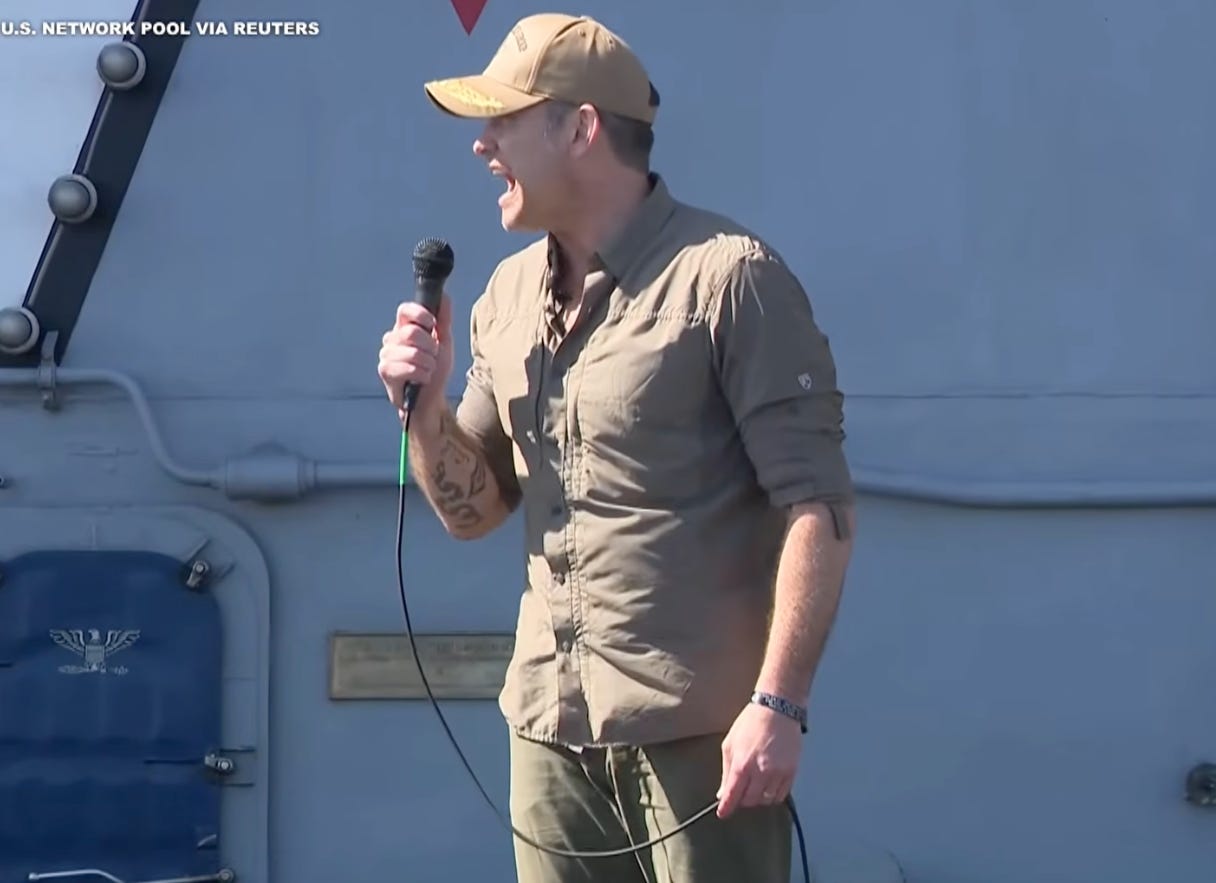
Somebody at the Pentagon should have checked which ship they were standing on.
On May 1, 2003, George W. Bush landed on this same carrier off San Diego, climbed out of a Navy jet in a flight suit, and announced the end of major combat operations in Iraq. Behind him hung a banner reading “Mission Accomplished.”
The banner aged badly. The vast majority of the roughly 4,400 Americans killed in Iraq died after it went up.
Twenty-three years later, the Lincoln is again the backdrop for a war declared won while it’s still being fought. This time nobody hung a banner. Hegseth just said the words.
The unit citation credits the strike group with 40 days of combat operations between Feb. 28 and Aug. 22. The war, of course, did not end with the Lincoln’s combat calendar. U.S. forces struck Iran ten nights running in July and again on Sept. 1.
Hegseth half-admitted it in the same speech, crediting “other great Americans” who are “still doing [it] right now.” The night before, in San Antonio, Trump promised “we’ll be out of there soon.”
So the mission has been accomplished, history has been changed, Iran has been permanently denied a nuclear weapon, and Americans are still fighting it.
Mission accomplished, mission ongoing. Terms and conditions may vary depending on the audience and proximity to Nov. 3.
Most of the speech wasn’t about Iran. It was about the press.
“There were a few folks in the media who tried to turn the USS Abraham Lincoln into some sort of a symbol,” Hegseth said, “a symbol of dysfunction or a symbol of low morale or a symbol of a failed mission.” He had talked with leadership and “a number of you,” he said, and knew “it’s the exact opposite.” The only reaction the American media should have, he added, “is pride.”
Here is what the media actually reported. Beginning in August, families of the crew described mold in the showers, broken toilets, rationed food and contaminated water. Stars and Stripes and Navy Times reported sailors who tried to go overboard, and one sailor’s wife said her husband went over the side on Aug. 3 and spent an hour in the Arabian Sea before he was pulled out.
Hegseth called the coverage “completely misrepresented” and posted that the “reckless & shameless ‘American’ media” had distorted it on purpose. The Navy said it had not identified an increase in suicide attempts aboard. CENTCOM’s Adm. Brad Cooper said the Lincoln had among the fewest mental health cases of the Navy’s 11 carriers, while allowing that not all was perfect.
Trump, asked whether the deployment had run too long, said: “Not nearly long enough.”
Then, in a Sept. 22 letter answering questions from Sen. Kirsten Gillibrand, acting Navy Secretary Hung Cao put a number on it. There had been “a total of eight suicide attempts across the strike group,” he wrote, though no deaths. One U.S. military official told CNN the figure was “incredibly high.”
The military papers had reported two attempts. The press didn’t exaggerate. If anything, it undercounted.
Two weeks after Cao’s letter, Hegseth stood in front of those sailors’ shipmates and explained that the reporting had their deployment backwards.
His argument is a remarkable one: because the crew endured the shortages, extensions and strain and still accomplished its mission, the reporting about the shortages, extensions and strain was somehow evidence of media hostility rather than evidence of what the crew had endured.
Resilience, in this telling, becomes retroactive proof that nothing went wrong. Enduring the consequences is somehow supposed to erase the decisions that produced them.
Hegseth never quite told the crew what to say when reporters stuck microphones in their faces. He did something more elegant. He supplied the answer before anyone could ask the question.
“When you greet your families tomorrow,” he said, “let them know that their long wait, we believe, was in service of a righteous and historic mission.”
He said it to sailors standing in formation, with their chain of command beside him, the afternoon before cameras met them at North Island.
From a pundit, that framing is spin; from a campaign surrogate, messaging. Coming from the secretary of defense to troops under his authority, on the eve of their homecoming, it deserves more scrutiny than either.
It also makes a peculiar companion to the commander-in-chief’s August assessment of their sacrifice: “Not nearly long enough.”
Then the line that belongs in every account of this event: “There’s only one president, one commander-in-chief, one military capable and willing to undertake that kind of mission.”
That is a comparison to every previous president, made to uniformed troops 27 days before a midterm election. Hegseth routed the thanks personally through “the president of the United States, Donald J. Trump,” read out the unit citation, and gathered the crew for the photograph.
It had already been a photogenic day. That morning in San Diego, Hegseth had joined Marines from the 3rd Marine Aircraft Wing for a 10-station workout at Miramar running, pull-ups, weighted lunges, burpees and the rest of the warrior-ethos catalog. Video later circulated of the 46-year-old secretary trailing some of the Marines between stations. A few hours later, aboard the Lincoln, he dropped to the flight deck for two push-ups after a sailor corrected one of his statistics.
NBC and the Washington Post reported in August that he has discussed a 2028 run; Hegseth called it “100% false.”
If a future candidate wanted a day’s worth of campaign B-roll, it would be difficult to improve on this one: sweating beside Marines in the morning, standing on an aircraft carrier in the afternoon, a Presidential Unit Citation, thousands of uniforms, two push-ups for the cameras and an enemy conveniently available both overseas and in the press. The only thing missing was a banner and Hegseth in a flight suit.
The Lincoln left San Diego on Nov. 21, 2025, for what was supposed to be a seven-month deployment, and the Navy extended it twice. Its run at sea broke the modern record of 206 consecutive days set by the Eisenhower. To relieve it, the Pentagon pulled the Japan-based George Washington, leaving the Western Pacific without a carrier.
None of that came up on the flight deck. Rep. Sara Jacobs of San Diego, who visited the ship in late September, is pressing for an inspector general investigation and a House Armed Services field hearing in her city. That fight starts at the pier.
The sailors have already answered the question that belonged to them. They carried out the orders they were given, under extraordinary conditions, and the Presidential Unit Citation documents what they accomplished.
The questions that remain belong to the civilians who sent them.
Was the threat presented honestly? Were the objectives achievable? What was the strategy for reaching them? Why did a seven-month deployment require two extensions? And how can a mission be historic and accomplished, its central objective permanently secured, while other Americans are still carrying it out?
Those questions are not insults to the crew. They are what civilian oversight of a military is supposed to look like.
In 2003, the problem was the banner.
This time they left the banner off and said the words anyway.
If you or someone in your family is struggling, the Veterans and Military Crisis Line is open around the clock: call or text 988, then press 1.
Excellent essay, Mary. This guy is just awful. This regime has nothing but the most awful people in it.
I wonder if Hegseth has presidential ambitions. Why not? Trump was as unqualified to be president as Hegseth is to be Secretary of Defense.
Unlike Trump, Hegseth has an ideology — Christian nationalism — as well as a far-right agenda that’s backed by dark money. Sure, Hegseth is a buffoon but so is Trump, and he managed to be elected to the presidency twice.
Even if a Democratic Congress impeaches Hegseth in 2027, I wouldn’t be surprised to see him resurface in 2028 as the Christian right’s presidential choice.