

Good morning! “What the president’s calling for,” explained economist Justin Wolfers, “is literally the dumbest thing that’s ever been said by a president.”
Speaking to Australia’s ABC after the Federal Reserve unanimously raised rates rather than cutting them. His underlying argument was less theatrical. Unemployment is low and stable. Inflation is too high. Those two things together give the Fed considerably more reason to restrain demand than to goose it with dramatically cheaper money.
Here’s what actually happened Wednesday: the Federal Reserve raised interest rates for the first time since 2023, to a range of 3.75 to 4 percent. The vote was 12–0. All 12 voting members of the Federal Open Market Committee, a body spanning presidential administrations and regional Reserve Banks, looked at the same economy and arrived at the same decision.
Wolfers again: “There is not an American alive, except for that one bloke living at 1600 Pennsylvania Avenue” who thinks Trump’s preferred policy is feasible, sensible, or in the country’s interest.
Trump wanted the board to be the villain here, the “very tough,” “hostile,” “political” board holding a good man, Kevin, hostage. It’s a tidier story than the vote total actually tells. The hostage, inconveniently, voted with his captors. Twelve voting members. One unanimous decision.
That’s the story before we even get to what Trump said about it. And he said a lot.
Strip away the politics for a moment, because Warsh mostly did. His public reasoning breaks into three pieces, and the first two are barely contestable. Unemployment sits at 4.1 percent, stable, low, no red flag there. Inflation, meanwhile, is high, and has been for more than five years running. Warsh has said that before. What he did Wednesday was different: he backed it up with an actual vote instead of another speech.
The third piece is the one that got buried under the headlines. Warsh described the move as “removing a dose of accommodation,” which is central-banker for taking away the punch bowl without actually turning on the lights and telling everybody to go home.
Wolfers translated that into something less technocratic: Warsh wasn’t describing himself as slamming on the brake. He was describing the Fed as taking its foot off the accelerator. Whether that leaves policy precisely at “neutral” is a debate Warsh himself declined to entertain. But the direction is unmistakable. And the Fed’s projections suggest the quarter-point move may not be the last one: the median projected policy rate at year-end is 4.1 percent.
If inflation stays elevated after the Fed has already begun withdrawing accommodation, how much further may it have to go? The projections offer a pretty good clue: 16 of 18 participants see rates ending the year above today’s midpoint.
Definitely worth sitting with before we get to what the President had to say about it. The version of this decision Trump would spend the rest of the day describing to the public; a hostile board, a rigged process, a man doing him wrong, has nothing to do with accelerators, neutral gears, or dot plots. It has nothing to do with the reasoning Warsh actually gave.
Watch the same argument travel across three completely different venues.
Wednesday afternoon, Truth Social, hours after the vote: “Interest Rates in the United States should be 1%, or less, because we are the Best Credit in the World — BY FAR... The word ‘Deficit’ is nothing more than a fancy word for LOSS... LOWER THE INTEREST RATES FOR THE UNITED STATES OF AMERICA, AND FAST!”
Wednesday evening, in North Carolina, a reporter asks him directly whether Warsh based the decision on what Trump told him. “No, I don’t think so,” Trump says. And then, without missing a beat: “Interest rates are too high.”
Wednesday night, in Gastonia, North Carolina, a speech ostensibly about Roy Cooper and crime, the same argument surfaces again, unprompted, word for word: “Interest rates in the United States should be 1% or less because we are the best credit in the world by far... if we stop trading with every country that we have a deficit with... we would make at least $1.5 trillion a year... lower the interest rates for the United States of America and fast.”
What’s missing from all three is any actual engagement with the reasoning Warsh gave. The argument doesn’t evolve to meet the moment, because it was never built to respond to the moment. It’s the same fixed block, deployed identically whether the audience is his own follower count, a traveling press pool, or several thousand people at a rally that has nothing to do with the Fed.
In that same Air Force One exchange, Trump says the quiet part about as plainly as it gets said. Asked if he’d tried to convince Warsh, he says no. “I said do what you want... because it doesn’t matter, he doesn’t have the vote.” Told the decision may not have followed his input, he agrees. In the very next breath, at the rally, he explains the logic itself: “Every time you have good news, they raise interest rates. Supposed to be the opposite. Every time you have good news, you’re supposed to lower interest rates because we become an even better credit.”
Whatever happened in the private conversation with Warsh, the public record is simpler. The Fed acted unanimously on one economic framework. Warsh publicly explained that framework. Trump then returned to the microphone and restated the opposite one.
Here’s what “the war is going to end soon” actually costs while everyone waits for soon to arrive.
Gasoline is averaging $4.37 a gallon, up 47 percent since the war with Iran began. Diesel, the fuel that moves buses, trains, and the trucks carrying nearly everything else, just hit an all-time high of $6.31 a gallon, a 68 percent jump over the same stretch. Prices aren’t just outrunning paychecks; paychecks are actually losing ground. After inflation, average hourly earnings fell 0.1 percent in August from July and 0.3 percent from a year earlier. The 30-year mortgage, meanwhile, is closing in on 7 percent, up a full point since February, before the bombing campaign started.
At the Gastonia rally, Trump came closer than usual to itemizing it himself. Gas was cheap a few months back, he told the crowd then, unprompted, he conceded prices have climbed since. His verdict: “a very inexpensive price to pay” for what the administration accomplished in Iran. It’s a rare moment of the ledger actually opening, he’s not denying the cost, he’s pricing it. The bet is that voters will agree the number is small enough to shrug off, and that whatever “soon” arrives before November 3rd will make the math irrelevant anyway.
Ten minutes earlier, at the same podium, he’d singled out Russia-Ukraine as “the” conflict behind the diesel spike. Every outlet covering Wednesday’s Fed decision, including his own administration’s framing elsewhere, centers the Iran war as the dominant driver of this inflation cycle. So even the invoice he’s willing to acknowledge, he can’t quite address to the right account. The war that’s costing you money keeps drifting to whichever one isn’t currently his to answer for.
It’s tempting to read this as the world falling in line behind Washington. Resist that temptation — the truth is stranger and, honestly, worse for Trump’s argument, not better.
The European Central Bank raised rates last week for the second time since the Iran war began. The Bank of Japan is expected to move again Friday. They aren’t following the Fed. Each is responding to its own inflation, employment and growth picture. What they increasingly share is an external energy shock appearing in those domestic calculations at the same time. Justin Wolfers put it plainly when asked what Wednesday’s hike means for other central banks: not much, at least not directly. The Reserve Bank of Australia, he noted, will look at Australian inflation and Australian jobs data, “not one of the important gauges for the RBA at all today.”
The war didn’t just raise prices in Ohio and North Carolina. The same global energy system is transmitting overlapping shocks into Frankfurt, Tokyo and Sydney. Each central bank still has to respond to its own inflation, employment and growth data. But increasingly, some of the same geopolitical disruptions are turning up inside those calculations.
Which makes Trump’s “best credit” argument harder to reconcile with what central banks actually do. Interest rates are not a discretionary favor handed out according to national prestige. Different central banks, answering to different governments and looking at different economies, can reach similar decisions when inflation pressures arrive through the same global markets.
In Strasbourg, we saw a different style of governing on display. Mark Carney has been here before. Back in April, when Trump paused his tariffs, we wrote about a former central banker who seemed constitutionally incapable of responding to economic chaos with more economic chaos. Six months later, the setting is bigger, the method unchanged.
Washington spent Wednesday ricocheting from demand to accusation to threat: rates are too high, the Fed is political, deficits are losses, stop trading with the countries running them. Every problem arrives as something to hit.
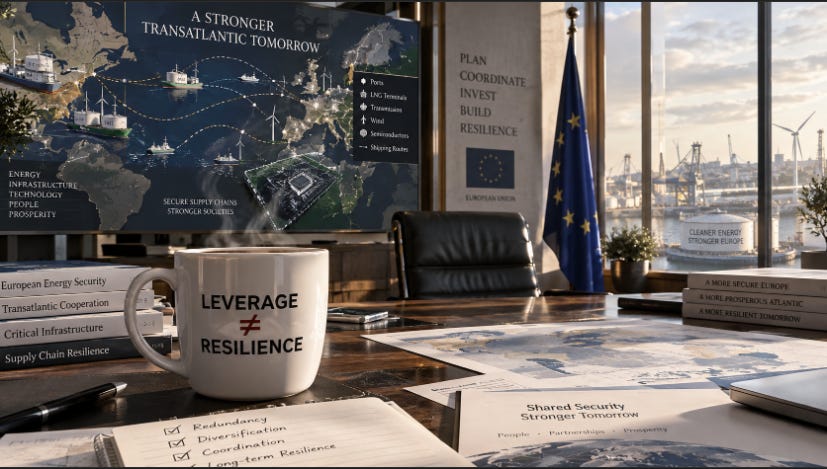
Carney walked into the European Parliament with a risk-management plan instead. His answer was to diversify: minerals, energy, semiconductors, AI, finance, ports; find the vulnerabilities before someone else finds them, and spread the exposure so no single hand controls the valve. “The objective is not self-sufficiency,” he said. “It is collective resilience.”
Trump’s instinct is transactional: find the pressure point, squeeze it. Carney’s is systemic; find it first, then design around it. One is about leverage. The other is about making yourself harder to leverage.
Because Carney is still Carney, he slipped the knife in without raising his voice, insisting he wasn’t building a bloc to become “another global bully, only with better manners,” just an alliance strong enough that “no one can dictate our choices.”
Trump spent this week telling three different rooms the same argument and getting the same result each time: a unanimous board, a mortgage rate near 7 percent, a diesel price at an all-time high, and a chairman he appointed who did the opposite of what he demanded anyway. Carney spent this same week building something that doesn’t require anyone’s permission to keep working.
Nobody’s waiting on Washington to get this right. Everyone else, quietly, is just getting on with it.
It occurs to me that what we have here is a clear "how" and "why" to Trump's failed businesses. #colormeenlightened
Given the corruption, incompetence, policy turmoil and sheer number of self-inflicted crises surrounding this administration, it begs the question why a third of the country still thinks
--"yeah, Trump's my guy"
If a foreign power set out to weaken America economically, diplomatically and strategically, it would be hard to beat what Trump has done: alienate allies, threaten NATO, undermine our commitments, turn trade relationships into confrontations, and treat the defining challenges of this century—climate change, artificial intelligence and global stability—as either inconveniences or bargaining chips.
That doesn’t prove the allegation that Trump is a Russian asset but it's worth asking: if Vladimir Putin had been handed a wish list for destroying America from within--who could have done a better job than DJT?
And if that's not bad enough, he's also INSANE as I explain here:
https://jaywilson1.substack.com/p/diary-of-a-madman?r=10sd39