


Good morning!
Britain spent yesterday asking everyone to stop speculating about what happened outside RAF Fairford. Washington apparently heard that as a challenge.
Three white vans in a Gloucestershire lane have now been examined by a bomb disposal robot, the British Army, and counterterrorism detectives. From an ocean away, the President of the United States alone seems to have reached a verdict.
The absence of explosives does not tell us what the men were doing at Fairford. It tells us that Trump was remarkably specific about what they intended to do before British investigators had established even that.
By Monday afternoon, British authorities had established a few facts. Five British nationals, aged 23 to 25 and all from London, were arrested in the small hours of Sunday after a farmer’s emergency call. Some 85 families were evacuated while a robot poked through the vans, and police said no viable explosive device had turned up. The men were then bailed after roughly a day and a half, well short of the 14 days terrorism law allows, under “stringent conditions.” Counterterrorism police described an open mind, with proxies acting “knowingly or unknowingly” for a foreign state among the possibilities.
The President had gone considerably further. The men, he said, meant to do “big damage,” had been “under view for a long time,” and were people about whom “we know everything.” His Secretary of State soon went on Fox to explain that some things couldn’t be said on air, then said that the episode “clearly involves the hands of a foreign actor.” Discretion, it seems, comes in more than one size. Trump also wondered aloud whether the bail was the cashless kind, which was an odd worry, since British police bail generally involves no cash at all.
Britain’s defence secretary, invited to confirm the President’s account, produced what may be the most diplomatic sentence of the year: “He chooses his words and I choose mine.”
The risk may go beyond embarrassment. The defence analyst Mark Urban notes that intelligence-led operations usually come with a cover story to protect sources and methods, which holds “right up until the moment Donald Trump gets involved.” Former national security adviser Mark Lyall Grant offered a reading in which agencies were quietly watching an early-stage plot and were forced to move when a member of the public phoned it in. On that theory, “we got them” is a premature victory lap over an unfinished case.
The range of live possibilities is wide. Professor Trevor Taylor of the Royal United Services Institute allowed that masked men with barrels near their vans might be after diesel, now expensive, while also allowing for reconnaissance on behalf of a foreign handler. If Tehran’s hand is there, Trump may have told whoever was involved that American and British services knew more than they had admitted. A fuel run gone wrong would make him the man who announced an international plot over a few barrels of diesel. The eventual answer matters enormously. But the problem exists in either version: certainty arrived before the publicly established evidence could support it.
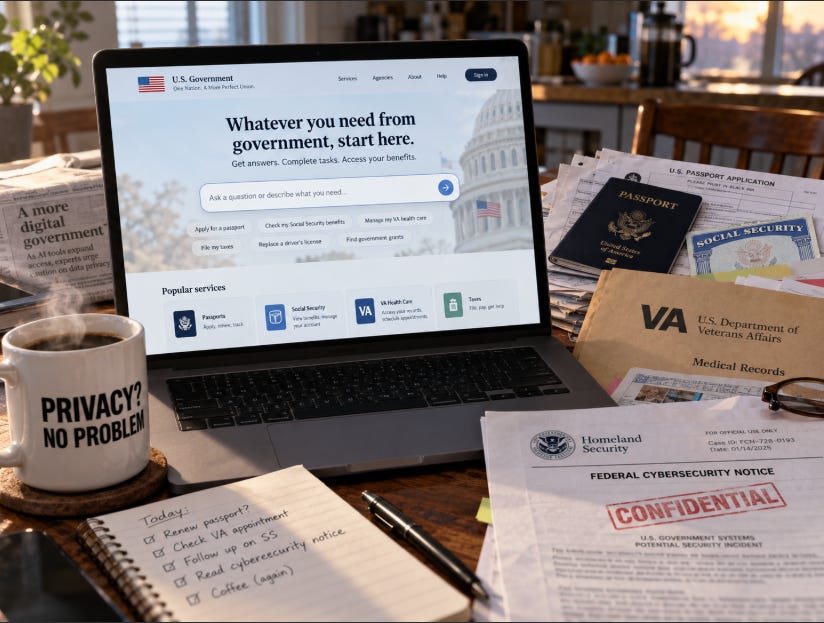
Washington was just warming up. The next morning, Trump walked onto a stage in Washington to unveil America.gov, which he called “one of the most revolutionary product launches of all time.”
The homepage is certainly handsome. It opens with an enormous “Hello, America” and the invitation: “Whatever you need from government, start here.” Instead of asking citizens to know whether they need the Department of Veterans Affairs, the Social Security Administration, the State Department, CMS, or some other corner of the federal archipelago, America.gov invites people to type a question into a conversational interface and let the technology sort it out.
On its face, a genuinely interesting idea. The federal government has thousands of websites and forms, citizens routinely struggle to know which agency does what, and simplifying that mess is a perfectly respectable goal. The White House calls the site a “front door” to federal services. The Wall Street Journal describes it as a digital concierge meant eventually to connect everything from passport renewals to Medicare and student loans, though full integration will take time and in some cases could require additional legal authority.
Trump, however, needed a villain.
“With America.gov, the federal government no longer stands in your way,” he declared. Washington’s bureaucracies had grown “ever larger and more intrusive.” Government had been “broken for many decades,” possibly centuries. Big government made the citizen “feel very small.”
Within about a dozen minutes, broken had become dead. “For years everyone has recognized that the old system of big government bureaucracy is failing and outdated,” Trump said. With America.gov, “that system is finally passing away.” Then, flatly: “It is dead.”
The administration is burying Big Government by having it deliver everything through one giant federal platform. Trump said he was signing an executive order directing every agency to connect its public-facing services to America.gov “as soon as possible,” so that anything citizens need from the government is available through the portal. Big government has not so much died as acquired a chatbot.
This is where the sales pitch becomes more interesting than the product.
I asked it how to renew a passport. The answer was competent, cited official sources, and would look familiar to anyone who has typed the same question into a search engine. It laid out the online, mail and in-person routes, listed the fees and linked to the State Department’s own renewal page. The one thing it could not do was renew the passport. The chatbot told me that capability is planned for 2027.
The chatbot can make government easier to navigate, but it does not replace the institutions behind it. Passports still come from State, veterans still depend on the VA, Medicare still depends on CMS, and Social Security still depends on the machinery of government working. America.gov may become a much better front door. Somebody still has to own the house.
Trump briefly detoured from customer service into election law. With America.gov, he said, nobody can complain any longer that providing proof of citizenship or voter identification is too complicated, because everything needed will be available with “one simple swipe.” He tied the claim to the SAVE America Act, though he never explained what the site would actually do to verify anyone’s citizenship. Nothing says frictionless passport renewal quite like an unexpected excursion into federal election legislation.
Then came the privacy pitch. Trump said the new technology ensures that personal information is not collected or stored, that conversations disappear when users leave, and that “everything stays totally private.”
And then, almost immediately: “When they figure a way to hack into it, we will end it. They always figure a way.”
The site’s own privacy notice is more careful than its champion. The service tries to detect sensitive details before a message goes out but warns that it “may not catch everything.” It sends a coarse location, estimated from your network address, to its AI provider, and America.gov itself may cache responses for up to two hours. The notice says the AI providers retain neither prompts nor responses. A reasonable policy, and a long way from “not collected or stored.”
What the notice does not do is name those providers. Joe Gebbia, the Chief Design Officer of the United States, told CNBC that the chatbot runs on Google’s Gemini and Elon Musk’s Grok, and nothing in the privacy notice tells a user which of them is processing a given question. Speaking for myself, I would not choose to hand a Musk-built model my Social Security number, my medical history, or my documents, and the only thing standing between me and that outcome is a filter that admits it may not catch everything. Musk, whom Trump credited on stage as the man who first envisioned transforming government through technology, turns out to supply one of the brains. Which provider receives which requests, what information accompanies them, and what technical controls enforce the promised non-retention are questions the White House should answer plainly.
All of this comes from a government whose FBI is still assessing a breach that hackers say includes agents’ medical records, and whose Pentagon disclosed this week that unencrypted Social Security numbers for roughly three million people sat exposed for about nine months. Neither incident involved America.gov, and neither proves it will fail. They do show that a beautiful interface does not lighten government’s obligation to protect what it holds. Trust us, the president says. Everything stays totally private.
The launch then turned into a branding workshop. Trump announced that artificial intelligence should be called “super intelligence” because “artificial” sounds fake, floated “artificial news” as a fresh insult for the press, and vowed to “never restrict the growth” of a technology he expects to dwarf the Industrial Revolution. Whoever wins the race with China wins, he said. “You’re probably not going to have second place.”
Meanwhile, in Liverpool, Andy Burnham was describing the same crisis of confidence and reaching the opposite conclusion. Trump’s culprit was bureaucracy itself. Burnham’s was decades of deindustrialization, deregulation, privatization, austerity, and Brexit, which left “a country run for vested interests, not in the public interest.” Essential services were sold off, he said, and councils hollowed out. His remedy is to rebuild public capacity and democratic control, from council housing to the GB Grid.
One leader proposed using technology to route citizens through, and rhetorically around, the bureaucracy. The other proposed rebuilding the institutions themselves. Both were speaking to people who feel small before systems they no longer trust.
Functioning institutions contain friction for a reason. Investigators sometimes will not tell us what they know. Prosecutors cannot jail people because a president thinks they look suspicious. Benefit programs need rules, databases need safeguards, and public servants need the expertise and resources to decide correctly. Democracies build procedures partly so that certainty, speed, and raw power cannot stand in for evidence and law.
Sometimes those procedures are ridiculous, and the form really does run seventeen pages when four would do. By all means, fix them. Give the veteran one place to ask where to get care. Let someone renew a passport without sacrificing a weekend to the gods of PDF.
But the interface is not the institution. Someone still has to protect the Social Security number, establish identity behind the passport button, and administer Medicare after the chatbot has answered. And at RAF Fairford, someone still has to determine what five men in three vans were doing before officials announce that they already know.
Trust still has to be built inside regardless of how shiny the new door is.
You've described the situation at Fairford very well. I imagine that the Secret Service are furious to have Trump blundering around their very sensituve case like a bull in a china shop.
Stay away from "America.gov"!